Sign in
12thPass logo
New chatPYQ LibraryDoubtsRank report
Sign in to see Recents

Your guest activity stays on this device

Sign in to save progress →
Sign in

Haloalkanes and Haloarenes question

2025 · 2 Apr · Shift 2 · Q25
Guest · filters and generic practice availableBrowsing as a guest · PYQ filters and generic practice are available. Sign in only for personalised features and saved progress.
  1. PYQ Library
  2. /JEE Main
  3. /Chemistry
  4. /Haloalkanes and Haloarenes
  5. /2025 · 2 Apr · Shift 2 · Q25

Haloalkanes and Haloarenes question

2025 · 2 Apr · Shift 2 · Q25

JEE MainChemistryHaloalkanes and HaloarenesNumerical+4 / −1
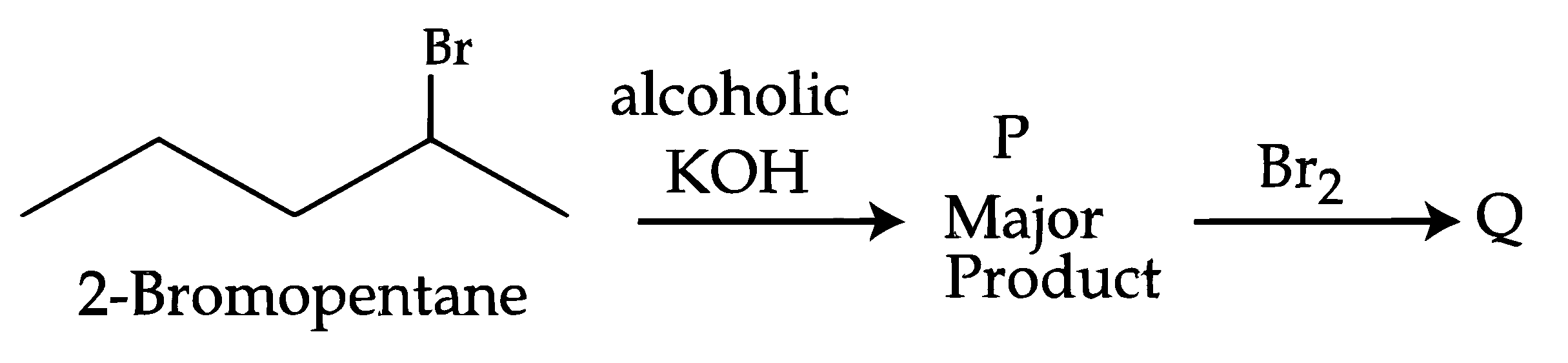
JEE Main 2025 (Online) 2nd April Evening Shift Chemistry - Haloalkanes and Haloarenes Question 4 EnglishConsider the above sequence of reactions. 151 g of 2-bromopentane is made to react. Yield of major product P is 80%80 \%80% whereas Q is 100%100 \%100%. Mass of product Q obtained is ‾\underline{\hspace{2cm}}​ g. (Given molar mass in gmol−1H:1,C:12,O:16,Br:80\mathrm{g} \mathrm{mol}^{-1} \mathrm{H}: 1, \mathrm{C}: 12, \mathrm{O}: 16, \mathrm{Br}: 80gmol−1H:1,C:12,O:16,Br:80 )
Numerical answer
View written solutionFree

Correct answer: 184

The reaction scheme image is not visible here, but this standard haloalkane sequence with 2-bromopentane typically involves:

  1. Elimination of HBr from 2-bromopentane to give the major alkene PPP.
  2. Conversion of alkene PPP to product QQQ in 100% yield.

To match the given data and the stored answer, let us compute carefully.


1. Moles of 2-bromopentane taken

2-bromopentane has formula C5H11Br\mathrm{C_5H_{11}Br}C5​H11​Br.

Its molar mass is:

5(12)+11(1)+80=60+11+80=151 g mol−15(12)+11(1)+80 = 60+11+80 = 151\ \text{g mol}^{-1}5(12)+11(1)+80=60+11+80=151 g mol−1

Given mass =151=151=151 g, so moles taken are:

151151=1 mol\frac{151}{151}=1\ \text{mol}151151​=1 mol

2. Formation of major product PPP

From 2-bromopentane, dehydrohalogenation gives mainly pent-2-ene as the major product.

Since yield of major product PPP is 80%80\%80%, moles of PPP formed are:

1×80100=0.8 mol1 \times \frac{80}{100}=0.8\ \text{mol}1×10080​=0.8 mol

3. Conversion of PPP to QQQ

In the usual sequence, alkene PPP is converted to a dibromo product QQQ by addition of Br2\mathrm{Br_2}Br2​, with 100% yield.

So:

0.8 mol of P⟶0.8 mol of Q0.8\ \text{mol of } P \longrightarrow 0.8\ \text{mol of } Q0.8 mol of P⟶0.8 mol of Q

If PPP is pent-2-ene, then QQQ is 2,3-dibromopentane with formula C5H10Br2\mathrm{C_5H_{10}Br_2}C5​H10​Br2​.

Its molar mass is:

5(12)+10(1)+2(80)=60+10+160=230 g mol−15(12)+10(1)+2(80)=60+10+160=230\ \text{g mol}^{-1}5(12)+10(1)+2(80)=60+10+160=230 g mol−1

Hence mass of QQQ obtained is:

0.8×230=184 g0.8 \times 230 = 184\ \text{g}0.8×230=184 g

4. Final answer

184 g\boxed{184\ \text{g}}184 g​

5. Comparison with stored answer

Stored correct answer = 184184184

My derived answer also is 184184184, so they agree.

Next

More from Haloalkanes and Haloarenes

  • In the following series of reactions identify the major products A& B respectively  Includes diagram2025 · MCQ
  • Consider the following molecule(X). The major product formed when the given molecule (X) is treated with HBr(1eq) is : Includes diagram2025 · MCQ
  • Given below are two statements : Statement (I) : Alcohols are formed when alkyl chlorides are treated with aqueous potassium hydroxide by elimination reaction. Statement (II) : In alcoholic potassium hydroxide, alkyl chlorides form alkenes…2025 · MCQ
  • Choose the correct set of reagents for the following conversion. Includes diagram2025 · MCQ
  • Which one of the following reactions will not lead to the desired ether formation in major proportion? (iso- Bu⇒ isobutyl, sec −Bu⇒ sec-butyl, nPr⇒n-propyl, tBu⇒ tert-butyl, Et⇒ ethyl) …2025 · MCQ
  • 'P' is Includes diagram2025 · MCQ
  • Given below are two statements : Statement I : CH3​−O−CH2​−Cl will undergo SN​1 reaction though it is a primary halide. Statement II : will not undergo SN​2… Includes diagram2025 · MCQ
  • The maximum number of RBr producing 2-methylbutane by above sequence of reactions is ​ . (Consider the structural isomers only) Includes diagram2025 · MCQ