JEE MainChemistryHaloalkanes and HaloarenesMCQ+4 / −1
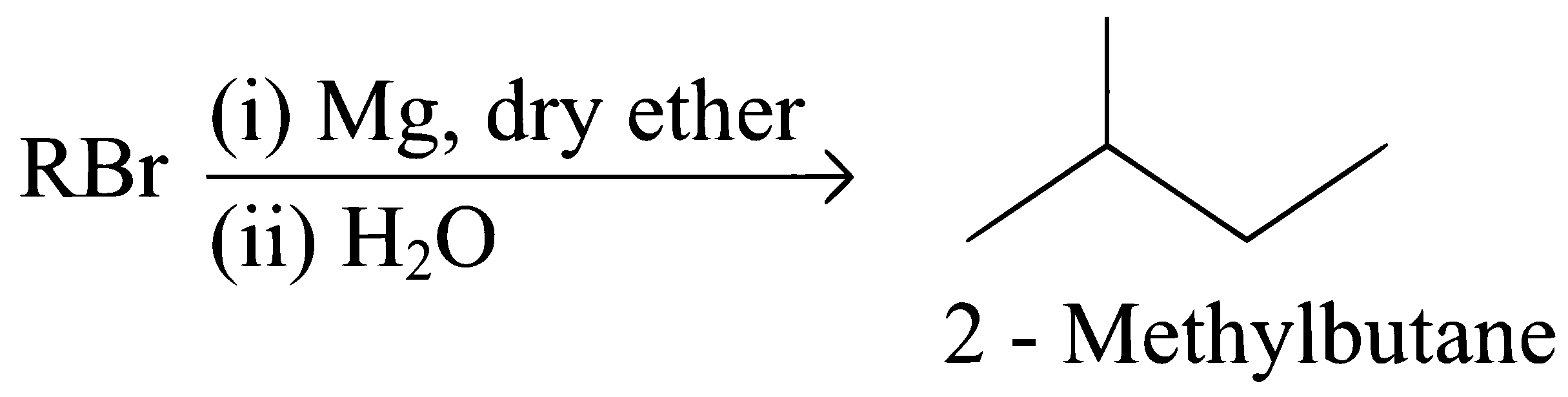 The maximum number of RBr producing 2-methylbutane by above sequence of reactions is . (Consider the structural isomers only)
- A5
- B3
- C4
- D1
More from Haloalkanes and Haloarenes
- Propane molecule on chlorination under photochemical condition gives two di-chloro products, " " and "". Amongst "" and "", " " is an optically active molecule. How many tri-chloro products (consider only structural isomers)…2025 · MCQ
- Identify the products [A] and [B], respectively in the following reaction: Includes diagram2025 · MCQ
- The ascending order of relative rate of solvolysis of following compounds is : Includes diagram2025 · MCQ
- Following are the four molecules "P", "Q", "R" and "S". Which one among the four molecules will react with at the fastest rate? Includes diagram2025 · MCQ
- Given below are two statements: Statement I: The conversion proceeds well in the less polar medium. … Includes diagram2025 · MCQ
- The structure of the major product formed in the following reaction is : Includes diagram2025 · MCQ
- Consider the following sequence of reactions: 11.25 mg of chlorobenzene will produce of product B. (Consider the reactions result in complete conversion.) [Given molar mass of … Includes diagram2025 · Numerical
- The products A and B in the following reactions, respectively are 2025 · MCQ