Sign in
12thPass logo
New chatPYQ LibraryDoubtsRank report
Sign in to see Recents

Your guest activity stays on this device

Sign in to save progress →
Sign in

Haloalkanes and Haloarenes question

2025 · 22 Jan · Shift 1 · Q2
Guest · filters and generic practice availableBrowsing as a guest · PYQ filters and generic practice are available. Sign in only for personalised features and saved progress.
  1. PYQ Library
  2. /JEE Main
  3. /Chemistry
  4. /Haloalkanes and Haloarenes
  5. /2025 · 22 Jan · Shift 1 · Q2

Haloalkanes and Haloarenes question

2025 · 22 Jan · Shift 1 · Q2

JEE MainChemistryHaloalkanes and HaloarenesMCQ+4 / −1
Given below are two statements : Statement I : CH3−O−CH2−Cl\quad \mathrm{CH}_3-\mathrm{O}-\mathrm{CH}_2-\mathrm{Cl}CH3​−O−CH2​−Cl will undergo SN1\mathrm{S}_{\mathrm{N}} 1SN​1 reaction though it is a primary halide. Statement II : JEE Main 2025 (Online) 22nd January Morning Shift Chemistry - Haloalkanes and Haloarenes Question 18 English will not undergo SN2\mathrm{S}_{\mathrm{N}} 2SN​2 reaction very easily though it is a primary halide. In the light of the above statements, choose the most appropriate answer from the options given below :
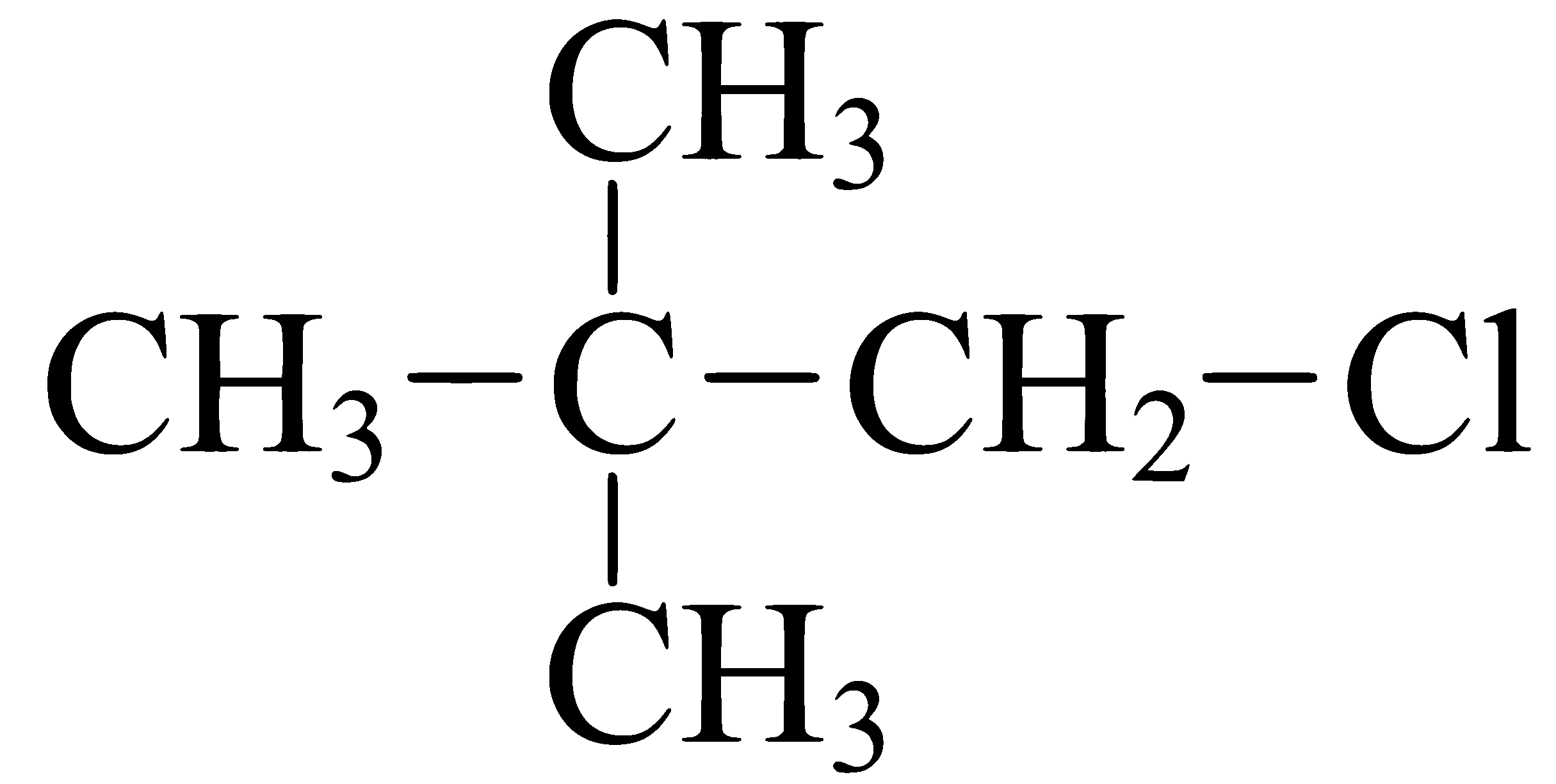
  1. A
    Both Statement I and Statement II are incorrect
  2. B
    Both Statement I and Statement II are correct
  3. C
    Statement I is correct but Statement II is incorrect
  4. D
    Statement I is incorrect but Statement II is correct
View written solutionFree

Correct answer: B

  1. Identify the substrate

    The compound is chloromethyl methyl ether: CH3−O−CH2−Cl\mathrm{CH_3-O-CH_2-Cl}CH3​−O−CH2​−Cl

    The carbon bearing chlorine is primary, but it is also adjacent to oxygen.

  2. Examine Statement I: It undergoes SN1S_N1SN​1 though it is a primary halide

    Normally, primary halides do not undergo SN1S_N1SN​1 because formation of a primary carbocation is unstable.

    But here, loss of Cl−\mathrm{Cl^-}Cl− gives a cation next to oxygen: CH3−O−CH2+\mathrm{CH_3-O-CH_2^+}CH3​−O−CH2+​

    This cation is stabilized by resonance with the lone pair on oxygen: CH3−O−CH2+↔CH3−O+=CH2\mathrm{CH_3-O-CH_2^+ \leftrightarrow CH_3-O^+=CH_2}CH3​−O−CH2+​↔CH3​−O+=CH2​

    Thus, the intermediate is not an ordinary unstable primary carbocation; it is resonance-stabilized oxonium/carboxonium-type cation.

    Therefore, SN1S_N1SN​1 is possible.

    So, Statement I is correct.

  3. Examine Statement II: It will not undergo SN2S_N2SN​2 very easily though it is a primary halide

    At first glance, a primary halide should favor SN2S_N2SN​2.

    However, in this molecule, the carbon attached to chlorine is bonded to an oxygen-containing group: −OCH3\mathrm{-OCH_3}−OCH3​

    Oxygen exerts a strong −I-I−I effect, making the carbon electrophilic, but the adjacent oxygen also affects backside attack because the substrate is a type of alkoxy methyl halide, where the reaction pathway can be influenced by neighboring electronic effects and easier ionization.

    More importantly, such compounds are known to undergo substitution not predominantly by a simple easy SN2S_N2SN​2 route; due to stabilization of the cation by oxygen, SN1S_N1SN​1 becomes unusually favorable, and SN2S_N2SN​2 is not very easy compared with normal primary alkyl halides.

    Hence, Statement II is also correct.

  4. Conclusion

    • Statement I: Correct
    • Statement II: Correct

    Therefore, the correct option is: B\boxed{\text{B}}B​

  5. Comparison with stored answer

    Stored correct answer: B

    My derived answer: B

    So, they agree.

PreviousNext

More from Haloalkanes and Haloarenes

  • The maximum number of RBr producing 2-methylbutane by above sequence of reactions is ​ . (Consider the structural isomers only) Includes diagram2025 · MCQ
  • Propane molecule on chlorination under photochemical condition gives two di-chloro products, " x" and "y". Amongst "x" and "y", "x " is an optically active molecule. How many tri-chloro products (consider only structural isomers)…2025 · MCQ
  • Identify the products [A] and [B], respectively in the following reaction: Includes diagram2025 · MCQ
  • The ascending order of relative rate of solvolysis of following compounds is : Includes diagram2025 · MCQ
  • Following are the four molecules "P", "Q", "R" and "S". Which one among the four molecules will react with H−Br(aq)​ at the fastest rate? Includes diagram2025 · MCQ
  • Given below are two statements: Statement I: The conversion proceeds well in the less polar medium. CH3​−CH2​−CH2​−CH2​−ClHO−​CH3​−CH2​−CH2​−CH2​−OH+Cl(−)… Includes diagram2025 · MCQ
  • The structure of the major product formed in the following reaction is : Includes diagram2025 · MCQ
  • Consider the following sequence of reactions: 11.25 mg of chlorobenzene will produce ​×10−1mg of product B. (Consider the reactions result in complete conversion.) [Given molar mass of C,H,O,N… Includes diagram2025 · Numerical