JEE MainChemistryHaloalkanes and HaloarenesMCQ+4 / −1
Choose the correct set of reagents for the following conversion. 
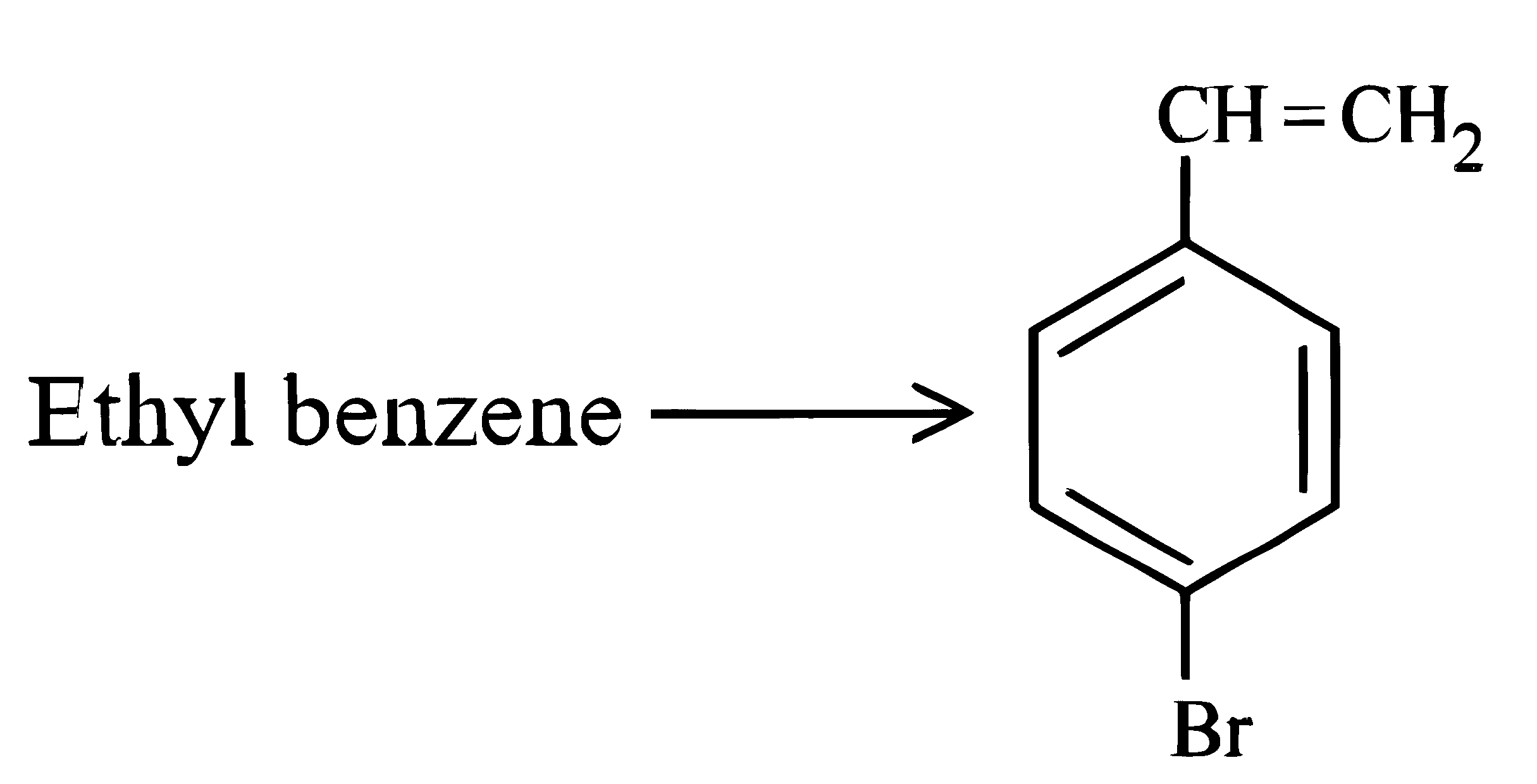
- Aanhy alc. KOH
- Banhy. ; aq. KOH
- C; alc. KOH
- Danhy. ; aq. KOH
View written solutionFree
Correct answer: C
- Interpret the reagent sequences
We need to identify which sequence can bring about the required aromatic side-chain transformation.
The key reagent patterns are:
- or electrophilic aromatic substitution on benzene ring.
- free-radical side-chain chlorination at benzylic position.
- alc. KOH generally elimination.
- aq. KOH generally nucleophilic substitution / hydrolysis.
So, if the conversion involves:
- first introducing a halogen on the ring,
- then chlorinating the side chain,
- then eliminating HCl to form an alkene,
we need the sequence:
- Check each option
Option A
- First two steps are both aromatic halogenations.
- No side-chain chlorination step like is present.
- Hence this sequence cannot generate a benzylic halide needed for elimination.
So, A is incorrect.
Option B
- Again, first two are ring halogenation steps.
- No benzylic radical chlorination.
- Final reagent is aq. KOH, which favors substitution, not elimination.
So, B is incorrect.
Option C
- : bromination of benzene ring.
- : benzylic chlorination of side chain.
- alc. KOH: elimination of HCl from side-chain chloride to form the corresponding alkene.
This is the chemically consistent sequence.
So, C is correct.
Option D
- First step (ring bromination) is acceptable.
- Second step (side-chain chlorination) is also acceptable.
- But final step uses aq. KOH, which would tend to give substitution/hydrolysis rather than the required elimination.
So, D is incorrect.
- Conclusion
The only suitable reagent set is:
- Comparison with stored answer
Stored correct answer: C
My derived answer: C
Hence, they agree.
More from Haloalkanes and Haloarenes
- Which one of the following reactions will not lead to the desired ether formation in major proportion? (iso- isobutyl, sec sec-butyl, -propyl, …2025 · MCQ
- 'P' is Includes diagram2025 · MCQ
- Given below are two statements : Statement I : will undergo reaction though it is a primary halide. Statement II : will not undergo … Includes diagram2025 · MCQ
- The maximum number of RBr producing 2-methylbutane by above sequence of reactions is . (Consider the structural isomers only) Includes diagram2025 · MCQ
- Propane molecule on chlorination under photochemical condition gives two di-chloro products, " " and "". Amongst "" and "", " " is an optically active molecule. How many tri-chloro products (consider only structural isomers)…2025 · MCQ
- Identify the products [A] and [B], respectively in the following reaction: Includes diagram2025 · MCQ
- The ascending order of relative rate of solvolysis of following compounds is : Includes diagram2025 · MCQ
- Following are the four molecules "P", "Q", "R" and "S". Which one among the four molecules will react with at the fastest rate? Includes diagram2025 · MCQ