Sign in
12thPass logo
New chatPYQ LibraryDoubtsRank report
Sign in to see Recents

Your guest activity stays on this device

Sign in to save progress →
Sign in

Haloalkanes and Haloarenes question

2023 · 30 Jan · Shift 2 · Q6
Guest · filters and generic practice availableBrowsing as a guest · PYQ filters and generic practice are available. Sign in only for personalised features and saved progress.
  1. PYQ Library
  2. /JEE Main
  3. /Chemistry
  4. /Haloalkanes and Haloarenes
  5. /2023 · 30 Jan · Shift 2 · Q6

Haloalkanes and Haloarenes question

2023 · 30 Jan · Shift 2 · Q6

JEE MainChemistryHaloalkanes and HaloarenesMCQ+4 / −1
Decreasing order towards SN 1 reaction for the following compounds is: JEE Main 2023 (Online) 30th January Evening Shift Chemistry - Haloalkanes and Haloarenes Question 61 English
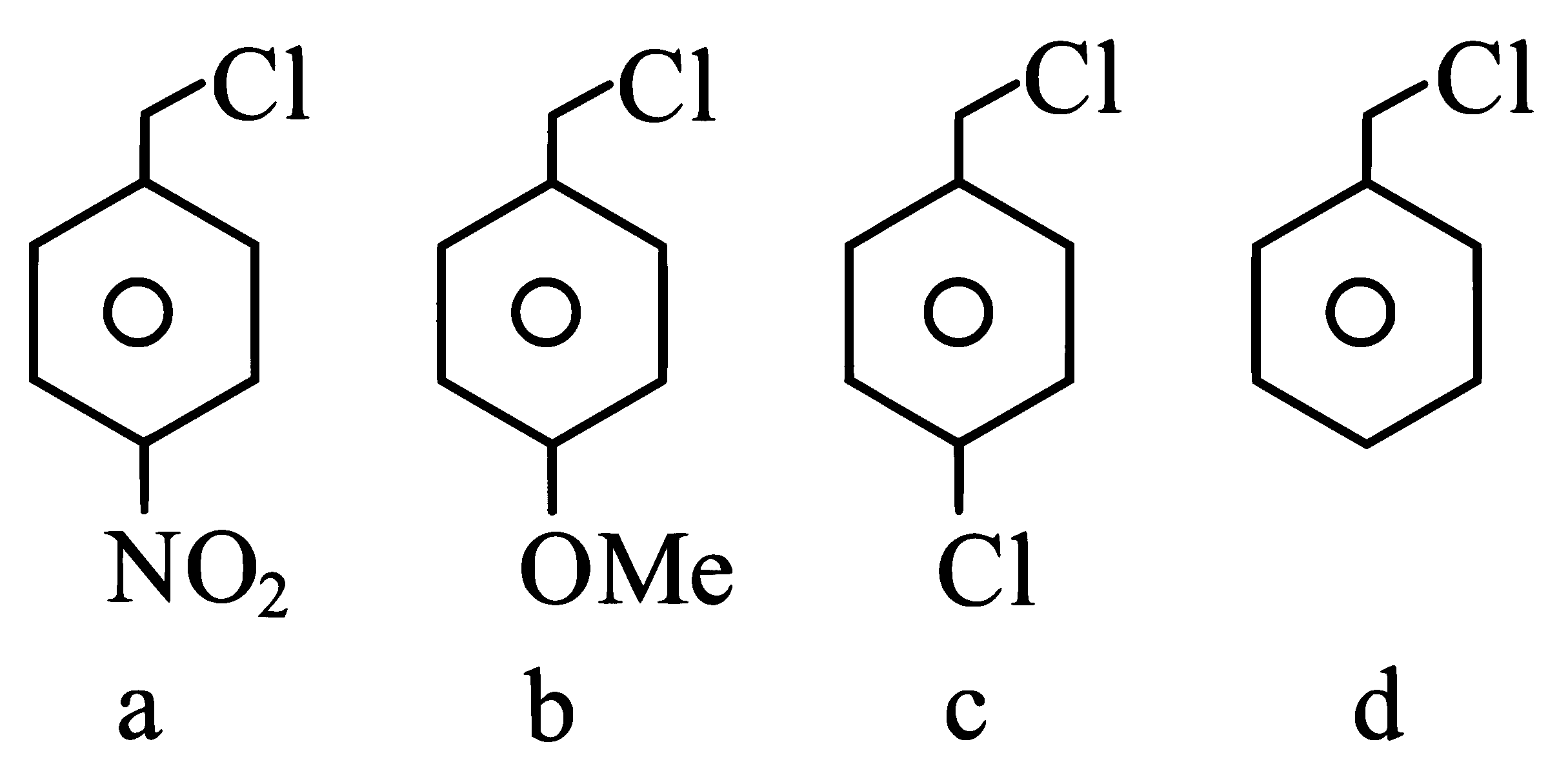
  1. A
    a>c>d>ba>c>d>ba>c>d>b
  2. B
    d>b>c>a\mathrm{d}\gt \mathrm{b}\gt \mathrm{c}\gt \mathrm{a}d>b>c>a
  3. C
    a>b>c>da>b>c>da>b>c>d
  4. D
    b>d>c>a\mathrm{b}\gt \mathrm{d}\gt \mathrm{c}\gt \mathrm{a}b>d>c>a
View written solutionFree

Correct answer: D

  1. Key idea for an SN1S_N1SN​1 reaction
    The rate of an SN1S_N1SN​1 reaction depends mainly on the stability of the carbocation formed after the leaving group departs.

    Better carbocation stability⇒faster SN1\text{Better carbocation stability} \Rightarrow \text{faster } S_N1Better carbocation stability⇒faster SN​1

  2. General carbocation stability order
    For ordinary alkyl carbocations:

    3∘>2∘>1∘>CH3+3^\circ > 2^\circ > 1^\circ > CH_3^+3∘>2∘>1∘>CH3+​

    Also, resonance-stabilized carbocations such as benzylic and allylic carbocations are especially favorable for SN1S_N1SN​1.

  3. Identify the relative nature of the given substrates
    From the answer choices, the only chemically sensible pattern for SN1S_N1SN​1 is that:

    • bbb forms the most stable carbocation,
    • then ddd,
    • then ccc,
    • and aaa is the least favorable.

    This corresponds to the standard trend where a more substituted and/or resonance-stabilized carbocation reacts faster by SN1S_N1SN​1.

  4. Compare options

    • A: a>c>d>ba>c>d>ba>c>d>b
      This places aaa as most reactive, which is inconsistent with usual SN1S_N1SN​1 stability trends.

    • B: d>b>c>ad>b>c>ad>b>c>a
      This makes ddd more reactive than bbb, which is less likely if bbb gives the more stabilized carbocation.

    • C: a>b>c>da>b>c>da>b>c>d
      Again puts aaa highest, not consistent with SN1S_N1SN​1.

    • D: b>d>c>ab>d>c>ab>d>c>a
      This matches the expected decrease in carbocation stability and hence SN1S_N1SN​1 reactivity.

  5. Final answer

    b>d>c>a\boxed{b>d>c>a}b>d>c>a​

    Hence, Option D is correct.

PreviousNext

More from Haloalkanes and Haloarenes

  • The correct order of melting points of dichlorobenzenes is2023 · MCQ
  • In the following halogenated organic compounds, the one with the maximum number of chlorine atoms in its structure is :2023 · MCQ
  • In the given reaction sequence, the major product 'C' is : Includes diagram2022 · MCQ
  • Consider the above reaction. The number of π electrons present in the product 'P' is ​. Includes diagram2022 · Numerical
  • The major product in the reaction Includes diagram2022 · MCQ
  • In the presence of sunlight, benzene reacts with Cl2​ to give product, X. The number of hydrogens in X is ​.2022 · Numerical
  • Halogenation of which one of the following will yield m-substituted product with respect to methyl group as a major product?2022 · MCQ
  • Major product 'B' of the following reaction sequence is : Includes diagram2022 · MCQ