Sign in
12thPass logo
New chatPYQ LibraryDoubtsRank report
Sign in to see Recents

Your guest activity stays on this device

Sign in to save progress →
Sign in

Haloalkanes and Haloarenes question

2022 · 25 Jun · Shift 1 · Q11
Guest · filters and generic practice availableBrowsing as a guest · PYQ filters and generic practice are available. Sign in only for personalised features and saved progress.
  1. PYQ Library
  2. /JEE Main
  3. /Chemistry
  4. /Haloalkanes and Haloarenes
  5. /2022 · 25 Jun · Shift 1 · Q11

Haloalkanes and Haloarenes question

2022 · 25 Jun · Shift 1 · Q11

JEE MainChemistryHaloalkanes and HaloarenesMCQ+4 / −1
The major product in the reaction JEE Main 2022 (Online) 25th June Morning Shift Chemistry - Haloalkanes and Haloarenes Question 72 English
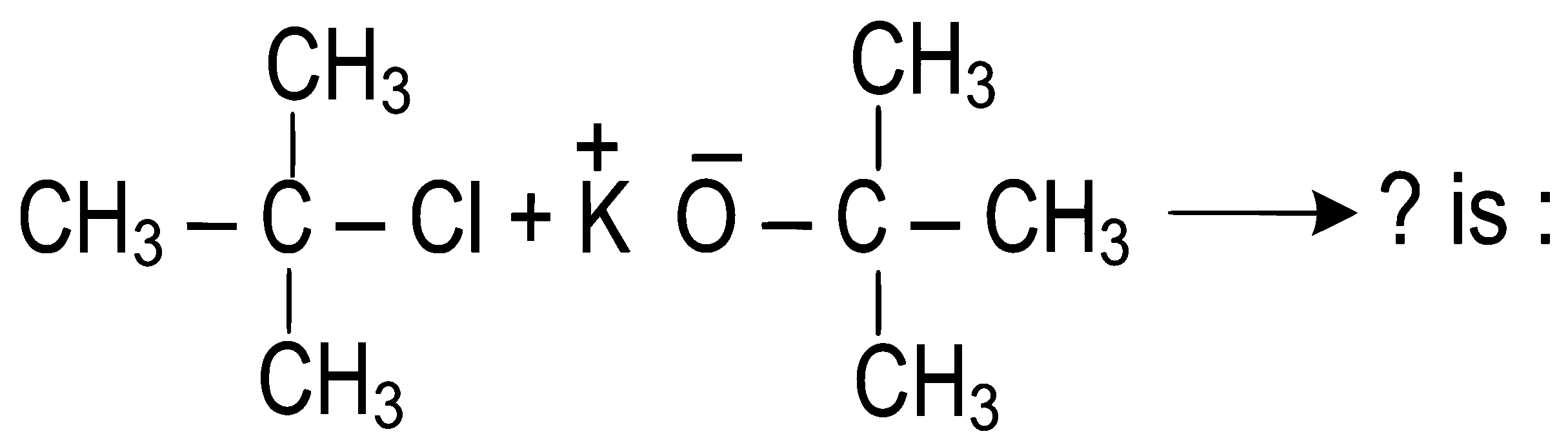
  1. A
    t-Butyl ethyl ether
  2. B
    2,2-Dimethyl butane
  3. C
    2-Methyl pent-1-ene
  4. D
    2-Methyl prop-1-ene
View written solutionFree

Correct answer: D

The question text appears incomplete because the actual reaction scheme/reagents are missing. So the exact product cannot be determined with full certainty from the text alone.

However, based on the given options and the chapter context (haloalkanes and haloarenes), this is most likely a standard reaction involving a tert-butyl halide under conditions favoring elimination, whose major product is 2-methylprop-1-ene.

Let us analyze the options from that perspective.


1. Likely reaction pattern

A very common JEE question in this topic is of the type:

(CH3)3C−X→alc.base?(CH_3)_3C-X \xrightarrow[\text{alc.}]{\text{base}} ?(CH3​)3​C−Xbasealc.​?

For a tertiary alkyl halide such as tert-butyl halide, substitution is hindered and under alcoholic base/heat, elimination is strongly favored.

The elimination gives:

(CH3)3C−X→(CH3)2C=CH2(CH_3)_3C-X \rightarrow (CH_3)_2C=CH_2(CH3​)3​C−X→(CH3​)2​C=CH2​

This compound is 2-methylprop-1-ene (isobutene).


2. Checking the options

Option A: t-Butyl ethyl ether

This would be formed by substitution with an ethoxide/ethanol-type nucleophile under suitable conditions:

(CH3)3C−X→(CH3)3C−O−C2H5(CH_3)_3C-X \rightarrow (CH_3)_3C-O-C_2H_5(CH3​)3​C−X→(CH3​)3​C−O−C2​H5​

But for a tertiary halide, especially in elimination-favoring conditions, ether is usually not the major product.

So, A is unlikely as the major product.

Option B: 2,2-Dimethylbutane

This is an alkane and would require coupling/rearrangement, not the standard major outcome of a simple haloalkane reaction.

So, B is unlikely.

Option C: 2-Methyl pent-1-ene

This has six carbons, whereas tert-butyl derivatives generally lead to a four-carbon alkene on elimination. So unless a larger substrate is involved, this does not fit.

So, C is unlikely.

Option D: 2-Methyl prop-1-ene

This is exactly the alkene obtained by elimination from a tert-butyl halide:

(CH3)3C−X→CH2=C(CH3)2(CH_3)_3C-X \rightarrow CH_2=C(CH_3)_2(CH3​)3​C−X→CH2​=C(CH3​)2​

So, D is the most plausible major product.


3. Final conclusion

The major product is:

2-Methyl prop-1-ene\boxed{\text{2-Methyl prop-1-ene}}2-Methyl prop-1-ene​

So the correct option is:

D\boxed{D}D​

4. Comparison with stored answer

Stored correct answer: D
Derived answer: D

Hence, they agree.

PreviousNext

More from Haloalkanes and Haloarenes

  • In the presence of sunlight, benzene reacts with Cl2​ to give product, X. The number of hydrogens in X is ​.2022 · Numerical
  • Halogenation of which one of the following will yield m-substituted product with respect to methyl group as a major product?2022 · MCQ
  • Major product 'B' of the following reaction sequence is : Includes diagram2022 · MCQ
  • The major product of the following reaction is : Includes diagram2022 · MCQ
  • The major product in the given reaction is Includes diagram2022 · MCQ
  • The major product (P) in the reaction is Includes diagram2022 · MCQ
  • Which one of the following compounds is inactive towards SN1 reaction?2022 · MCQ
  • The major product of the following reaction contains ​ bromine atom(s). Includes diagram2022 · Numerical