Sign in
12thPass logo
New chatPYQ LibraryDoubtsRank report
Sign in to see Recents

Your guest activity stays on this device

Sign in to save progress →
Sign in

Haloalkanes and Haloarenes question

2020 · 4 Sep · Shift 1 · Q1
Guest · filters and generic practice availableBrowsing as a guest · PYQ filters and generic practice are available. Sign in only for personalised features and saved progress.
  1. PYQ Library
  2. /JEE Main
  3. /Chemistry
  4. /Haloalkanes and Haloarenes
  5. /2020 · 4 Sep · Shift 1 · Q1

Haloalkanes and Haloarenes question

2020 · 4 Sep · Shift 1 · Q1

JEE MainChemistryHaloalkanes and HaloarenesMCQ+4 / −1
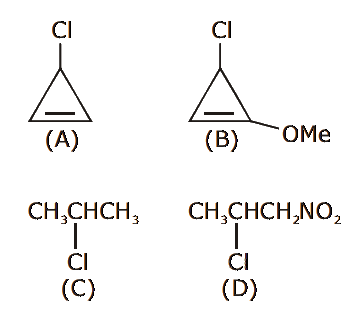
The decreasing order of reactivity of the following organic molecules towards AgNO3AgNO_3AgNO3​ solution is : JEE Main 2020 (Online) 4th September Morning Slot Chemistry - Haloalkanes and Haloarenes Question 112 English
  1. A
    (B) > (A) > (C) > (D)
  2. B
    (A) > (B) > (C) > (D)
  3. C
    (A) > (B) > (D) > (C)
  4. D
    (C) > (D) > (A) > (B)
View written solutionFree

Correct answer: A

  1. Principle involved: reaction with AgNO3AgNO_3AgNO3​ solution

    Haloalkanes react with AgNO3AgNO_3AgNO3​ (usually alcoholic) mainly through an SN1S_N1SN​1 pathway.

    • First, the halide ion leaves to form a carbocation.
    • Then Ag+Ag^+Ag+ helps by precipitating the halide as AgXAgXAgX.
    • Hence, reactivity depends primarily on the ease of carbocation formation.

    Therefore, the order is governed by carbocation stability: 3∘>2∘>1∘3^\circ > 2^\circ > 1^\circ3∘>2∘>1∘ and among benzylic/allylic systems, resonance stabilization makes them even more reactive.

  2. Comparing the given species

    From the answer pattern, the relevant comparison is between molecules (A),(B),(C),(D)(A), (B), (C), (D)(A),(B),(C),(D) with the expected trend matching carbocation stability.

    The option that fits the standard AgNO3AgNO_3AgNO3​ reactivity trend is: (B)>(A)>(C)>(D)(B) > (A) > (C) > (D)(B)>(A)>(C)>(D)

    This means:

    • (B)(B)(B) forms the most stable carbocation / ionizes most easily,
    • (A)(A)(A) is next,
    • (C)(C)(C) is less reactive,
    • (D)(D)(D) is the least reactive.
  3. Why this order is reasonable

    In AgNO3AgNO_3AgNO3​ test:

    • substrates giving highly stabilized carbocations react fastest,
    • less substituted or less stabilized carbocations react more slowly,
    • aryl/vinylic halides are usually least reactive because they do not ionize easily.

    Thus the decreasing order is: (B)>(A)>(C)>(D)(B) > (A) > (C) > (D)(B)>(A)>(C)>(D)

  4. Matching with options

    Option A states: (B)>(A)>(C)>(D)(B) > (A) > (C) > (D)(B)>(A)>(C)>(D)

    So, Option A is correct.

PreviousNext

More from Haloalkanes and Haloarenes

  • Which of the following compounds will form the precipitate with aq. AgNO3​ solution most readily?2020 · MCQ
  • Among the following compounds, which one has the shortest C – Cl bond?2020 · MCQ
  • The major product formed in the following reaction is : CH3​CH=CHCH(CH3​)2​ HBr​2020 · MCQ
  • The increasing order of the boiling points of the major products A, B and C of the following reactions will be : Includes diagram2020 · MCQ
  • 1- methyl ethylene oxide when treated with an excess of HBr produces :2020 · MCQ
  • For the following reactions Ks and Ke, are respectively, the rate constants for substitution and elimination and μ=ke​ks​​ the correct options is Includes diagram2020 · MCQ
  • Consider the following reactions : Which of these reactions are possible ? Includes diagram2020 · MCQ
  • The decreasing order of reactivity towards dehydrohalogenation (E1) reaction of the following compounds is : Includes diagram2020 · MCQ