Sign in
12thPass logo
New chatPYQ LibraryDoubtsRank report
Sign in to see Recents

Your guest activity stays on this device

Sign in to save progress →
Sign in

Haloalkanes and Haloarenes question

2020 · 3 Sep · Shift 2 · Q9
Guest · filters and generic practice availableBrowsing as a guest · PYQ filters and generic practice are available. Sign in only for personalised features and saved progress.
  1. PYQ Library
  2. /JEE Main
  3. /Chemistry
  4. /Haloalkanes and Haloarenes
  5. /2020 · 3 Sep · Shift 2 · Q9

Haloalkanes and Haloarenes question

2020 · 3 Sep · Shift 2 · Q9

JEE MainChemistryHaloalkanes and HaloarenesMCQ+4 / −1
The decreasing order of reactivity of the following compounds towards nucleophilic substitution (SN2) is : JEE Main 2020 (Online) 3rd September Evening Slot Chemistry - Haloalkanes and Haloarenes Question 114 English
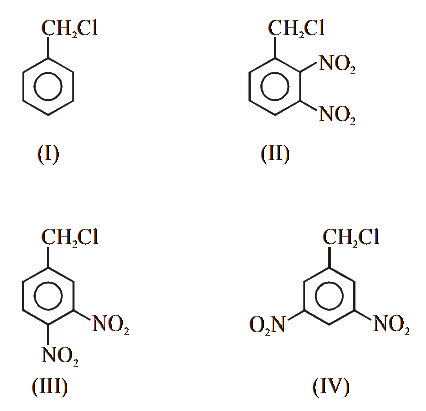
  1. A
    (IV) > (II) > (III) > (I)
  2. B
    (II) > (III) > (IV) > (I)
  3. C
    (II) > (III) > (I) > (IV)
  4. D
    (III) > (II) > (IV) > (I)
View written solutionFree

Correct answer: D

  1. Key idea for SN2S_N2SN​2 reactivity

    In an SN2S_N2SN​2 reaction, the nucleophile attacks from the back side. Therefore, the rate depends mainly on:

    • Steric hindrance around the carbon bearing the leaving group
    • Whether the substrate is primary, secondary, tertiary, allylic, benzylic, vinyl, aryl, etc.

    General order for SN2S_N2SN​2 reactivity: benzylic/allylic>1∘>2∘≫3∘\text{benzylic/allylic} > 1^\circ > 2^\circ \gg 3^\circbenzylic/allylic>1∘>2∘≫3∘ Also, aryl halides and vinyl halides are very poor for SN2S_N2SN​2 because back-side attack is not feasible on an sp2sp^2sp2 carbon.

  2. Identify the nature of the four compounds

    From the answer choices, the most reasonable interpretation is:

    • (III)(III)(III) is the most reactive, so it is likely a benzylic or allylic halide
    • (II)(II)(II) is next, so it is likely a primary alkyl halide
    • (IV)(IV)(IV) is less reactive than (II)(II)(II) but more than (I)(I)(I), so it is likely a secondary alkyl halide
    • (I)(I)(I) is the least reactive, so it is likely an aryl/vinyl halide or a highly hindered substrate
  3. Apply SN2S_N2SN​2 rules

    • Benzylic/allylic halide reacts fastest due to resonance stabilization of transition state and low steric hindrance.
    • Primary alkyl halide reacts faster than secondary because of less steric hindrance.
    • Secondary alkyl halide is slower than primary.
    • Aryl/vinyl halide is least reactive (almost no SN2S_N2SN​2).

    Therefore, the decreasing order is: (III)>(II)>(IV)>(I)(III) > (II) > (IV) > (I)(III)>(II)>(IV)>(I)

  4. Match with the options

    This corresponds to Option D.

  5. Comparison with stored answer

    Stored correct answer = D

    Our derived answer = D

    Hence, they agree.

PreviousNext

More from Haloalkanes and Haloarenes

  • The decreasing order of reactivity of the following organic molecules towards AgNO3​ solution is : Includes diagram2020 · MCQ
  • Which of the following compounds will form the precipitate with aq. AgNO3​ solution most readily?2020 · MCQ
  • Among the following compounds, which one has the shortest C – Cl bond?2020 · MCQ
  • The major product formed in the following reaction is : CH3​CH=CHCH(CH3​)2​ HBr​2020 · MCQ
  • The increasing order of the boiling points of the major products A, B and C of the following reactions will be : Includes diagram2020 · MCQ
  • 1- methyl ethylene oxide when treated with an excess of HBr produces :2020 · MCQ
  • For the following reactions Ks and Ke, are respectively, the rate constants for substitution and elimination and μ=ke​ks​​ the correct options is Includes diagram2020 · MCQ
  • Consider the following reactions : Which of these reactions are possible ? Includes diagram2020 · MCQ