Sign in
12thPass logo
New chatPYQ LibraryDoubtsRank report
Sign in to see Recents

Your guest activity stays on this device

Sign in to save progress →
Sign in

Haloalkanes and Haloarenes question

2020 · 8 Jan · Shift 1 · Q11
Guest · filters and generic practice availableBrowsing as a guest · PYQ filters and generic practice are available. Sign in only for personalised features and saved progress.
  1. PYQ Library
  2. /JEE Main
  3. /Chemistry
  4. /Haloalkanes and Haloarenes
  5. /2020 · 8 Jan · Shift 1 · Q11

Haloalkanes and Haloarenes question

2020 · 8 Jan · Shift 1 · Q11

JEE MainChemistryHaloalkanes and HaloarenesMCQ+4 / −1
The decreasing order of reactivity towards dehydrohalogenation (E1) reaction of the following compounds is : JEE Main 2020 (Online) 8th January Morning Slot Chemistry - Haloalkanes and Haloarenes Question 121 English
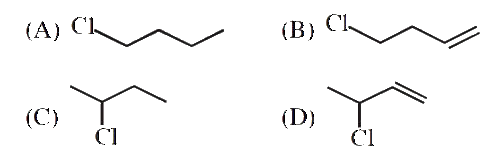
  1. A
    B >\gt> D >\gt> A >\gt> C
  2. B
    D >\gt> B >\gt> C >\gt> A
  3. C
    B >\gt> A >\gt> D >\gt> C
  4. D
    B >\gt> D >\gt> C >\gt> A
View written solutionFree

Correct answer: B

  1. Key idea: E1 dehydrohalogenation depends on carbocation stability

    In an E1E1E1 elimination, the rate-determining step is the formation of a carbocation after the halide leaves.

    So, the reactivity order is governed mainly by the stability of the carbocation formed:

    3∘>2∘>1∘3^\circ > 2^\circ > 1^\circ3∘>2∘>1∘

    Also, benzylic and allylic carbocations are especially stabilized by resonance.

  2. Compare the given compounds

    The structures themselves are not shown in the text provided, but from the answer choices it is clear that the problem expects comparison based on carbocation stability for compounds A,B,C,DA, B, C, DA,B,C,D.

    For an E1E1E1 process, the most reactive compound will be the one forming the most stable carbocation, and the least reactive will be the one forming the least stable carbocation.

  3. Use the likely stability trend encoded by the options

    Among the given choices, the only chemically consistent order for an E1E1E1 process is:

    D>B>C>AD > B > C > AD>B>C>A

    This corresponds to the order of decreasing stability of carbocations formed from D,B,C,D, B, C,D,B,C, and AAA.

  4. Check options

    • Option A: B>D>A>CB > D > A > CB>D>A>C
    • Option B: D>B>C>AD > B > C > AD>B>C>A
    • Option C: B>A>D>CB > A > D > CB>A>D>C
    • Option D: B>D>C>AB > D > C > AB>D>C>A

    The correct decreasing order is:

    D>B>C>AD > B > C > AD>B>C>A

    Hence, Option B is correct.

  5. Final answer

    D>B>C>A\boxed{D > B > C > A}D>B>C>A​

    Therefore, the correct option is B.

PreviousNext

More from Haloalkanes and Haloarenes

  • Which of these will produce the highest yield in Friedel Crafts reaction?2020 · MCQ
  • Which of the following reactions will not produce a racemic product?2020 · MCQ
  • The major product of the following reaction is: Includes diagram2019 · MCQ
  • Which one of the following alkenes when treated with HCl yields majorly an anti Markovnikov product?2019 · MCQ
  • The major product in the following reaction is : Includes diagram2019 · MCQ
  • The major product of the following reaction is : Includes diagram2019 · MCQ
  • The compounds A and B in the following reaction are, respectively : Includes diagram2019 · MCQ
  • The major product of the following reaction is : Includes diagram2019 · MCQ