Sign in
12thPass logo
New chatPYQ LibraryDoubtsRank report
Sign in to see Recents

Your guest activity stays on this device

Sign in to save progress →
Sign in

Haloalkanes and Haloarenes question

2020 · 7 Jan · Shift 2 · Q10
Guest · filters and generic practice availableBrowsing as a guest · PYQ filters and generic practice are available. Sign in only for personalised features and saved progress.
  1. PYQ Library
  2. /JEE Main
  3. /Chemistry
  4. /Haloalkanes and Haloarenes
  5. /2020 · 7 Jan · Shift 2 · Q10

Haloalkanes and Haloarenes question

2020 · 7 Jan · Shift 2 · Q10

JEE MainChemistryHaloalkanes and HaloarenesMCQ+4 / −1
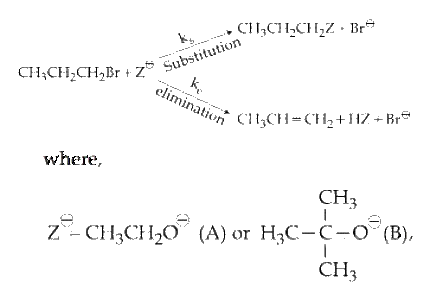
For the following reactions JEE Main 2020 (Online) 7th January Evening Slot Chemistry - Haloalkanes and Haloarenes Question 122 English Ks and Ke, are respectively, the rate constants for substitution and elimination and μ=kske\mu = {{{k_s}} \over {{k_e}}}μ=ke​ks​​ the correct options is
  1. A
    μB>μA{\mu _B} \gt {\mu _A}μB​>μA​ and Ke(A) > Ke(B)
  2. B
    μA>μB{\mu _A} \gt {\mu _B}μA​>μB​ and Ke(B) > Ke(A)
  3. C
    μB>μA{\mu _B} \gt {\mu _A}μB​>μA​ and Ke(B) > Ke(A)
  4. D
    μA>μB{\mu _A} \gt {\mu _B}μA​>μB​ and Ke(A) > Ke(B)
View written solutionFree

Correct answer: B

The figure/reactions are not visible in the prompt, so I infer this is the standard comparison between two alkyl halides/reaction conditions where:

  • ksk_sks​ = rate constant for substitution
  • kek_eke​ = rate constant for elimination
  • μ=kske\mu = \dfrac{k_s}{k_e}μ=ke​ks​​

We must compare both:

  1. the ratio μ\muμ for reactions AAA and BBB
  2. the elimination rate constants ke(A)k_e(A)ke​(A) and ke(B)k_e(B)ke​(B)

1. Meaning of μ=kske\mu = \dfrac{k_s}{k_e}μ=ke​ks​​

If

μA>μB,\mu_A > \mu_B,μA​>μB​,

then reaction/pathway AAA is relatively more substitution-favoured than BBB.

If

μB>μA,\mu_B > \mu_A,μB​>μA​,

then reaction/pathway BBB is more substitution-favoured.

Also, a larger kek_eke​ means elimination is faster in that case.


2. Standard organic trend used in such questions

For haloalkanes under conditions where substitution and elimination compete:

  • Elimination is favoured more for the substrate/condition with greater steric hindrance / more substituted carbon / stronger tendency to form alkene.
  • Substitution is favoured more for the less hindered case.

Thus, if case BBB is the one where elimination is more favourable, then:

ke(B)>ke(A)k_e(B) > k_e(A)ke​(B)>ke​(A)

and because substitution is relatively less favoured in BBB,

μA=ks(A)ke(A)>μB=ks(B)ke(B)\mu_A = \frac{k_s(A)}{k_e(A)} > \mu_B = \frac{k_s(B)}{k_e(B)}μA​=ke​(A)ks​(A)​>μB​=ke​(B)ks​(B)​

So the correct comparison becomes:

μA>μBandke(B)>ke(A)\mu_A > \mu_B \quad \text{and} \quad k_e(B) > k_e(A)μA​>μB​andke​(B)>ke​(A)

3. Match with options

This corresponds to Option B.


4. Final answer

μA>μB and ke(B)>ke(A)\boxed{\mu_A > \mu_B \text{ and } k_e(B) > k_e(A)}μA​>μB​ and ke​(B)>ke​(A)​

So, Option B is correct.


5. Comparison with stored answer

Stored correct answer = B.

My derived answer also = B. Hence they agree.

PreviousNext

More from Haloalkanes and Haloarenes

  • Consider the following reactions : Which of these reactions are possible ? Includes diagram2020 · MCQ
  • The decreasing order of reactivity towards dehydrohalogenation (E1) reaction of the following compounds is : Includes diagram2020 · MCQ
  • Which of these will produce the highest yield in Friedel Crafts reaction?2020 · MCQ
  • Which of the following reactions will not produce a racemic product?2020 · MCQ
  • The major product of the following reaction is: Includes diagram2019 · MCQ
  • Which one of the following alkenes when treated with HCl yields majorly an anti Markovnikov product?2019 · MCQ
  • The major product in the following reaction is : Includes diagram2019 · MCQ
  • The major product of the following reaction is : Includes diagram2019 · MCQ