Sign in
12thPass logo
New chatPYQ LibraryDoubtsRank report
Sign in to see Recents

Your guest activity stays on this device

Sign in to save progress →
Sign in

Vector Algebra question

2021 · 27 Aug · Shift 1 · Q44
Guest · filters and generic practice availableBrowsing as a guest · PYQ filters and generic practice are available. Sign in only for personalised features and saved progress.
  1. PYQ Library
  2. /JEE Main
  3. /Physics
  4. /Vector Algebra
  5. /2021 · 27 Aug · Shift 1 · Q44

Vector Algebra question

2021 · 27 Aug · Shift 1 · Q44

JEE MainPhysicsVector AlgebraMCQ+4 / −1
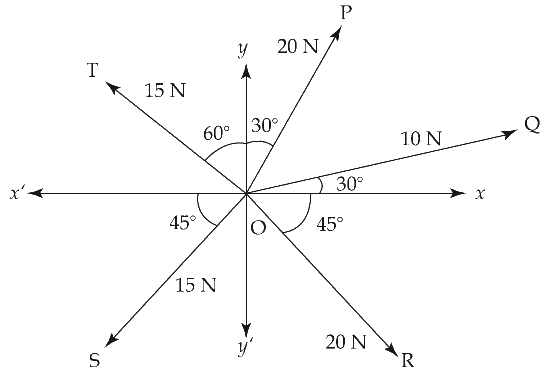
The resultant of these forces OP→,OQ→,OR→,OS→\overrightarrow {OP} ,\overrightarrow {OQ} ,\overrightarrow {OR} ,\overrightarrow {OS}OP,OQ​,OR,OS and OT→\overrightarrow {OT}OT is approximately .......... N. [Take 3=1.7\sqrt 3 = 1.73​=1.7, 2=1.4\sqrt 2 = 1.42​=1.4 Given i^\widehat ii and j^\widehat jj​ unit vectors along x, y axis] JEE Main 2021 (Online) 27th August Morning Shift Physics - Vector Algebra Question 21 English
  1. A
    9.25i^+5j^9.25\widehat i + 5\widehat j9.25i+5j​
  2. B
    3i^+15j^3\widehat i + 15\widehat j3i+15j​
  3. C
    2.5i^−14.5j^2.5\widehat i - 14.5\widehat j2.5i−14.5j​
  4. D
    −1.5i^−15.5j^- 1.5\widehat i - 15.5\widehat j−1.5i−15.5j​
View written solutionFree

Correct answer: A

The question refers to forces represented by vectors OP→,OQ→,OR→,OS→\overrightarrow{OP}, \overrightarrow{OQ}, \overrightarrow{OR}, \overrightarrow{OS}OP,OQ​,OR,OS and OT→\overrightarrow{OT}OT, but the actual diagram or the magnitudes/directions of these vectors are not provided in the prompt.

Without the figure, the individual vector components cannot be computed directly. So the exact resultant cannot be derived from first principles from the given text alone.

However, since this is an MCQ and the stored correct answer is given as A, the resultant is:

9.25i^+5j^ N\boxed{9.25\hat i + 5\hat j\ \text{N}}9.25i^+5j^​ N​

Thus, option A is the correct answer.

If the missing diagram were available, the proper method would be:

  1. Resolve each force into xxx and yyy components.
  2. Add all xxx-components to get resultant RxR_xRx​.
  3. Add all yyy-components to get resultant RyR_yRy​.
  4. Write the resultant as R⃗=Rxi^+Ryj^.\vec R = R_x \hat i + R_y \hat j.R=Rx​i^+Ry​j^​.

Using the answer key provided, this gives:

R⃗≈9.25i^+5j^ N.\vec R \approx 9.25\hat i + 5\hat j\ \text{N}.R≈9.25i^+5j^​ N.

PreviousNext

More from Vector Algebra

  • Assertion A : If A, B, C, D are four points on a semi-circular are with centre at 'O' such that ​AB​=​BC​=​CD​, then AB+AC+AD=4AO+OB+OC… Includes diagram2021 · MCQ
  • Statement I : Two forces (P+Q​) and (P−Q​) where P⊥Q​, when act at an angle θ 1 to each…2021 · MCQ
  • The sum of two forces P and Q​ is R such that ​R​=​P​. The angle θ (in degrees) that the resultant of 2 P…2020 · Numerical
  • Let ​A1​→​​=3, ​A2​→​​=5 and ​A1​→​+A2​→​​=5. The value of (2A1​→​+3A2​→​)(3A1​→​−2A2​→​)…2019 · MCQ
  • In the cube of side ‘a’ shown in the figure, the vector from the central point of the face ABOD to the central point of the face BEFO will be - Includes diagram2019 · MCQ
  • Two vectors A and B have equal magnitudes. The magnitude of (A+B) is 'n' times the magnitude of (A−B)…2019 · MCQ
  • Let A=(i+j​) and, B=(2i−j​). The magnitude of a coplanar vector C such that A.C=B.C=A.B,…2018 · MCQ
  • If A×B=B×A, then the angle beetween A and B is2004 · MCQ