Sign in
12thPass logo
New chatPYQ LibraryDoubtsRank report
Sign in to see Recents

Your guest activity stays on this device

Sign in to save progress →
Sign in

Vector Algebra question

2021 · 26 Aug · Shift 2 · Q50
Guest · filters and generic practice availableBrowsing as a guest · PYQ filters and generic practice are available. Sign in only for personalised features and saved progress.
  1. PYQ Library
  2. /JEE Main
  3. /Physics
  4. /Vector Algebra
  5. /2021 · 26 Aug · Shift 2 · Q50

Vector Algebra question

2021 · 26 Aug · Shift 2 · Q50

JEE MainPhysicsVector AlgebraMCQ+4 / −1
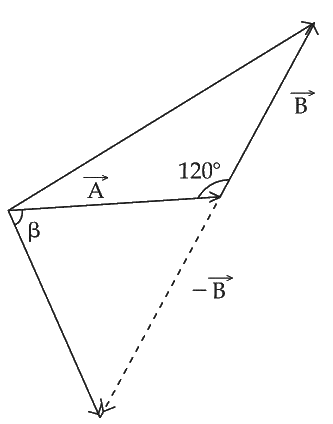
The angle between vector (A→)\left( {\overrightarrow A } \right)(A) and (A→−B→)\left( {\overrightarrow A - \overrightarrow B } \right)(A−B) is : JEE Main 2021 (Online) 26th August Evening Shift Physics - Vector Algebra Question 22 English
  1. A
    tan⁡−1(−B2A−B32){\tan ^{ - 1}}\left( {{{ - {B \over 2}} \over {A - B{{\sqrt 3 } \over 2}}}} \right)tan−1(A−B23​​−2B​​)
  2. B
    tan⁡−1(A0.7B){\tan ^{ - 1}}\left( {{A \over {0.7B}}} \right)tan−1(0.7BA​)
  3. C
    tan⁡−1(3B2A−B){\tan ^{ - 1}}\left( {{{\sqrt 3 B} \over {2A - B}}} \right)tan−1(2A−B3​B​)
  4. D
    tan⁡−1(Bcos⁡θA−Bsin⁡θ){\tan ^{ - 1}}\left( {{{B\cos \theta } \over {A - B\sin \theta }}} \right)tan−1(A−BsinθBcosθ​)
View written solutionFree

Correct answer: C

  1. Interpret the question

We need the angle between the vectors A⃗\vec AA and (A⃗−B⃗)(\vec A-\vec B)(A−B).

Since the options are numerical expressions involving only AAA and BBB, the question implicitly uses the standard figure where the angle between A⃗\vec AA and B⃗\vec BB is 60∘60^\circ60∘.

So, let the angle between A⃗\vec AA and B⃗\vec BB be 60∘60^\circ60∘.


  1. Resolve vectors conveniently

Take A⃗\vec AA along the xxx-axis.

Then

A⃗=(A,0)\vec A=(A,0)A=(A,0)

If B⃗\vec BB makes 60∘60^\circ60∘ with A⃗\vec AA, then

B⃗=(Bcos⁡60∘, Bsin⁡60∘)=(B2, 3B2)\vec B=(B\cos60^\circ,\, B\sin60^\circ) =\left(\frac B2,\,\frac{\sqrt3 B}{2}\right)B=(Bcos60∘,Bsin60∘)=(2B​,23​B​)

Therefore,

A⃗−B⃗=(A−B2, −3B2)\vec A-\vec B= \left(A-\frac B2,\, -\frac{\sqrt3 B}{2}\right)A−B=(A−2B​,−23​B​)
  1. Find the angle between A⃗\vec AA and (A⃗−B⃗)(\vec A-\vec B)(A−B)

Since A⃗\vec AA lies along the positive xxx-axis, the required angle ϕ\phiϕ is the angle made by A⃗−B⃗\vec A-\vec BA−B with the xxx-axis.

Hence,

\tan\phi= \frac{\text{magnitude of perpendicular component}}{\text{parallel component}} = rac{\frac{\sqrt3 B}{2}}{A-\frac B2}

So,

tan⁡ϕ=3B2A−B\tan\phi=\frac{\sqrt3 B}{2A-B}tanϕ=2A−B3​B​

Thus,

ϕ=tan⁡−1(3B2A−B)\phi=\tan^{-1}\left(\frac{\sqrt3 B}{2A-B}\right)ϕ=tan−1(2A−B3​B​)
  1. Match with the options

This matches Option C:

tan⁡−1(3B2A−B)\tan^{-1}\left(\frac{\sqrt3 B}{2A-B}\right)tan−1(2A−B3​B​)
  1. Conclusion

The correct answer is:

C\boxed{\text{C}}C​
PreviousNext

More from Vector Algebra

  • The resultant of these forces OP,OQ​,OR,OS and OT is approximately .......... N. [Take 3​=1.7, 2​=1.4 Given i… Includes diagram2021 · MCQ
  • Assertion A : If A, B, C, D are four points on a semi-circular are with centre at 'O' such that ​AB​=​BC​=​CD​, then AB+AC+AD=4AO+OB+OC… Includes diagram2021 · MCQ
  • Statement I : Two forces (P+Q​) and (P−Q​) where P⊥Q​, when act at an angle θ 1 to each…2021 · MCQ
  • The sum of two forces P and Q​ is R such that ​R​=​P​. The angle θ (in degrees) that the resultant of 2 P…2020 · Numerical
  • Let ​A1​→​​=3, ​A2​→​​=5 and ​A1​→​+A2​→​​=5. The value of (2A1​→​+3A2​→​)(3A1​→​−2A2​→​)…2019 · MCQ
  • In the cube of side ‘a’ shown in the figure, the vector from the central point of the face ABOD to the central point of the face BEFO will be - Includes diagram2019 · MCQ
  • Two vectors A and B have equal magnitudes. The magnitude of (A+B) is 'n' times the magnitude of (A−B)…2019 · MCQ
  • Let A=(i+j​) and, B=(2i−j​). The magnitude of a coplanar vector C such that A.C=B.C=A.B,…2018 · MCQ