Sign in
12thPass logo
New chatPYQ LibraryDoubtsRank report
Sign in to see Recents

Your guest activity stays on this device

Sign in to save progress →
Sign in

Simple Harmonic Motion question

2023 · 31 Jan · Shift 1 · Q67
Guest · filters and generic practice availableBrowsing as a guest · PYQ filters and generic practice are available. Sign in only for personalised features and saved progress.
  1. PYQ Library
  2. /JEE Main
  3. /Physics
  4. /Simple Harmonic Motion
  5. /2023 · 31 Jan · Shift 1 · Q67

Simple Harmonic Motion question

2023 · 31 Jan · Shift 1 · Q67

JEE MainPhysicsSimple Harmonic MotionNumerical+4 / −1
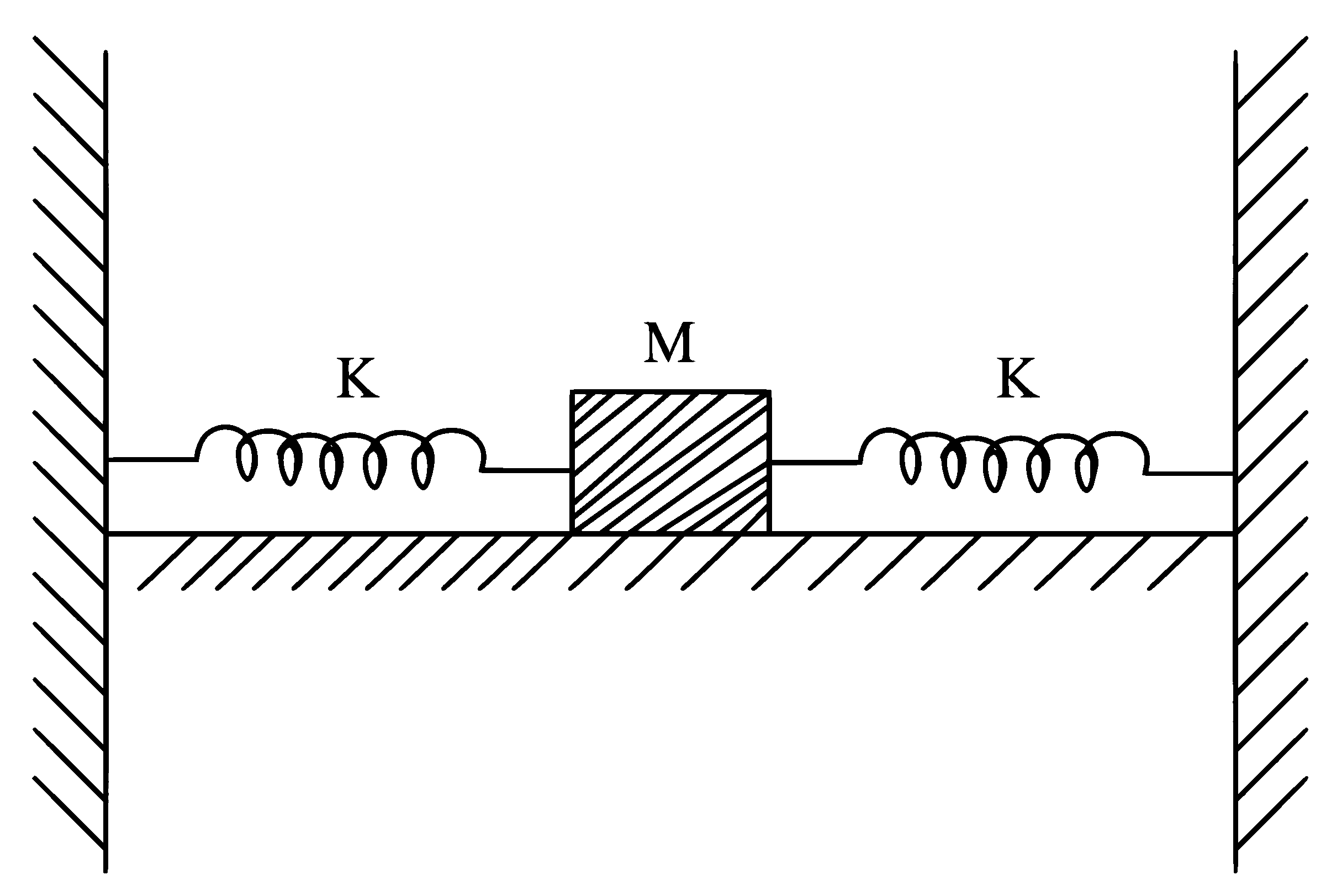
In the figure given below, a block of mass M=490 gM=490 \mathrm{~g}M=490 g placed on a frictionless table is connected with two springs having same spring constant (K=2 N m−1)\left(\mathrm{K}=2 \mathrm{~N} \mathrm{~m}^{-1}\right)(K=2 N m−1). If the block is horizontally displaced through 'X\mathrm{X}X' m\mathrm{m}m then the number of complete oscillations it will make in 14π14 \pi14π seconds will be ‾\underline{\hspace{2cm}}​. JEE Main 2023 (Online) 31st January Morning Shift Physics - Simple Harmonic Motion Question 46 English
Numerical answer
View written solutionFree

Correct answer: 20

  1. Identify the effective spring constant

The block is attached to two identical springs of spring constant K=2 N m−1K=2\,\text{N m}^{-1}K=2N m−1.

When the block is displaced horizontally by xxx, each spring contributes a restoring force toward equilibrium. So the net restoring force is

F=−(K+K)x=−2KxF=-(K+K)x=-2KxF=−(K+K)x=−2Kx

Hence, the effective spring constant is

keff=2K=2×2=4 N m−1k_{\text{eff}}=2K=2\times 2=4\,\text{N m}^{-1}keff​=2K=2×2=4N m−1

  1. Write the angular frequency

For SHM,

ω=keffM\omega=\sqrt{\frac{k_{\text{eff}}}{M}}ω=Mkeff​​​

Given mass,

M=490 g=0.49 kgM=490\,\text{g}=0.49\,\text{kg}M=490g=0.49kg

Thus,

ω=40.49\omega=\sqrt{\frac{4}{0.49}}ω=0.494​​

ω=40049=207 rad s−1\omega=\sqrt{\frac{400}{49}}=\frac{20}{7}\,\text{rad s}^{-1}ω=49400​​=720​rad s−1

  1. Find the time period

T=2πωT=\frac{2\pi}{\omega}T=ω2π​

So,

T=2π20/7=14π20=7π10 sT=\frac{2\pi}{20/7}=\frac{14\pi}{20}=\frac{7\pi}{10}\,\text{s}T=20/72π​=2014π​=107π​s

  1. Find number of complete oscillations in 14π14\pi14π seconds

Number of oscillations,

n=tTn=\frac{t}{T}n=Tt​

Given t=14πt=14\pit=14π s,

n=14π7π/10=14π×107π=20n=\frac{14\pi}{7\pi/10}=14\pi\times \frac{10}{7\pi}=20n=7π/1014π​=14π×7π10​=20

  1. Final answer

The number of complete oscillations is

20\boxed{20}20​

PreviousNext

More from Simple Harmonic Motion

  • Two massless springs with spring constants 2 k and 9 k, carry 50 g and 100 g masses at their free ends. These two masses oscillate vertically such that their maximum velocities are equal. Then, the ratio of their respective amplitudes will…2022 · MCQ
  • In figure (A), mass '2 m’  is fixed on mass 'm' which is attached to two springs of spring constant k. In figure (B), mass 'm' is attached to two springs of spring constant… Includes diagram2022 · MCQ
  • When a particle executes Simple Hormonic Motion, the nature of graph of velocity as a function of displacement will be :2022 · MCQ
  • As per given figures, two springs of spring constants k and 2k are connected to mass m. If the period of oscillation in figure (a) is 3s, then the period of oscillation in figure (b) will be x​ s. The value of x… Includes diagram2022 · Numerical
  • Time period of a simple pendulum in a stationary lift is 'T'. If the lift accelerates with 6g​ vertically upwards then the time period will be : (Where g = acceleration due to gravity)2022 · MCQ
  • A mass 0.9 kg, attached to a horizontal spring, executes SHM with an amplitude A1​. When this mass passes through its mean position, then a smaller mass of 124 g is placed over it and both masses move…2022 · Numerical
  • The displacement of simple harmonic oscillator after 3 seconds starting from its mean position is equal to half of its amplitude. The time period of harmonic motion is :2022 · MCQ
  • The equation of a particle executing simple harmonic motion is given by x=sinπ(t+31​)m. At t = 1s, the speed of particle will be (Given : π = 3.14)2022 · MCQ