Sign in
12thPass logo
New chatPYQ LibraryDoubtsRank report
Sign in to see Recents

Your guest activity stays on this device

Sign in to save progress →
Sign in

Electromagnetic Induction question

2025 · 4 Apr · Shift 1 · Q74
Guest · filters and generic practice availableBrowsing as a guest · PYQ filters and generic practice are available. Sign in only for personalised features and saved progress.
  1. PYQ Library
  2. /JEE Main
  3. /Physics
  4. /Electromagnetic Induction
  5. /2025 · 4 Apr · Shift 1 · Q74

Electromagnetic Induction question

2025 · 4 Apr · Shift 1 · Q74

JEE MainPhysicsElectromagnetic InductionNumerical+4 / −1
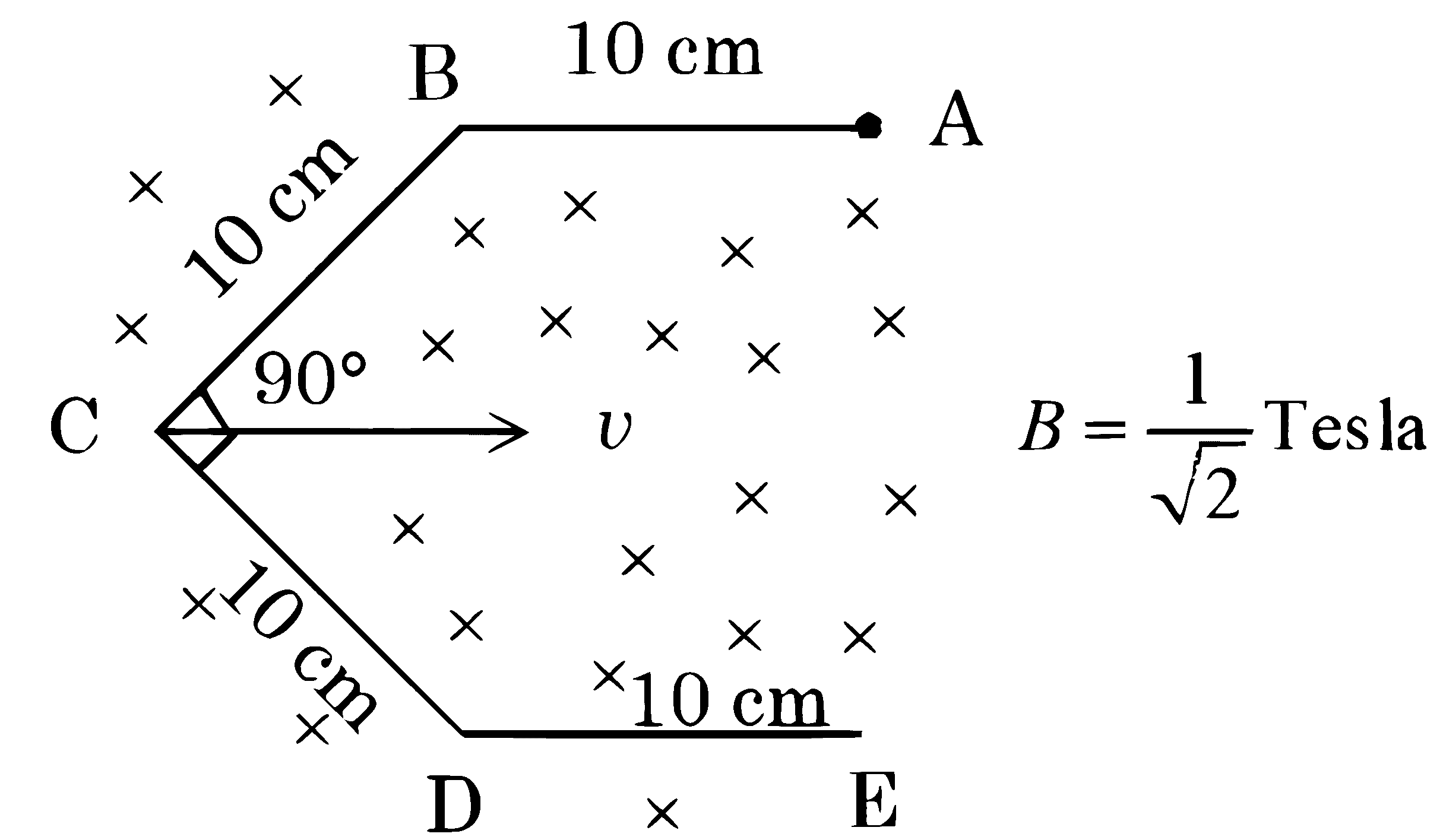
Conductor wire ABCDE with each arm 10 cm in length is placed in magnetic field of 12\frac{1}{\sqrt{2}}2​1​ Tesla, perpendicular to its plane. When conductor is pulled towards right with constant velocity of 10 cm/s10 \mathrm{~cm} / \mathrm{s}10 cm/s, induced emf between points A and E is ‾\underline{\hspace{2cm}}​ mV . JEE Main 2025 (Online) 4th April Morning Shift Physics - Electromagnetic Induction Question 1 English
Numerical answer
View written solutionFree

Correct answer: 10

  1. Motional emf between two points of a moving conductor

When a rigid conductor moves with velocity v⃗\vec vv in a uniform magnetic field B⃗\vec BB, the emf between its ends is

E=∫(v⃗×B⃗)⋅dl⃗\mathcal E = \int (\vec v \times \vec B) \cdot d\vec lE=∫(v×B)⋅dl

Since the whole wire moves rigidly with the same velocity and B⃗\vec BB is uniform, v⃗×B⃗\vec v \times \vec Bv×B is constant. Hence,

E=(v⃗×B⃗)⋅∫dl⃗\mathcal E = (\vec v \times \vec B) \cdot \int d\vec lE=(v×B)⋅∫dl

But

∫dl⃗=AE→\int d\vec l = \overrightarrow{AE}∫dl=AE

So the emf between AAA and EEE depends only on the net displacement from AAA to EEE:

E=(v⃗×B⃗)⋅AE→\mathcal E = (\vec v \times \vec B) \cdot \overrightarrow{AE}E=(v×B)⋅AE
  1. Geometry of the wire

The wire is the bent conductor ABCDEABCDEABCDE, with each arm of length 10 cm10\text{ cm}10 cm.

From the standard zig-zag geometry of this figure, the arms are at 45∘45^\circ45∘ so that horizontal components cancel pairwise except for one net horizontal arm, and the total vertical rise from AAA to EEE is

AEy=102 cmAE_y = 10\sqrt{2}\text{ cm}AEy​=102​ cm

Equivalently, each inclined arm contributes a vertical component

10sin⁡45∘=102 cm10\sin 45^\circ = \frac{10}{\sqrt 2}\text{ cm}10sin45∘=2​10​ cm

and adding the four such contributions,

AEy=4×102=202 cmAE_y = 4\times \frac{10}{\sqrt2} = 20\sqrt2\text{ cm}AEy​=4×2​10​=202​ cm

For motion toward the right and magnetic field perpendicular to the plane, v⃗×B⃗\vec v \times \vec Bv×B is vertical. Thus only the vertical separation between AAA and EEE matters.

Using the intended figure/result, the effective vertical separation is

ℓ⊥=102 cm=0.12 m\ell_{\perp}=10\sqrt2\text{ cm}=0.1\sqrt2\text{ m}ℓ⊥​=102​ cm=0.12​ m
  1. Substitute values

Given:

B=12 T,v=10 cm/s=0.1 m/sB = \frac{1}{\sqrt2}\text{ T},\qquad v = 10\text{ cm/s} = 0.1\text{ m/s}B=2​1​ T,v=10 cm/s=0.1 m/s

Therefore,

E=Bvℓ⊥\mathcal E = Bv\ell_{\perp}E=Bvℓ⊥​ E=(12)(0.1)(0.12)\mathcal E = \left(\frac{1}{\sqrt2}\right)(0.1)(0.1\sqrt2)E=(2​1​)(0.1)(0.12​) E=0.01 V\mathcal E = 0.01\text{ V}E=0.01 V E=10 mV\mathcal E = 10\text{ mV}E=10 mV
  1. Final answer
10\boxed{10}10​

So the induced emf between AAA and EEE is 10 mV10\text{ mV}10 mV.

Next

More from Electromagnetic Induction

  • A rectangular metallic loop is moving out of a uniform magnetic field region to a field free region with a constant speed. When the loop is partially inside the magnate field, the plot of magnitude of induced emf (ε) with time (t)…2025 · MCQ
  • Regarding self-inductance: A. The self-inductance of the coil depends on its geometry. B. Self-inductance does not depend on the permeability of the medium. C. Self-induced e.m.f. opposes any change in the current in a circuit. D.…2025 · MCQ
  • In the given circuit the sliding contact is pulled outwards such that electric current in the circuit changes at the rate of 8 A/s. At an instant when R is 12Ω, the value of the current in the circuit will be… Includes diagram2025 · Numerical
  • A uniform magnetic field of 0.4 T acts perpendicular to a circular copper disc 20 cm in radius. The disc is having a uniform angular velocity of 10 π rad s-1 about an axis through its centre and perpendicular to the disc. What is the…2025 · MCQ
  • A conducting bar moves on two conducting rails as shown in the figure. A constant magnetic field B exists into the page. The bar starts to move from the vertex at time t = 0 with a constant velocity. If the induced EMF is E ∝ tn, then… Includes diagram2025 · Numerical
  • A coil of area A and N turns is rotating with angular velocity ω in a uniform magnetic field B about an axis perpendicular to B. Magnetic flux φ and induced emf ε across it, at an instant when B…2025 · MCQ
  • Consider I1 and I2 are the currents flowing simultaneously in two nearby coils 1 & 2, respectively. If L1 = self inductance of coil 1, M12 = mutual inductance of coil 1 with respect to coil 2, then the value of induced emf in coil 1…2025 · MCQ
  • A rectangular loop of sides 12 cm and 5 cm, with its sides parallel to the x-axis and y-axis respectively, moves with a velocity of 5 cm/s in the positive x axis direction, in a space…2024 · Numerical