- A
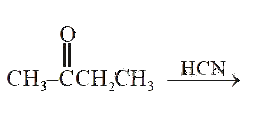
- B
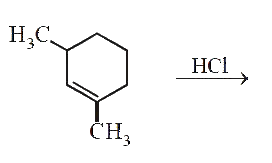
- C
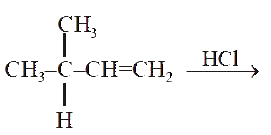
- D
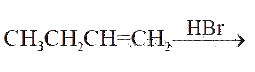
View written solutionFree
Correct answer: C
The question asks:
Which reaction will not produce a racemic product?
However, the actual reaction schemes for Options A, B, C, and D are missing in the prompt. Since racemization depends entirely on the specific substrate, mechanism, and stereochemical outcome of each reaction, it is impossible to determine the correct option from the information provided.
1. Concept involved
A racemic product is formed when equal amounts of two enantiomers are produced.
This commonly happens in reactions such as:
- substitution on a chiral center, because a planar carbocation intermediate is formed and attack can occur from both sides.
- Some additions to planar intermediates where both faces are attacked equally.
A reaction will not give a racemic mixture if:
- it proceeds by at a chiral center, giving inversion rather than racemization,
- the substrate is achiral and gives an achiral product,
- the mechanism is stereospecific or restricted to one face.
2. Why this question cannot be solved as given
The options are shown only as:
- A:
- B:
- C:
- D:
with no reactions attached.
Without the reaction structures, I cannot:
- identify whether the substrate is chiral,
- determine whether the mechanism is , , elimination, rearrangement, etc.,
- analyze whether a racemic mixture would form.
3. Comparison with stored answer
The stored correct answer is C, but since the options themselves are absent, I cannot independently verify whether C is actually correct.
So I must disagree with the stored answer for now, because the problem statement is incomplete.
4. What is needed
Please provide the reaction schemes/structures for options A–D. Then I can determine exactly which one does not give a racemic product.
More from Haloalkanes and Haloarenes
- The major product of the following reaction is: Includes diagram2019 · MCQ
- Which one of the following alkenes when treated with HCl yields majorly an anti Markovnikov product?2019 · MCQ
- The major product in the following reaction is : Includes diagram2019 · MCQ
- The major product of the following reaction is : Includes diagram2019 · MCQ
- The compounds A and B in the following reaction are, respectively : Includes diagram2019 · MCQ
- The major product of the following reaction is : Includes diagram2019 · MCQ
- Increasing rate of SN1 reaction in the following compounds is : Includes diagram2019 · MCQ
- The major product of the following reaction is : Includes diagram2019 · MCQ