Sign in
12thPass logo
New chatPYQ LibraryDoubtsRank report
Sign in to see Recents

Your guest activity stays on this device

Sign in to save progress →
Sign in

Haloalkanes and Haloarenes question

2020 · 3 Sep · Shift 1 · Q12
Guest · filters and generic practice availableBrowsing as a guest · PYQ filters and generic practice are available. Sign in only for personalised features and saved progress.
  1. PYQ Library
  2. /JEE Main
  3. /Chemistry
  4. /Haloalkanes and Haloarenes
  5. /2020 · 3 Sep · Shift 1 · Q12

Haloalkanes and Haloarenes question

2020 · 3 Sep · Shift 1 · Q12

JEE MainChemistryHaloalkanes and HaloarenesMCQ+4 / −1
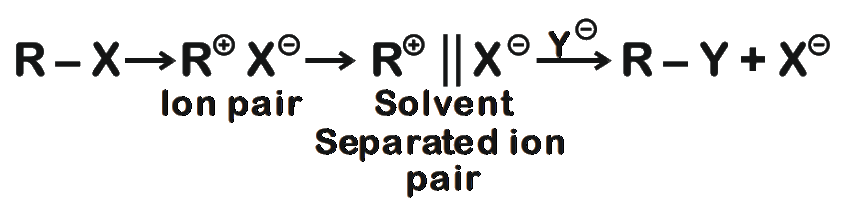
The mechanism of SN1SN_1SN1​ reaction is given as : JEE Main 2020 (Online) 3rd September Morning Slot Chemistry - Haloalkanes and Haloarenes Question 115 English A student writes general characteristics based on the given mechanism as : (a) The reaction is favoured by weak nucleophiles. (b) R+R^+R+ would be easily formed if the substituents are bulky. (c) The reaction is accompanied by racemization. (d) The reaction is favoured by non-polar solvents.
  1. A
    (a) and (b)
  2. B
    (a), (b) and (c)
  3. C
    (a) and (c)
  4. D
    (b) and (d)
View written solutionFree

Correct answer: B

  1. Recall the characteristics of an SN1S_N1SN​1 reaction

    The SN1S_N1SN​1 mechanism occurs in two steps:

    R−LG→R++LG−R-LG \rightarrow R^+ + LG^-R−LG→R++LG− R++Nu→R−NuR^+ + Nu \rightarrow R-NuR++Nu→R−Nu

    The rate-determining step is the formation of the carbocation R+R^+R+. Therefore, factors that stabilize the carbocation or help ionization favor the reaction.

  2. Check statement (a): The reaction is favoured by weak nucleophiles.

    In an SN1S_N1SN​1 reaction, the nucleophile attacks after the slow step. Since the rate depends mainly on carbocation formation, even weak nucleophiles can participate.

    So, (a) is correct.

  3. Check statement (b): R+R^+R+ would be easily formed if the substituents are bulky.

    Bulky substituents usually mean more alkyl groups around the carbon, which can stabilize the carbocation by +I+I+I effect and hyperconjugation.

    Thus, tertiary carbocations form more easily than secondary, and secondary more easily than primary:

    3∘>2∘>1∘3^\circ > 2^\circ > 1^\circ3∘>2∘>1∘

    So, (b) is correct.

  4. Check statement (c): The reaction is accompanied by racemization.

    In SN1S_N1SN​1, a planar carbocation intermediate is formed. Since it is planar, the nucleophile can attack from either side, producing both retention and inversion.

    Hence, the product is racemized (often partial racemization in practice).

    So, (c) is correct.

  5. Check statement (d): The reaction is favoured by non-polar solvents.

    SN1S_N1SN​1 reactions are favored by polar protic solvents because they stabilize both the carbocation and the leaving group.

    Non-polar solvents do not favor ionization.

    So, (d) is incorrect.

  6. Identify the correct option

    Correct statements are:

    (a),(b),(c)(a), (b), (c)(a),(b),(c)

    Therefore, the correct option is B.

PreviousNext

More from Haloalkanes and Haloarenes

  • The major product in the following reaction is : Includes diagram2020 · MCQ
  • The decreasing order of reactivity of the following compounds towards nucleophilic substitution (SN2) is : Includes diagram2020 · MCQ
  • The decreasing order of reactivity of the following organic molecules towards AgNO3​ solution is : Includes diagram2020 · MCQ
  • Which of the following compounds will form the precipitate with aq. AgNO3​ solution most readily?2020 · MCQ
  • Among the following compounds, which one has the shortest C – Cl bond?2020 · MCQ
  • The major product formed in the following reaction is : CH3​CH=CHCH(CH3​)2​ HBr​2020 · MCQ
  • The increasing order of the boiling points of the major products A, B and C of the following reactions will be : Includes diagram2020 · MCQ
  • 1- methyl ethylene oxide when treated with an excess of HBr produces :2020 · MCQ