JEE MainChemistryHaloalkanes and HaloarenesMCQ+4 / −1
Consider the reaction sequence given below: 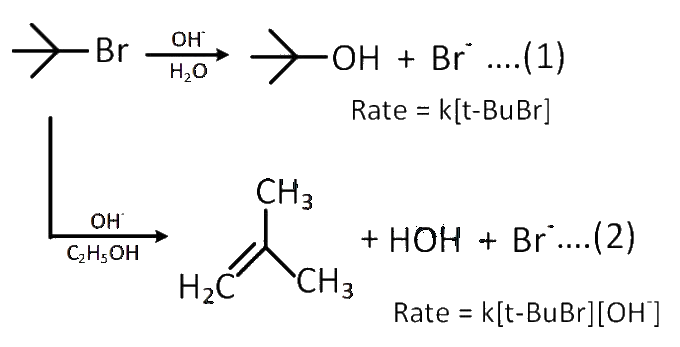 Which of the following statements is true?
Which of the following statements is true?- AChanging the concentration of base will have no effect on reaction (1)
- BChanging the concentration of base will have no effect on reaction (2)
- CChanging the base from to -OR will have no effect on reaction (2)
- DDoubling the concentration of base will double the rate of both the reactions
More from Haloalkanes and Haloarenes
- The mechanism of reaction is given as : A student writes general characteristics based on the given mechanism as : (a) The reaction is favoured by weak nucleophiles. (b) would be easily formed if the substituents are bulky.… Includes diagram2020 · MCQ
- The major product in the following reaction is : Includes diagram2020 · MCQ
- The decreasing order of reactivity of the following compounds towards nucleophilic substitution (SN2) is : Includes diagram2020 · MCQ
- The decreasing order of reactivity of the following organic molecules towards solution is : Includes diagram2020 · MCQ
- Which of the following compounds will form the precipitate with aq. solution most readily?2020 · MCQ
- Among the following compounds, which one has the shortest C – Cl bond?2020 · MCQ
- The major product formed in the following reaction is : 2020 · MCQ
- The increasing order of the boiling points of the major products A, B and C of the following reactions will be : Includes diagram2020 · MCQ