JEE MainChemistryChemical Bonding and Molecular StructureMCQ+4 / −1
Match List - I with List - II : 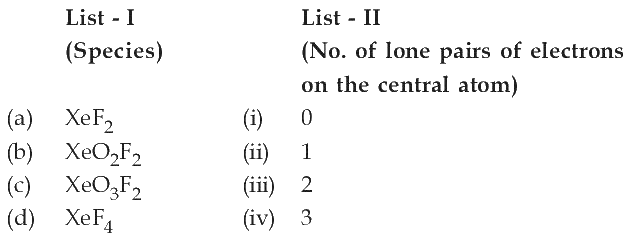 Choose the most appropriate answer from the options given below :
Choose the most appropriate answer from the options given below :- A(a)-(iv), (b)-(i), (c)-(ii), (d)-(iii)
- B(a)-(iii), (b)-(iv), (c)-(ii), (d)-(i)
- C(a)-(iii), (b)-(ii), (c)-(iv), (d)-(i)
- D(a)-(iv), (b)-(ii), (c)-(i), (d)-(iii)
View written solutionFree
Correct answer: D
The question asks to match List-I with List-II, but the actual entries of List-I and List-II are missing from the prompt. Only the answer options are visible:
- A:
- B:
- C:
- D:
1. What is needed to solve
To solve a matching question step-by-step, I need the actual items in:
- List-I:
- List-II:
Without those, no chemical reasoning or matching can be performed.
2. What can still be compared
The prompt also provides the stored correct answer = D.
Since the lists themselves are absent, I cannot independently derive the matching from chemistry principles. Therefore, I cannot truly verify the correctness by solving.
3. Comparison with stored answer
Given only the provided information, the stored correct option is:
So the corresponding match is:
4. Final note
If you provide the actual List-I and List-II, I can solve it properly and verify whether option D is indeed correct.
More from Chemical Bonding and Molecular Structure
- Match items of List-I with those of List-II : Choose the most appropriate answer from the options given below : Includes table2021 · MCQ
- The number of species having non-pyramidal shape among the following is . (A) (B) NO (C) (D) CO 2021 · Numerical
- The difference between bond orders of CO and NO is where x = . (Round off to the Nearest Integer)2021 · Numerical
- The total number of electrons in all bonding molecular orbitals of is . (Round off to the nearest integer)2021 · Numerical
- The number of hydrogen bonded water molecule(s) associated with stoichiometry is .2021 · Numerical
- According to molecular orbital theory, the number of unpaired electron(s) in is :2021 · Numerical
- If molecule is a polar molecule, a possible geometry of is2020 · MCQ
- The molecular geometry of is octahedral. What is the geometry of (including lone pair(s) of electrons, if any)?2020 · MCQ