Sign in
12thPass logo
New chatPYQ LibraryDoubtsRank report
Sign in to see Recents

Your guest activity stays on this device

Sign in to save progress →
Sign in

Chemical Bonding and Molecular Structure question

2018 · 15 Apr · Shift 1 · Q9
Guest · filters and generic practice availableBrowsing as a guest · PYQ filters and generic practice are available. Sign in only for personalised features and saved progress.
  1. PYQ Library
  2. /JEE Main
  3. /Chemistry
  4. /Chemical Bonding and Molecular Structure
  5. /2018 · 15 Apr · Shift 1 · Q9

Chemical Bonding and Molecular Structure question

2018 · 15 Apr · Shift 1 · Q9

JEE MainChemistryChemical Bonding and Molecular StructureMCQ+4 / −1
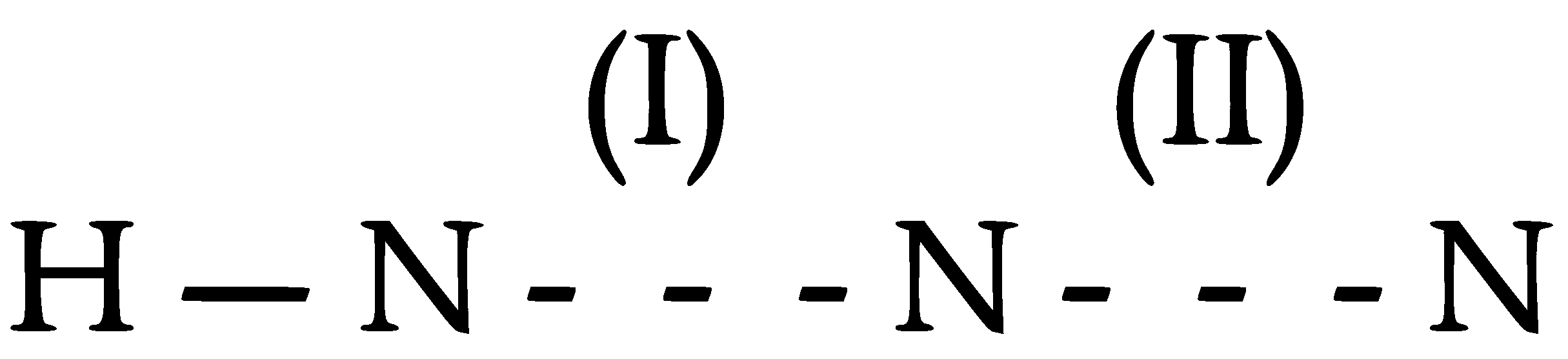
JEE Main 2018 (Online) 15th April Morning Slot Chemistry - Chemical Bonding & Molecular Structure Question 202 English In hydrogen azide (above) the bond orders of bond (I) and (II) are :
  1. A
    (I)                               (II)2\begin{aligned} & (\mathrm{I})\,\,\,\,\,\,\,\,\,\,\,\,\,\,\,\,\,\,\,\,\,\,\,\,\,\,\,\,\,\,\,(\mathrm{II}) \\ & 2 \\\end{aligned}​(I)(II)2​
  2. B
    (I)                               (II)>2                            <2\begin{aligned} & (\mathrm{I})\,\,\,\,\,\,\,\,\,\,\,\,\,\,\,\,\,\,\,\,\,\,\,\,\,\,\,\,\,\,\,(\mathrm{II}) \\ & \gt 2\,\,\,\,\,\,\,\,\,\,\,\,\,\,\,\,\,\,\,\,\,\,\,\,\,\,\,\, \lt 2 \\\end{aligned}​(I)(II)>2<2​
  3. C
    (I)                               (II)>2                            >2\begin{aligned} & (\mathrm{I})\,\,\,\,\,\,\,\,\,\,\,\,\,\,\,\,\,\,\,\,\,\,\,\,\,\,\,\,\,\,\,(\mathrm{II}) \\ & \gt 2\,\,\,\,\,\,\,\,\,\,\,\,\,\,\,\,\,\,\,\,\,\,\,\,\,\,\,\, \gt 2 \\\end{aligned}​(I)(II)>2>2​
  4. D
    (I)                               (II)<2                            <2\begin{aligned} & (\mathrm{I})\,\,\,\,\,\,\,\,\,\,\,\,\,\,\,\,\,\,\,\,\,\,\,\,\,\,\,\,\,\,\,(\mathrm{II}) \\ & \lt 2\,\,\,\,\,\,\,\,\,\,\,\,\,\,\,\,\,\,\,\,\,\,\,\,\,\,\,\, \lt 2 \\\end{aligned}​(I)(II)<2<2​
View written solutionFree

Correct answer: A

  1. Structure of hydrogen azide

Hydrogen azide is HN3\mathrm{HN_3}HN3​ with skeleton H−N(I)−N(II)−N\mathrm{H-N^{(I)}-N^{(II)}-N}H−N(I)−N(II)−N where bonds (I)(I)(I) and (II)(II)(II) are the two N−N\mathrm{N-N}N−N bonds shown in the chain.

  1. Important resonance forms

The azide group is resonance-stabilized. The main canonical forms are of the type: H−N=N+=N−\mathrm{H-N=N^+=N^-}H−N=N+=N− H−N−−N+≡N\mathrm{H-N^- -N^+\equiv N}H−N−−N+≡N H−N≡N+−N−\mathrm{H-N\equiv N^+ -N^-}H−N≡N+−N−

For hydrogen azide, the significant resonance leads to delocalization over the three nitrogen atoms, and the two N−N\mathrm{N-N}N−N bonds become equivalent on resonance averaging.

  1. Bond order calculation

Across the resonance forms, one can see that each N−N\mathrm{N-N}N−N bond has partial double-bond character, but because of delocalization the average bond order of each comes out to be: Bond order of (I)=Bond order of (II)=2\text{Bond order of }(I)=\text{Bond order of }(II)=2Bond order of (I)=Bond order of (II)=2

Thus both bonds are effectively equal and have bond order 222.

  1. Checking options
  • A: (I)=2, (II)=2(I)=2,\ (II)=2(I)=2, (II)=2 ✅
  • B: (I)>2, (II)<2(I)>2,\ (II)<2(I)>2, (II)<2 ❌
  • C: (I)>2, (II)>2(I)>2,\ (II)>2(I)>2, (II)>2 ❌
  • D: (I)<2, (II)<2(I)<2,\ (II)<2(I)<2, (II)<2 ❌

Therefore, the correct option is A.

PreviousNext

More from Chemical Bonding and Molecular Structure

  • Which of the following best describes the diagram below of a molecular orbital ? Includes diagram2018 · MCQ
  • The incorrect geometry is represented by :2018 · MCQ
  • Which of the following conversions involves change in both shape and hybridisation ?2018 · MCQ
  • Which of the following compounds contain(s) no covalent bond(s)? KCl, PH3​, O2​, B2​H6​, H2​SO4​2018 · MCQ
  • Total number of lone pair of electrons in I3−​ ion is2018 · MCQ
  • According to molecular orbital theory, which of the following will not be a viable molecule?2018 · MCQ
  • sp3d2 hybridization is not displayed by :2017 · MCQ
  • Which of the following is paramagnetic ?2017 · MCQ