Sign in
12thPass logo
New chatPYQ LibraryDoubtsRank report
Sign in to see Recents

Your guest activity stays on this device

Sign in to save progress →
Sign in

Current Electricity question

2024 · 8 Apr · Shift 1 · Q79
Guest · filters and generic practice availableBrowsing as a guest · PYQ filters and generic practice are available. Sign in only for personalised features and saved progress.
  1. PYQ Library
  2. /JEE Main
  3. /Physics
  4. /Current Electricity
  5. /2024 · 8 Apr · Shift 1 · Q79

Current Electricity question

2024 · 8 Apr · Shift 1 · Q79

JEE MainPhysicsCurrent ElectricityMCQ+4 / −1
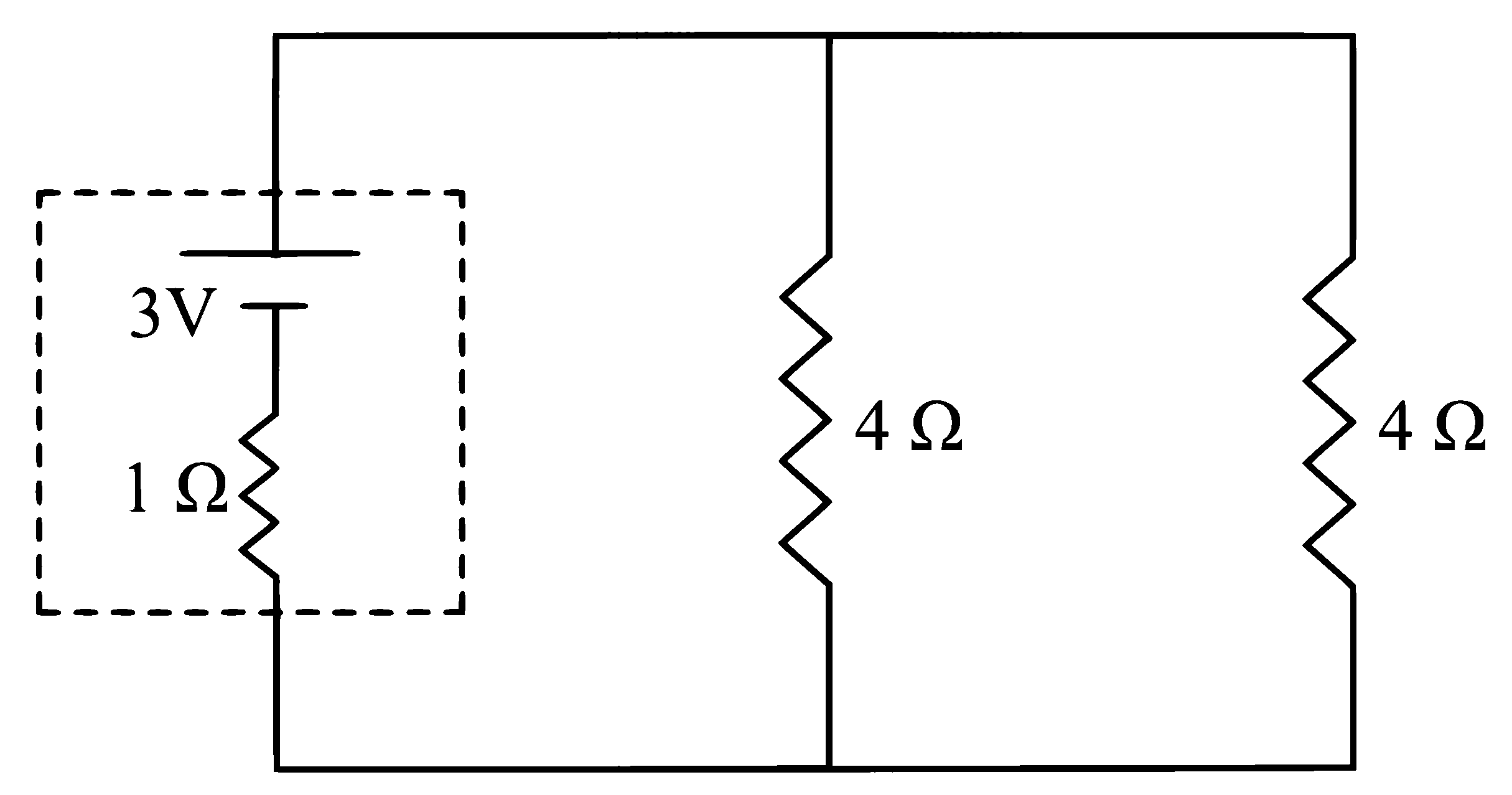
In the given circuit, the terminal potential difference of the cell is : JEE Main 2024 (Online) 8th April Morning Shift Physics - Current Electricity Question 31 English
  1. A
    3 V
  2. B
    4 V
  3. C
    2 V
  4. D
    1.5 V
View written solutionFree

Correct answer: C

  1. Key idea

    The terminal potential difference of a cell is V=E−IrV = E - IrV=E−Ir when the cell is supplying current, where:

    • EEE = emf of the cell
    • rrr = internal resistance
    • III = current in the circuit
  2. From the circuit

    For the given cell:

    • emf E=3 VE = 3\,\text{V}E=3V
    • internal resistance r=1 Ωr = 1\,\Omegar=1Ω
    • external resistance R=2 ΩR = 2\,\OmegaR=2Ω

    So total resistance in the circuit is Rtotal=R+r=2+1=3 ΩR_{\text{total}} = R + r = 2 + 1 = 3\,\OmegaRtotal​=R+r=2+1=3Ω

  3. Find the current

    Using Ohm’s law for the whole circuit: I=ER+r=33=1 AI = \frac{E}{R+r} = \frac{3}{3} = 1\,\text{A}I=R+rE​=33​=1A

  4. Find terminal potential difference

    V=E−Ir=3−(1)(1)=2 VV = E - Ir = 3 - (1)(1) = 2\,\text{V}V=E−Ir=3−(1)(1)=2V

    Alternatively, terminal voltage across the external resistor is V=IR=(1)(2)=2 VV = IR = (1)(2) = 2\,\text{V}V=IR=(1)(2)=2V

  5. Match with options

    2 V2\,\text{V}2V corresponds to Option C.

  6. Comparison with stored answer

    Stored correct answer: C
    Derived answer: C
    Hence, they agree.

PreviousNext

More from Current Electricity

  • Resistance of a wire at 0∘C,100∘C and t∘C is found to be 10Ω,10.2Ω and 10.95Ω respectively. The temperature t in Kelvin scale is ​.2024 · Numerical
  • Water boils in an electric kettle in 20 minutes after being switched on. Using the same main supply, the length of the heating element should be ​ to ​ times of its initial length if the…2024 · MCQ
  • A heater is designed to operate with a power of 1000 W in a 100 V line. It is connected in combination with a resistance of 10Ω and a resistance R, to a 100 V mains as shown in figure. For the… Includes diagram2024 · Numerical
  • A galvanometer has a coil of resistance 200Ω with a full scale deflection at 20μA. The value of resistance to be added to use it as an ammeter of range (0−20)mA is :2024 · MCQ
  • The equivalent resistance between A and B is : Includes diagram2024 · MCQ
  • The current flowing through the 1Ω resistor is 10n​ A. The value of n is ​. Includes diagram2024 · Numerical
  • The effective resistance between A and B, if resistance of each resistor is R, will be : Includes diagram2024 · MCQ
  • To determine the resistance (R) of a wire, a circuit is designed below. The V-I characteristic curve for this circuit is plotted for the voltmeter and the ammeter readings as shown in figure. The value of R is ​… Includes diagram2024 · Numerical