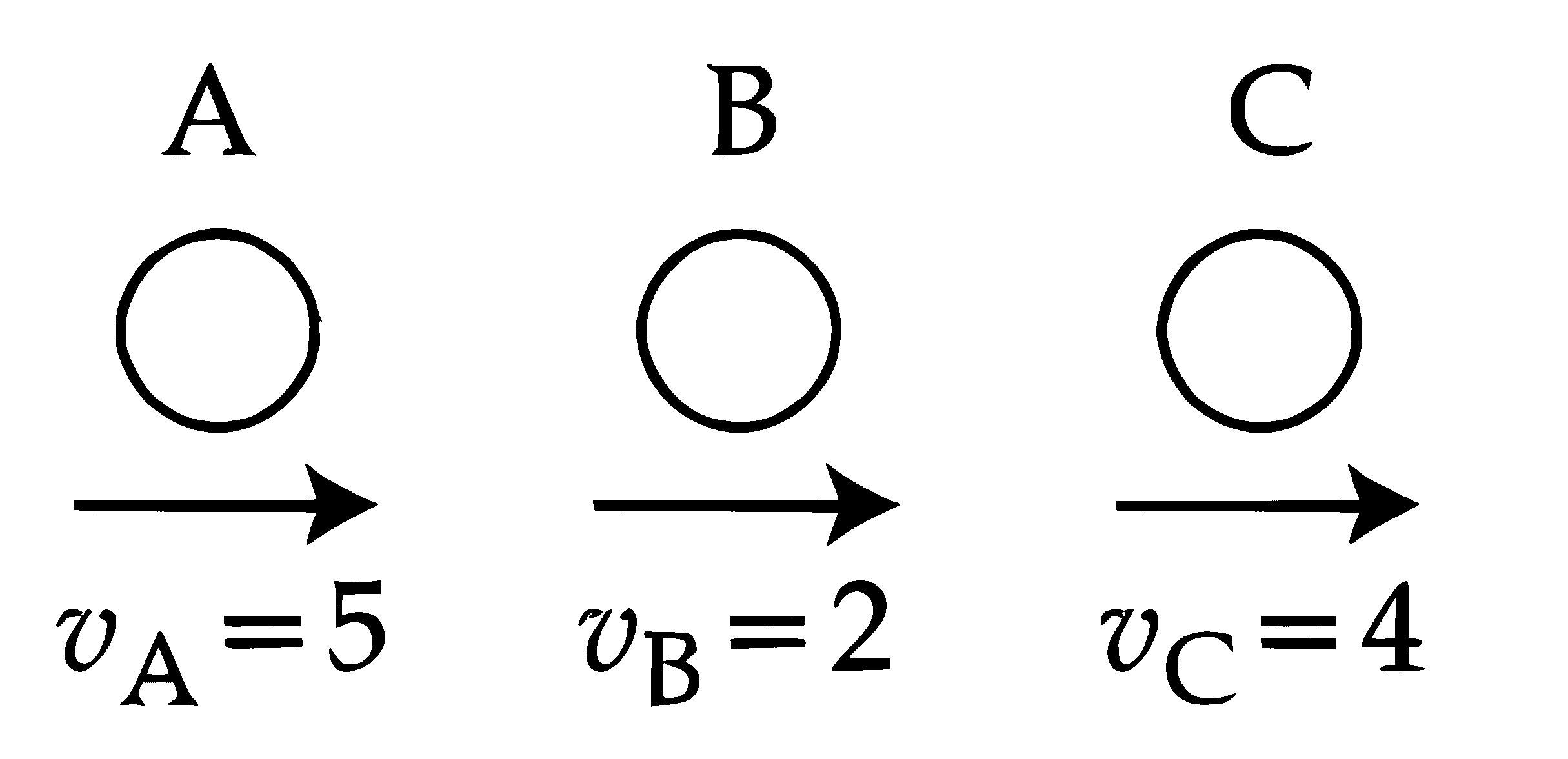
 Three identical spheres of same mass undergo one dimensional motion as shown in figure with initial velocities . If we wait sufficiently long for elastic collision to happen, then , will be the final velocities. Reason (R): In an elastic collision between identical masses, two objects exchange their velocities. In the light of the above statements, choose the correct answer from the options given below:
- ABoth (A) and (R) are true but (R) is NOT the correct explanation of (A)
- BBoth (A) and (R) are true and (R) is the correct explanation of (A)
- C(A) is false but (R) is true
- D(A) is true but (R) is false
View written solutionFree
Correct answer: C
- Given data and geometry of motion
Three identical spheres move in one dimension with initial velocities:
From the usual figure for such questions, sphere is behind , and is behind , all moving along the same line to the right.
So initially:
- is fastest,
- is next,
- is slowest.
Hence collisions will occur because faster spheres from behind catch slower ones ahead.
- Key fact for 1D elastic collision of identical masses
For a head-on elastic collision between two identical masses, the two bodies exchange velocities.
So the Reason (R) is:
In an elastic collision between identical masses, two objects exchange their velocities.
This statement is true.
- Track the sequence of collisions
Since has speed m/s and has speed m/s, catches first.
First collision: with
Before collision:
After elastic collision of identical masses, they exchange velocities:
Now check further collisions:
- m/s, so it cannot catch anyone.
- m/s is behind m/s, so catches .
Second collision: with
Before collision:
After exchange of velocities:
Thus final velocities become:
- Check the Assertion (A)
Assertion says final velocities will be:
But from correct collision analysis, final velocities are:
So Assertion (A) is false.
- Check the Reason (R)
The reason states that in an elastic collision between identical masses, velocities are exchanged.
This is a standard correct result for 1D elastic collisions of equal masses.
So Reason (R) is true.
- Final conclusion
- Assertion (A): False
- Reason (R): True
Therefore the correct option is:
(A) is false but (R) is true
- Comparison with stored correct answer
Stored correct answer: C
My derived answer: C
They agree.
More from Center of Mass
- Three identical spheres each of mass are placed at the corners of a right angled triangle with mutually perpendicular sides equal to each. Taking point of intersection of these two sides as origin, the…2024 · Numerical
- In a system two particles of masses and are placed at certain distance from each other. The particle of mass is moved towards the center of mass of the system through a distance …2024 · Numerical
- A stationary particle breaks into two parts of masses and which move with velocities and respectively. The ratio of their kinetic energies is :2024 · MCQ
- A uniform thin metal plate of mass with dimensions is shown. The ratio of and y coordinates of center of mass of plate in . The value of is . Includes diagram2024 · Numerical
- Two bodies of mass and are moving with equal kinetic energies. The ratio of magnitude of their linear momentum is :2024 · MCQ
- A body of mass is moving horizontally with a velocity . If extra mass is added, the final velocity (in ) is:2024 · MCQ
- A spherical body of mass is dropped from a height of from the ground. After hitting the ground, the body rebounds to a height of . The impulse of force imparted by the ground to the body is…2024 · MCQ
- An artillery piece of mass fires a shell of mass horizontally. Instantaneously after the firing, the ratio of kinetic energy of the artillery and that of the shell is:2024 · MCQ