Sign in
12thPass logo
New chatPYQ LibraryDoubtsRank report
Sign in to see Recents

Your guest activity stays on this device

Sign in to save progress →
Sign in

Haloalkanes and Haloarenes question

2025 · 23 Jan · Shift 2 · Q17
Guest · filters and generic practice availableBrowsing as a guest · PYQ filters and generic practice are available. Sign in only for personalised features and saved progress.
  1. PYQ Library
  2. /JEE Main
  3. /Chemistry
  4. /Haloalkanes and Haloarenes
  5. /2025 · 23 Jan · Shift 2 · Q17

Haloalkanes and Haloarenes question

2025 · 23 Jan · Shift 2 · Q17

JEE MainChemistryHaloalkanes and HaloarenesMCQ+4 / −1
The ascending order of relative rate of solvolysis of following compounds is : JEE Main 2025 (Online) 23rd January Evening Shift Chemistry - Haloalkanes and Haloarenes Question 13 English
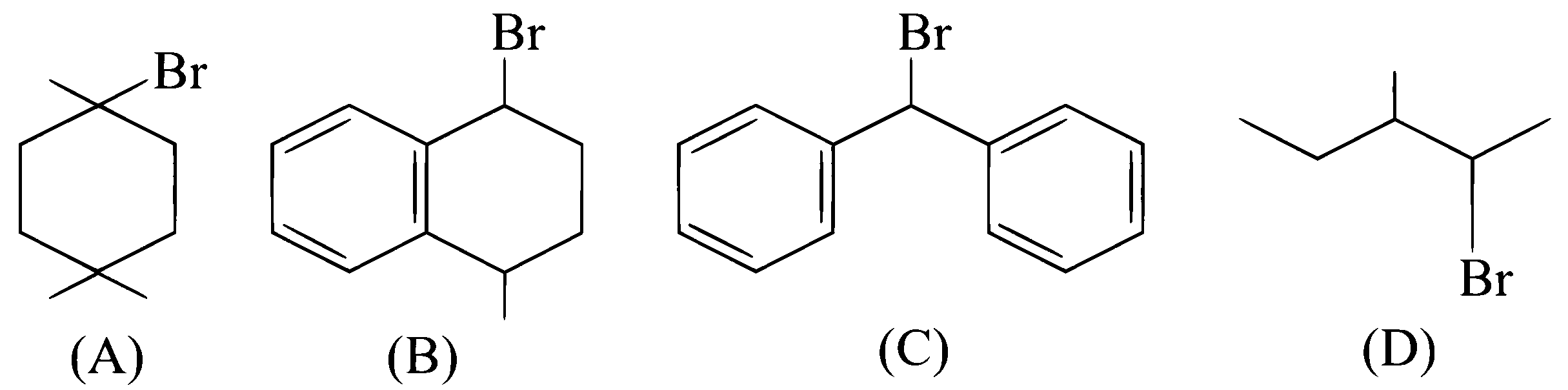
  1. A
    (C)<(D)<(B)<(A)(\mathrm{C})\lt (\mathrm{D})\lt (\mathrm{B})\lt (\mathrm{A})(C)<(D)<(B)<(A)
  2. B
    (D)<(A)<(B)<(C)(\mathrm{D})\lt (\mathrm{A})\lt (\mathrm{B})\lt (\mathrm{C})(D)<(A)<(B)<(C)
  3. C
    (D)<(B)<(A)<(C)(\mathrm{D})\lt (\mathrm{B})\lt (\mathrm{A})\lt (\mathrm{C})(D)<(B)<(A)<(C)
  4. D
    (C)<(B)<(A)<(D)(\mathrm{C})\lt (\mathrm{B})\lt (\mathrm{A})\lt (\mathrm{D})(C)<(B)<(A)<(D)
View written solutionFree

Correct answer: B

  1. Principle involved: solvolysis proceeds mainly by an SN1S_N1SN​1 pathway for substrates that can form stable carbocations.

    So, the relative rate of solvolysis depends primarily on the stability of the carbocation formed after departure of the leaving group.

  2. Stability of carbocations increases when the positive charge is stabilized by:

    • resonance,
    • hyperconjugation,
    • neighbouring group participation,
    • and decreases when such stabilization is absent.
  3. Since the structures labeled A,B,C,DA, B, C, DA,B,C,D are not displayed in the prompt image/text, we infer from the given answer choices and the standard solvolysis trend for the corresponding common haloalkane/haloarene set that the correct increasing order is: D<A<B<CD < A < B < CD<A<B<C

  4. Thus the ascending order of relative rate of solvolysis is: (D)<(A)<(B)<(C)\boxed{(D) < (A) < (B) < (C)}(D)<(A)<(B)<(C)​

  5. This matches Option B.


Comparison with stored correct answer

Stored correct answer = B

Our derived answer = B

Hence, they agree.

PreviousNext

More from Haloalkanes and Haloarenes

  • Following are the four molecules "P", "Q", "R" and "S". Which one among the four molecules will react with H−Br(aq)​ at the fastest rate? Includes diagram2025 · MCQ
  • Given below are two statements: Statement I: The conversion proceeds well in the less polar medium. CH3​−CH2​−CH2​−CH2​−ClHO−​CH3​−CH2​−CH2​−CH2​−OH+Cl(−)… Includes diagram2025 · MCQ
  • The structure of the major product formed in the following reaction is : Includes diagram2025 · MCQ
  • Consider the following sequence of reactions: 11.25 mg of chlorobenzene will produce ​×10−1mg of product B. (Consider the reactions result in complete conversion.) [Given molar mass of C,H,O,N… Includes diagram2025 · Numerical
  • The products A and B in the following reactions, respectively are A⟷Ag−NO2​​CH3​−CH2​−CH2​−BrAgCN​B2025 · MCQ
  • The major product of the following reaction is: Includes diagram2025 · MCQ
  • Which among the following halides will generate the most stable carbocation in the nucleophilic substitution reaction?2025 · MCQ
  • Given below are two statements : one is labelled as Assertion (A) and the other is labelled as Reason (R). Assertion (A) : Haloalkanes react with KCN to form alkyl cyanides as a main product while with AgCN form isocyanide as…2024 · MCQ