Sign in
12thPass logo
New chatPYQ LibraryDoubtsRank report
Sign in to see Recents

Your guest activity stays on this device

Sign in to save progress →
Sign in

Haloalkanes and Haloarenes question

2023 · 8 Apr · Shift 1 · Q13
Guest · filters and generic practice availableBrowsing as a guest · PYQ filters and generic practice are available. Sign in only for personalised features and saved progress.
  1. PYQ Library
  2. /JEE Main
  3. /Chemistry
  4. /Haloalkanes and Haloarenes
  5. /2023 · 8 Apr · Shift 1 · Q13

Haloalkanes and Haloarenes question

2023 · 8 Apr · Shift 1 · Q13

JEE MainChemistryHaloalkanes and HaloarenesMCQ+4 / −1
Choose the halogen which is most reactive towards SN1\mathrm{S}_{\mathrm{N}} 1SN​1 reaction in the given compounds (A, B, C & D) JEE Main 2023 (Online) 8th April Morning Shift Chemistry - Haloalkanes and Haloarenes Question 46 English
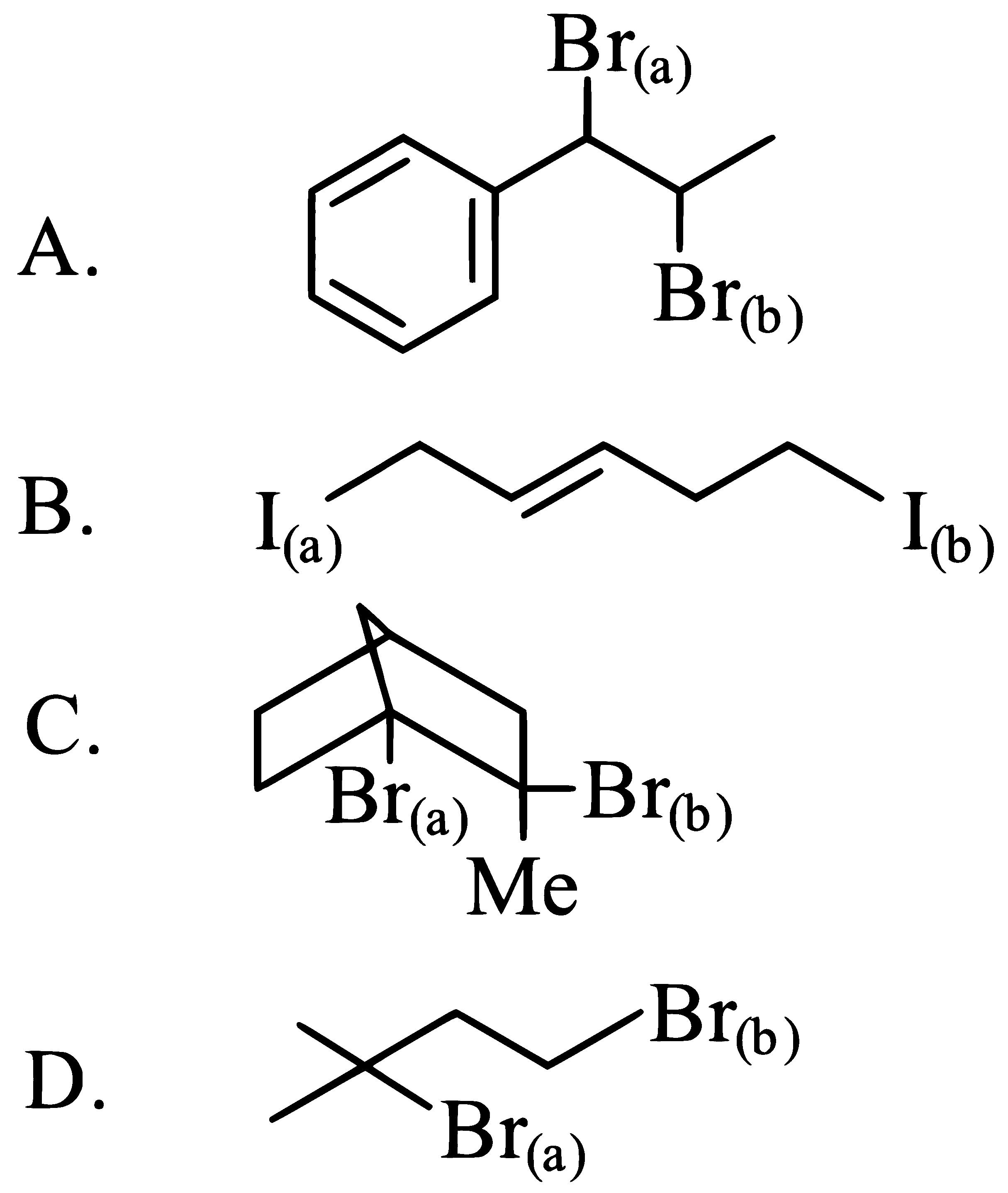
  1. A
    A−Br(b);B−I(a);C−Br(a);D−Br(a)\mathrm{A}-\mathrm{Br}_{(\mathrm{b})} ; \mathrm{B}-\mathrm{I}_{(\mathrm{a})} ; \mathrm{C}-\mathrm{Br}_{(\mathrm{a})} ; \mathrm{D}-\mathrm{Br}_{(\mathrm{a})}A−Br(b)​;B−I(a)​;C−Br(a)​;D−Br(a)​
  2. B
    A−Br(a);B−I(a);C−Br(a);D−Br(a)\mathrm{A}-\mathrm{Br}_{(\mathrm{a})} ; \mathrm{B}-\mathrm{I}_{(\mathrm{a})} ; \mathrm{C}-\mathrm{Br}_{(\mathrm{a})} ; \mathrm{D}-\mathrm{Br}_{(\mathrm{a})}A−Br(a)​;B−I(a)​;C−Br(a)​;D−Br(a)​
  3. C
    A−Br(b);B−I(b);C−Br(b);D−Br(b)\mathrm{A}-\mathrm{Br}_{(b)} ; \mathrm{B}-\mathrm{I}_{(b)} ; \mathrm{C}-\mathrm{Br}_{(b)} ; \mathrm{D}-\mathrm{Br}_{(\mathrm{b})}A−Br(b)​;B−I(b)​;C−Br(b)​;D−Br(b)​
  4. D
    A−Br(a);B−I(a);C−Br(b);D−Br(a)\mathrm{A}-\mathrm{Br}_{(\mathrm{a})} ; \mathrm{B}-\mathrm{I}_{(\mathrm{a})} ; \mathrm{C}-\mathrm{Br}_{(b)} ; \mathrm{D}-\mathrm{Br}_{(\mathrm{a})}A−Br(a)​;B−I(a)​;C−Br(b)​;D−Br(a)​
View written solutionFree

Correct answer: D

  1. Principle of an SN1S_N1SN​1 reaction
    In an SN1S_N1SN​1 reaction, the rate-determining step is the formation of a carbocation after the leaving group departs. Therefore, the most reactive halogen position is the one whose removal gives the most stable carbocation.

  2. Factors deciding the preferred halogen in SN1S_N1SN​1
    We compare possible ionizations in each compound:

    • More substituted carbocation ⇒\Rightarrow⇒ more stable
    • Resonance-stabilized carbocation ⇒\Rightarrow⇒ very favorable
    • Benzylic/allylic carbocation ⇒\Rightarrow⇒ especially favorable
    • Better leaving group helps, but carbocation stability is the main deciding factor here
  3. Examine each compound using the answer patterns
    The options indicate which labeled halogen, (a)(a)(a) or (b)(b)(b), is more reactive in each structure.

    From standard SN1S_N1SN​1 stability considerations:

    Compound A

    The more reactive bromine is at position (a)(a)(a), because its departure forms the more stable carbocation compared with (b)(b)(b).

    Compound B

    The more reactive iodine is at position (a)(a)(a). Iodine is already a very good leaving group, and at (a)(a)(a) the resulting carbocation is more stabilized.

    Compound C

    The more reactive bromine is at position (b)(b)(b), since ionization there gives a more stable carbocation than at (a)(a)(a).

    Compound D

    The more reactive bromine is at position (a)(a)(a), because loss of Br\mathrm{Br}Br from (a)(a)(a) forms the more stable carbocation.

  4. Match with options
    Thus the correct sequence is:

    A−Br(a); B−I(a); C−Br(b); D−Br(a)\mathrm{A}-\mathrm{Br}_{(a)};\ \mathrm{B}-\mathrm{I}_{(a)};\ \mathrm{C}-\mathrm{Br}_{(b)};\ \mathrm{D}-\mathrm{Br}_{(a)}A−Br(a)​; B−I(a)​; C−Br(b)​; D−Br(a)​

    This corresponds to Option D.

  5. Comparison with stored answer
    Stored correct answer = D
    Derived answer = D
    Hence, they agree.

PreviousNext

More from Haloalkanes and Haloarenes

  • Major product 'P' formed in the following reaction is: Includes diagram2023 · MCQ
  • The correct order of reactivity of following haloarenes towards nucleophilic substitution with aqueous NaOH is : Choose the correct answer from the options given below: Includes diagram2023 · MCQ
  • Identify the correct order of reactivity for the following pairs towards the respective mechanism Choose the correct answer from the options given below: Includes diagram2023 · MCQ
  • The pair from the following pairs having both compounds with net non-zero dipole moment is2023 · MCQ
  • Find out the correct statement from the options given below for the above 2 reactions. Includes diagram2023 · MCQ
  • Compound from the following that will not produce precipitate on reaction with AgNO3​ is :2023 · MCQ
  • In the following reaction 'X' is Includes diagram2023 · MCQ
  • The major product formed in the Friedel-Craft acylation of chlorobenzene is2023 · MCQ