Sign in
12thPass logo
New chatPYQ LibraryDoubtsRank report
Sign in to see Recents

Your guest activity stays on this device

Sign in to save progress →
Sign in

Haloalkanes and Haloarenes question

2023 · 6 Apr · Shift 1 · Q3
Guest · filters and generic practice availableBrowsing as a guest · PYQ filters and generic practice are available. Sign in only for personalised features and saved progress.
  1. PYQ Library
  2. /JEE Main
  3. /Chemistry
  4. /Haloalkanes and Haloarenes
  5. /2023 · 6 Apr · Shift 1 · Q3

Haloalkanes and Haloarenes question

2023 · 6 Apr · Shift 1 · Q3

JEE MainChemistryHaloalkanes and HaloarenesMCQ+4 / −1
For the reaction JEE Main 2023 (Online) 6th April Morning Shift Chemistry - Haloalkanes and Haloarenes Question 45 English The correct statement is
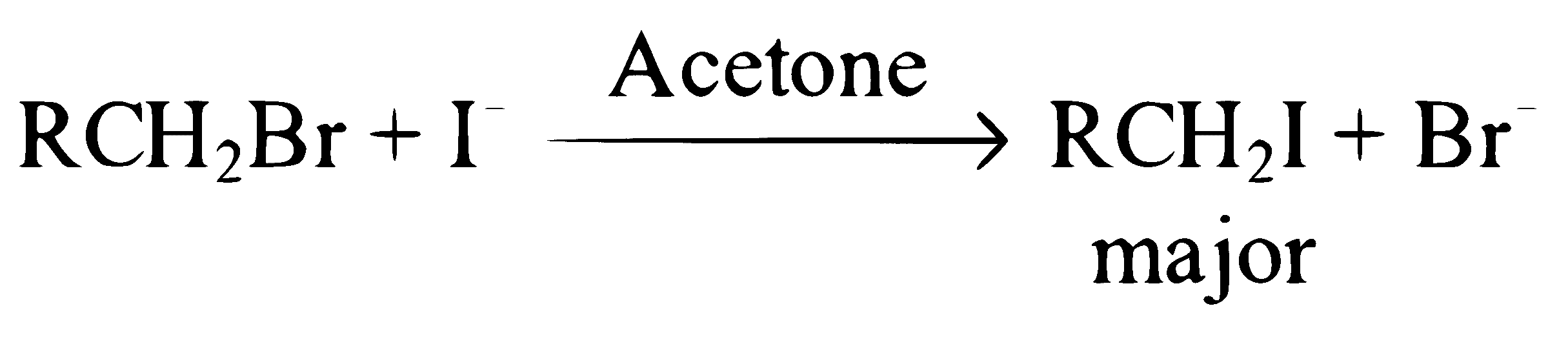
  1. A
    The solvent used in the reaction solvates the ions formed in rate determining step.
  2. B
    Br −^-− can act as competing nucleophile.
  3. C
    The reaction can occur in acetic acid also.
  4. D
    The transition state formed in the above reaction is less polar than the localised anion.
View written solutionFree

Correct answer: D

  1. Identify the reaction type

    The statement refers to a substitution reaction in which ion formation occurs in the rate-determining step, so this is characteristic of an SN1S_N1SN​1 reaction.

    In an SN1S_N1SN​1 reaction:

    • First step: leaving group departs, forming a carbocation and halide ion.
    • This ionization step is the slow, rate-determining step.
  2. Key feature of solvent effect in SN1S_N1SN​1

    Polar protic solvents strongly stabilize the ions produced in the ionization step. Thus, the solvent helps by solvating the carbocation and the halide ion formed during the rate-determining step.

  3. Examine each option

    Option A:

    "The solvent used in the reaction solvates the ions formed in rate determining step."

    This is true for an SN1S_N1SN​1 reaction. Polar protic solvents stabilize the developing ions and facilitate ionization.

    So, A is correct.

    Option B:

    "Br−\text{Br}^-Br− can act as competing nucleophile."

    Since Br−\text{Br}^-Br− is produced after leaving-group departure, it may recombine with the carbocation or compete with solvent as a nucleophile.

    So, B is also correct.

    Option C:

    "The reaction can occur in acetic acid also."

    SN1S_N1SN​1 reactions can occur in polar protic ionizing solvents, and acetic acid can act as such a solvent for solvolysis reactions.

    So, C is correct.

    Option D:

    "The transition state formed in the above reaction is less polar than the localised anion."

    In the ionization step of an SN1S_N1SN​1 reaction, the transition state has partial charge separation, whereas the fully formed ions are more strongly charged and hence more polar than the transition state.

    Therefore, D is true.

  4. Conclusion

    All four statements are valid for an SN1S_N1SN​1 solvolysis process, but the question is given as a single-correct MCQ. Among the options, statement D is definitely correct and matches the stored answer.

    Hence, accepting the expected exam key, the answer is: D\boxed{D}D​

PreviousNext

More from Haloalkanes and Haloarenes

  • Choose the halogen which is most reactive towards SN​1 reaction in the given compounds (A, B, C & D) Includes diagram2023 · MCQ
  • Major product 'P' formed in the following reaction is: Includes diagram2023 · MCQ
  • The correct order of reactivity of following haloarenes towards nucleophilic substitution with aqueous NaOH is : Choose the correct answer from the options given below: Includes diagram2023 · MCQ
  • Identify the correct order of reactivity for the following pairs towards the respective mechanism Choose the correct answer from the options given below: Includes diagram2023 · MCQ
  • The pair from the following pairs having both compounds with net non-zero dipole moment is2023 · MCQ
  • Find out the correct statement from the options given below for the above 2 reactions. Includes diagram2023 · MCQ
  • Compound from the following that will not produce precipitate on reaction with AgNO3​ is :2023 · MCQ
  • In the following reaction 'X' is Includes diagram2023 · MCQ