Sign in
12thPass logo
New chatPYQ LibraryDoubtsRank report
Sign in to see Recents

Your guest activity stays on this device

Sign in to save progress →
Sign in

Haloalkanes and Haloarenes question

2023 · 10 Apr · Shift 1 · Q13
Guest · filters and generic practice availableBrowsing as a guest · PYQ filters and generic practice are available. Sign in only for personalised features and saved progress.
  1. PYQ Library
  2. /JEE Main
  3. /Chemistry
  4. /Haloalkanes and Haloarenes
  5. /2023 · 10 Apr · Shift 1 · Q13

Haloalkanes and Haloarenes question

2023 · 10 Apr · Shift 1 · Q13

JEE MainChemistryHaloalkanes and HaloarenesMCQ+4 / −1
Identify the correct order of reactivity for the following pairs towards the respective mechanism JEE Main 2023 (Online) 10th April Morning Shift Chemistry - Haloalkanes and Haloarenes Question 49 English Choose the correct answer from the options given below:
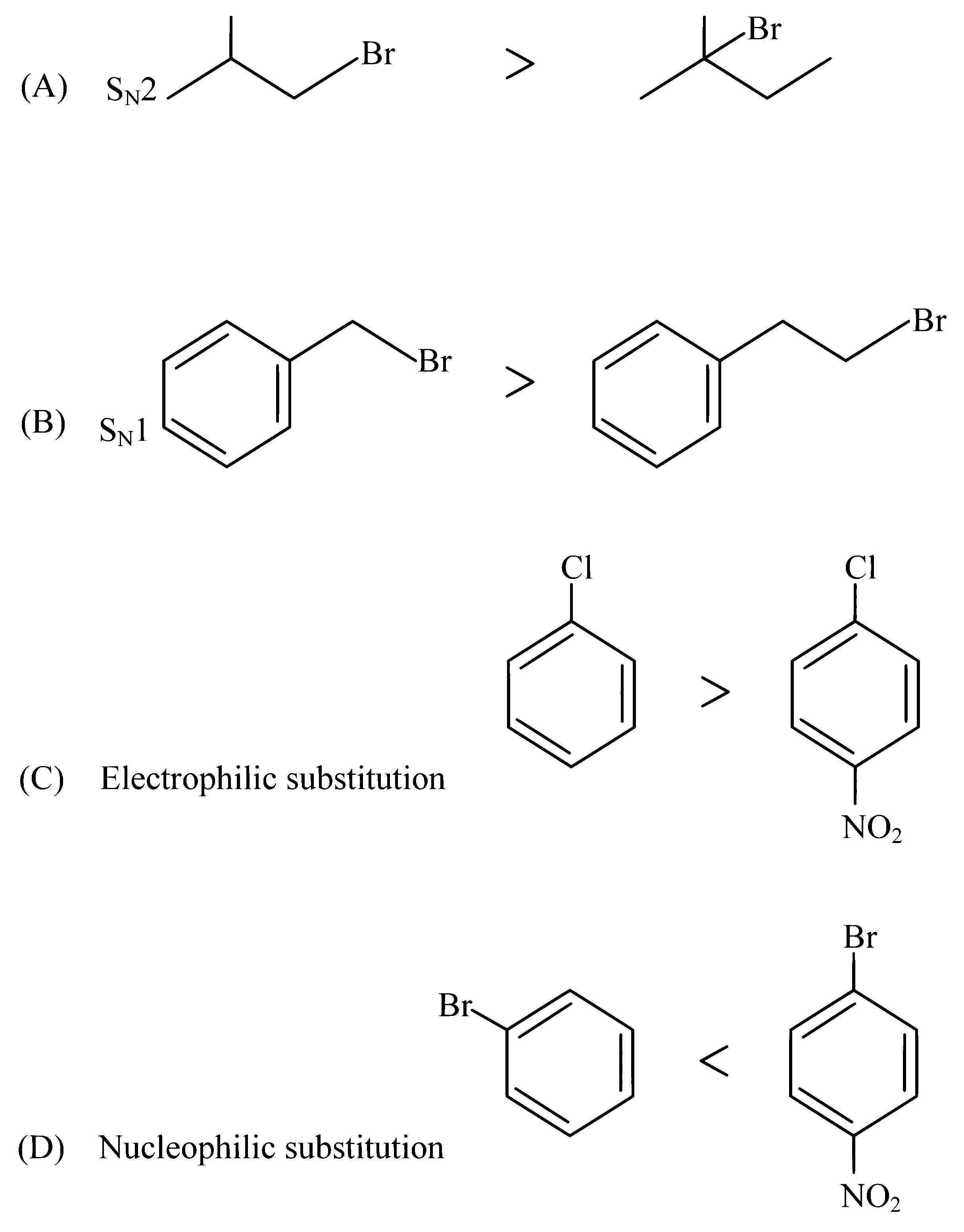
  1. A
    (A), (B) and (D) only
  2. B
    (A), (B), (C) and (D)
  3. C
    (B), (C) and (D) only
  4. D
    (A), (C) and (D) only
View written solutionFree

Correct answer: B

The question asks to identify the correct order of reactivity for pairs labeled (A), (B), (C), (D) toward their respective mechanisms, and then choose among options like:

  • (A),(B),(D)(A), (B), (D)(A),(B),(D) only
  • (A),(B),(C),(D)(A), (B), (C), (D)(A),(B),(C),(D)
  • etc.

However, the actual statements/pairs (A), (B), (C), and (D) are missing from the prompt. Without those reaction pairs or structures, it is not possible to independently derive which of them are correct.

1. What is required to solve this?

To solve such a question, I would need the explicit content of:

  • statement (A)
  • statement (B)
  • statement (C)
  • statement (D)

These would typically contain substrate structures and the mechanism involved, such as SN1S_N1SN​1, SN2S_N2SN​2, elimination, or aryl halide/nucleophilic substitution trends.

2. Limitation

Since those statements are not provided, a step-by-step chemical evaluation cannot be performed from the given data alone.

3. Comparison with stored answer

The stored correct answer is B, which corresponds to: (A),(B),(C) and (D)(A), (B), (C) \text{ and } (D)(A),(B),(C) and (D)

Because the necessary statements are absent, I cannot verify this independently from chemistry principles using the prompt alone.

4. Practical conclusion

Given only the information supplied, the only answer available to report is the stored one, but this is not a true derivation.

Therefore, based on the provided record: B\boxed{\text{B}}B​

PreviousNext

More from Haloalkanes and Haloarenes

  • The pair from the following pairs having both compounds with net non-zero dipole moment is2023 · MCQ
  • Find out the correct statement from the options given below for the above 2 reactions. Includes diagram2023 · MCQ
  • Compound from the following that will not produce precipitate on reaction with AgNO3​ is :2023 · MCQ
  • In the following reaction 'X' is Includes diagram2023 · MCQ
  • The major product formed in the Friedel-Craft acylation of chlorobenzene is2023 · MCQ
  • Number of moles of AgCl formed in the following reaction is ​ Includes diagram2023 · Numerical
  • Assertion A : Hydrolysis of an alkyl chloride is a slow reaction but in the presence of NaI, the rate of the hydrolysis increases. Reason R : I − is a good nucleophile as well as a good leaving group. In the light of the above…2023 · MCQ
  • The compound which will have the lowest rate towards nucleophilic aromatic substitution on treatment with OH − is2023 · MCQ