Sign in
12thPass logo
New chatPYQ LibraryDoubtsRank report
Sign in to see Recents

Your guest activity stays on this device

Sign in to save progress →
Sign in

Haloalkanes and Haloarenes question

2021 · 31 Aug · Shift 1 · Q1
Guest · filters and generic practice availableBrowsing as a guest · PYQ filters and generic practice are available. Sign in only for personalised features and saved progress.
  1. PYQ Library
  2. /JEE Main
  3. /Chemistry
  4. /Haloalkanes and Haloarenes
  5. /2021 · 31 Aug · Shift 1 · Q1

Haloalkanes and Haloarenes question

2021 · 31 Aug · Shift 1 · Q1

JEE MainChemistryHaloalkanes and HaloarenesMCQ+4 / −1
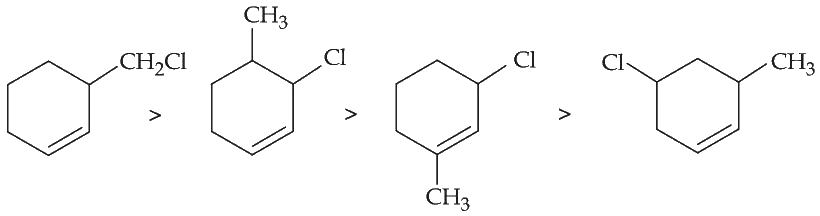
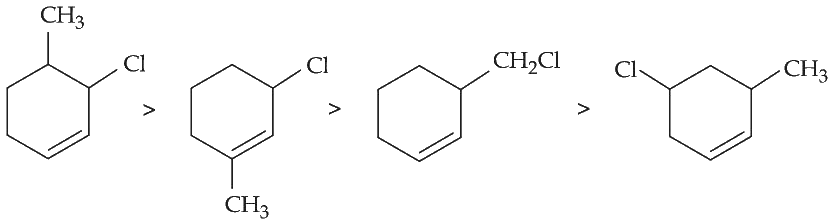
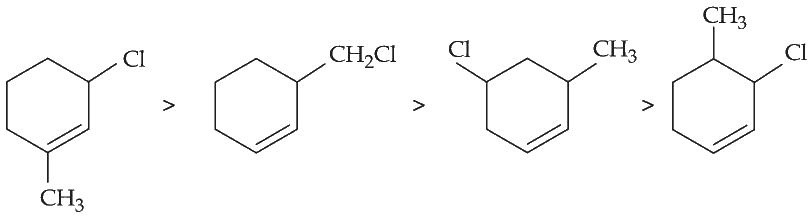
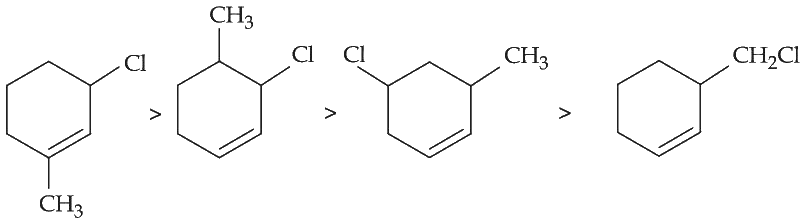
The correct order of reactivity of the given chlorides with acetate in acetic acid is :
  1. A
    JEE Main 2021 (Online) 31st August Morning Shift Chemistry - Haloalkanes and Haloarenes Question 84 English Option 1
  2. B
    JEE Main 2021 (Online) 31st August Morning Shift Chemistry - Haloalkanes and Haloarenes Question 84 English Option 2
  3. C
    JEE Main 2021 (Online) 31st August Morning Shift Chemistry - Haloalkanes and Haloarenes Question 84 English Option 3
  4. D
    JEE Main 2021 (Online) 31st August Morning Shift Chemistry - Haloalkanes and Haloarenes Question 84 English Option 4
View written solutionFree

Correct answer: D

The question asks for the order of reactivity of the given chlorides with acetate in acetic acid, but the actual structures corresponding to options A, B, C, and D are missing from the prompt.

Without the structures of the chlorides, the order of reactivity cannot be determined uniquely, because the answer depends on factors such as:

  1. Whether the chloride is alkyl, allylic, benzylic, vinylic, or aryl
  2. Degree of substitution: primary, secondary, tertiary
  3. Possibility of resonance stabilization of carbocation
  4. Whether the reaction proceeds via SN1S_N1SN​1 or SN2S_N2SN​2 in acetic acid/acetate medium
  5. Steric hindrance

General principle

In acetic acid with acetate ion, the medium is polar protic and weakly nucleophilic, so substrates that can react by SN1S_N1SN​1 are often more reactive. Typical trend is:

benzylic/allylic tertiary>tertiary>secondary>primary≫vinyl/aryl\text{benzylic/allylic tertiary} > \text{tertiary} > \text{secondary} > \text{primary} \gg \text{vinyl/aryl}benzylic/allylic tertiary>tertiary>secondary>primary≫vinyl/aryl

Also,

  • Benzylic and allylic chlorides are highly reactive due to resonance stabilization.
  • Aryl chlorides and vinyl chlorides are very unreactive toward nucleophilic substitution under ordinary conditions.

Why the problem cannot be solved fully

Since the structures for options A, B, C, and D are absent, I cannot:

  • identify the substrates,
  • compare their mechanisms,
  • or derive the exact order.

Therefore, the stored correct answer D cannot be verified from the information provided.

What is needed

Please provide the image or names/structures of the chlorides in options A–D. Then I can determine the exact reactivity order step-by-step and compare it properly with the stored answer.

PreviousNext

More from Haloalkanes and Haloarenes

  • The major product of the following reaction is : Includes diagram2021 · MCQ
  • Which of the following compunds will show retention in configuration on nucleophilic substitution by OH– ion?2020 · MCQ
  • The major product obtained from E2 - elimination of 3-bromo-2-fluoropentane is2020 · MCQ
  • Consider the reaction sequence given below: Which of the following statements is true? Includes diagram2020 · MCQ
  • The mechanism of SN1​ reaction is given as : A student writes general characteristics based on the given mechanism as : (a) The reaction is favoured by weak nucleophiles. (b) R+ would be easily formed if the substituents are bulky.… Includes diagram2020 · MCQ
  • The major product in the following reaction is : Includes diagram2020 · MCQ
  • The decreasing order of reactivity of the following compounds towards nucleophilic substitution (SN2) is : Includes diagram2020 · MCQ
  • The decreasing order of reactivity of the following organic molecules towards AgNO3​ solution is : Includes diagram2020 · MCQ