Sign in
12thPass logo
New chatPYQ LibraryDoubtsRank report
Sign in to see Recents

Your guest activity stays on this device

Sign in to save progress →
Sign in

Haloalkanes and Haloarenes question

2019 · 9 Jan · Shift 1 · Q4
Guest · filters and generic practice availableBrowsing as a guest · PYQ filters and generic practice are available. Sign in only for personalised features and saved progress.
  1. PYQ Library
  2. /JEE Main
  3. /Chemistry
  4. /Haloalkanes and Haloarenes
  5. /2019 · 9 Jan · Shift 1 · Q4

Haloalkanes and Haloarenes question

2019 · 9 Jan · Shift 1 · Q4

JEE MainChemistryHaloalkanes and HaloarenesMCQ+4 / −1
The compounds A and B in the following reaction are, respectively : JEE Main 2019 (Online) 9th January Morning Slot Chemistry - Haloalkanes and Haloarenes Question 139 English
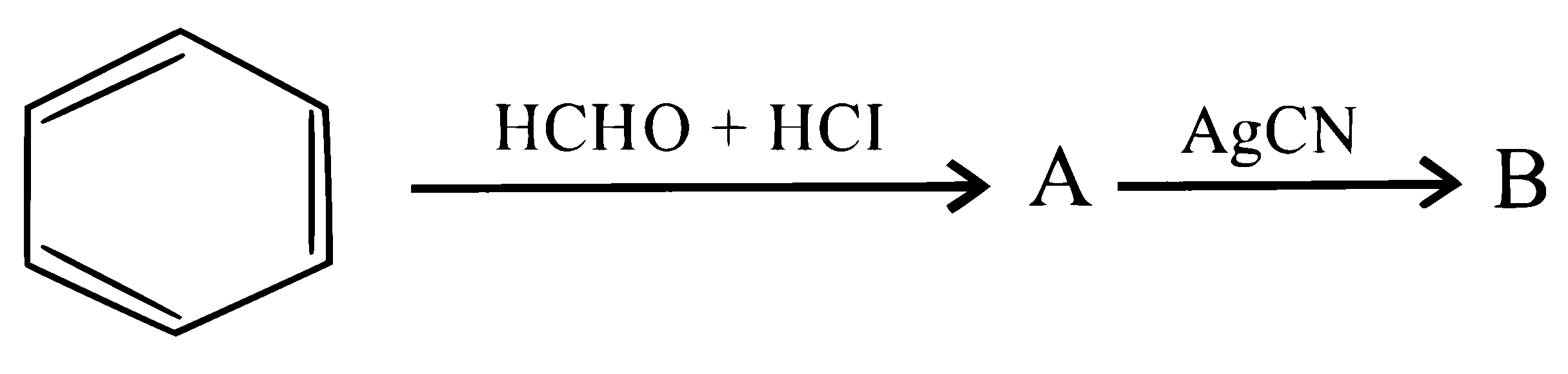
  1. A
    A = Benzyl alcohol, B = Benzyl cyanide
  2. B
    A = Benzyl chloride, B = Benzyl cyanide
  3. C
    A = Benzyl alcohol, B = Benzyl isocyanide
  4. D
    A = Benzyl chloride, B = Benzyl isocyanide
View written solutionFree

Correct answer: D

  1. Identify the likely reaction sequence

    In standard haloalkane/haloarene conversions, a benzylic compound is often prepared first and then reacted with cyanide-type reagents.

    The key distinction is:

    • With alcoholic KCN, alkyl halides generally give nitriles: R−CNR{-}CNR−CN
    • With AgCN, alkyl halides generally give isocyanides: R−NCR{-}NCR−NC
  2. Determine compound A

    Since the second step must involve substitution by CNCNCN or NCNCNC, compound AAA should be a benzyl halide, not benzyl alcohol, because benzyl alcohol does not directly give these products under the usual cyanide substitution conditions.

    Thus, A=benzyl chloride (C6H5CH2Cl)A = \text{benzyl chloride } (C_6H_5CH_2Cl)A=benzyl chloride (C6​H5​CH2​Cl)

  3. Determine compound B

    If benzyl chloride reacts with AgCN, the nitrogen end attacks preferentially because AgCN is largely covalent. Hence the product is isocyanide: C6H5CH2Cl→AgCNC6H5CH2NCC_6H_5CH_2Cl \xrightarrow{AgCN} C_6H_5CH_2NCC6​H5​CH2​ClAgCN​C6​H5​CH2​NC

    Therefore, B=benzyl isocyanideB = \text{benzyl isocyanide}B=benzyl isocyanide

  4. Match with options

    • A: A=A=A= benzyl alcohol, B=B=B= benzyl cyanide ×\quad \times×
    • B: A=A=A= benzyl chloride, B=B=B= benzyl cyanide ×\quad \times×
    • C: A=A=A= benzyl alcohol, B=B=B= benzyl isocyanide ×\quad \times×
    • D: A=A=A= benzyl chloride, B=B=B= benzyl isocyanide ✓\quad \checkmark✓
  5. Final answer

    The compounds are: A=benzyl chloride,B=benzyl isocyanideA = \text{benzyl chloride}, \qquad B = \text{benzyl isocyanide}A=benzyl chloride,B=benzyl isocyanide

    So the correct option is D.

PreviousNext

More from Haloalkanes and Haloarenes

  • The major product of the following reaction is : Includes diagram2019 · MCQ
  • Increasing rate of SN1 reaction in the following compounds is : Includes diagram2019 · MCQ
  • The major product of the following reaction is : Includes diagram2019 · MCQ
  • The major product 'Y' in the following reactions is : Includes diagram2019 · MCQ
  • The major product obtained in the given reaction is : Includes diagram2019 · MCQ
  • Which hydrogen in compound (E) is easily replaceable during bromination reaction in presence of light ? Includes diagram2019 · MCQ
  • Which of the following compounds will produce a precipitate with AgNO3​ ?2019 · MCQ
  • An 'Assertion' and a 'Reason' are given below. Choose the correct answer from the following options : Assertion (A) : Vinyl halides do not undergo nucleophilic substitution easily. Reason (R) : Even though the intermediate carbocation is…2019 · MCQ