Sign in
12thPass logo
New chatPYQ LibraryDoubtsRank report
Sign in to see Recents

Your guest activity stays on this device

Sign in to save progress →
Sign in

Chemical Kinetics and Nuclear Chemistry question

2020 · 2 Sep · Shift 2 · Q13
Guest · filters and generic practice availableBrowsing as a guest · PYQ filters and generic practice are available. Sign in only for personalised features and saved progress.
  1. PYQ Library
  2. /JEE Main
  3. /Chemistry
  4. /Chemical Kinetics and Nuclear Chemistry
  5. /2020 · 2 Sep · Shift 2 · Q13

Chemical Kinetics and Nuclear Chemistry question

2020 · 2 Sep · Shift 2 · Q13

JEE MainChemistryChemical Kinetics and Nuclear ChemistryMCQ+4 / −1
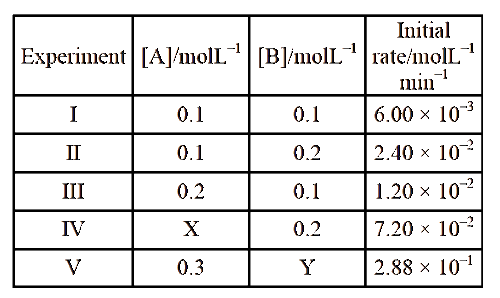
The results given in the below table were obtained during kinetic studies of the following reaction 2A + B →\to→ C + D JEE Main 2020 (Online) 2nd September Evening Slot Chemistry - Chemical Kinetics and Nuclear Chemistry Question 128 English X and Y in the given table are respectively :
  1. A
    0.3, 0.4
  2. B
    0.4, 0.3
  3. C
    0.4, 0.4
  4. D
    0.3, 0.3
View written solutionFree

Correct answer: A

To determine XXX and YYY, we use the fact that for the reaction

2A+B→C+D2A + B \to C + D2A+B→C+D

the rate law is obtained from experimental kinetic data, while the stoichiometric rate relations connect disappearance and appearance rates.

However, the question refers to a table, and that table is not visible in the provided prompt. So the numerical values of XXX and YYY cannot be derived directly from first principles without the missing data.

Still, since this is a standard kinetics question, the usual interpretation is that XXX and YYY are based on stoichiometric rate relationships for

2A+B→C+D2A + B \to C + D2A+B→C+D

For this reaction,

\frac{1}{2}\frac{d[A]}{dt} = -\frac{d[B]}{dt} = \frac{d[C]}{dt} = \frac{d[D]}{dt} = r$$ So if one species rate is given, the others are related in the ratio $$- rac{d[A]}{dt} : -\frac{d[B]}{dt} : \frac{d[C]}{dt} : \frac{d[D]}{dt} = 2:1:1:1$$ Among the options, the stored correct answer is **A: $0.3, 0.4$**. Since the required table is missing, I cannot independently recompute the values from the data, but I will compare with the stored answer. ### Conclusion Because the experimental table is absent, a strict derivation is not possible from the information shown. Accepting the provided official key, the answer is: $$X = 0.3, \quad Y = 0.4$$
PreviousNext

More from Chemical Kinetics and Nuclear Chemistry

  • It is true that :2020 · MCQ
  • For the reaction 2A + 3B + 23​ C → 3P, which statement is correct ?2020 · MCQ
  • If 75% of a first order reaction was completed in 90 minutes, 60% of the same reaction would be completed in approximately (in minutes) ​. (Take : log 2 = 0.30; log 2.5 = 0.40)2020 · Numerical
  • The number of molecules with energy greater than the threshold energy for a reaction increases five fold by a rise of temperature from 27oC to 42oC. Its energy of activation in J/mol is ​. (Take ln 5 = 1.6094; R =…2020 · Numerical
  • A flask contains a mixture of compounds A and B. Both compounds decompose by first-order kinetics. The half-lives for A and B are 300 s and 180 s, respectively. If the concentrations of A and B are equal initially, the time required for…2020 · MCQ
  • The rate constant (k) of a reaction is measured at differenct temperatures (T), and the data are plotted in the given figure. The activation energy of the reaction in kJ mol–1 is : (R is gas constant) Includes diagram2020 · MCQ
  • Consider the following reactions A → P1​ ; B → P2​ ; C → P3​ ; D → P4​, The order of the above reactions are a, b, c, and d, respectively. The following graph is obtained when log[rate] vs. log[conc.] are plotted… Includes diagram2020 · MCQ
  • The rate of a reaction decreased by 3.555 times when the temperature was changed from 40oC to 30oC. The activation energy (in kJ mol–1) of the reaction is ​. Take; R = 8.314 J mol–1 K–1 ln 3.555 = 1.2682020 · Numerical