JEE MainChemistryChemical Kinetics and Nuclear ChemistryMCQ+4 / −1
The rate constant (k) of a reaction is measured at differenct temperatures (T), and the data are plotted in the given figure. The activation energy of the reaction in kJ mol–1 is : (R is gas constant) 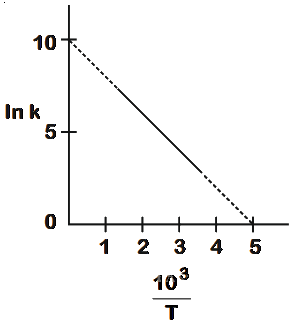
- AR
- B2R
- C
- D
More from Chemical Kinetics and Nuclear Chemistry
- Consider the following reactions A ; B ; C ; D , The order of the above reactions are a, b, c, and d, respectively. The following graph is obtained when log[rate] vs. log[conc.] are plotted… Includes diagram2020 · MCQ
- The rate of a reaction decreased by 3.555 times when the temperature was changed from 40oC to 30oC. The activation energy (in kJ mol–1) of the reaction is . Take; R = 8.314 J mol–1 K–1 ln 3.555 = 1.2682020 · Numerical
- During the nuclear explosion, one of the products is 90Sr with half life of 6.93 years. If 1 g of 90Sr was absorbed in the bones of newly born baby in placed of Ca, how much time, in years, is required to reduce much time, in year,…2020 · Numerical
- For the reaction 2(g) + 2(g) (g) + 2(g) the observed rate expression is, rate = Kf[]2[]. The rate expression for the reverse reaction is :2020 · MCQ
- The rate of a certain biochemical reaction at physiological temperature (T) occurs 106 times faster with enzyme than without. The change in the activation energy upon adding enzyme is :2020 · MCQ
- Consider the following plots of rate constant versus for four different reactions. Which of the following orders is correct for the activation energies of these reactions? Includes diagram2020 · MCQ
- For the following reactions it was found that Ea is decreased by 30 kJ/mol in the…2020 · MCQ
- A sample of milk splits after 60 min. at 300 K and after 40 min. at 400 K when the population of lactobacillus acidophilus in it doubles. The activa tion energy (in kJ/ mol) for this process is closest to .…2020 · Numerical