Sign in
12thPass logo
New chatPYQ LibraryDoubtsRank report
Sign in to see Recents

Your guest activity stays on this device

Sign in to save progress →
Sign in

Electrostatics question

2025 · 24 Jan · Shift 2 · Q69
Guest · filters and generic practice availableBrowsing as a guest · PYQ filters and generic practice are available. Sign in only for personalised features and saved progress.
  1. PYQ Library
  2. /JEE Main
  3. /Physics
  4. /Electrostatics
  5. /2025 · 24 Jan · Shift 2 · Q69

Electrostatics question

2025 · 24 Jan · Shift 2 · Q69

JEE MainPhysicsElectrostaticsMCQ+4 / −1
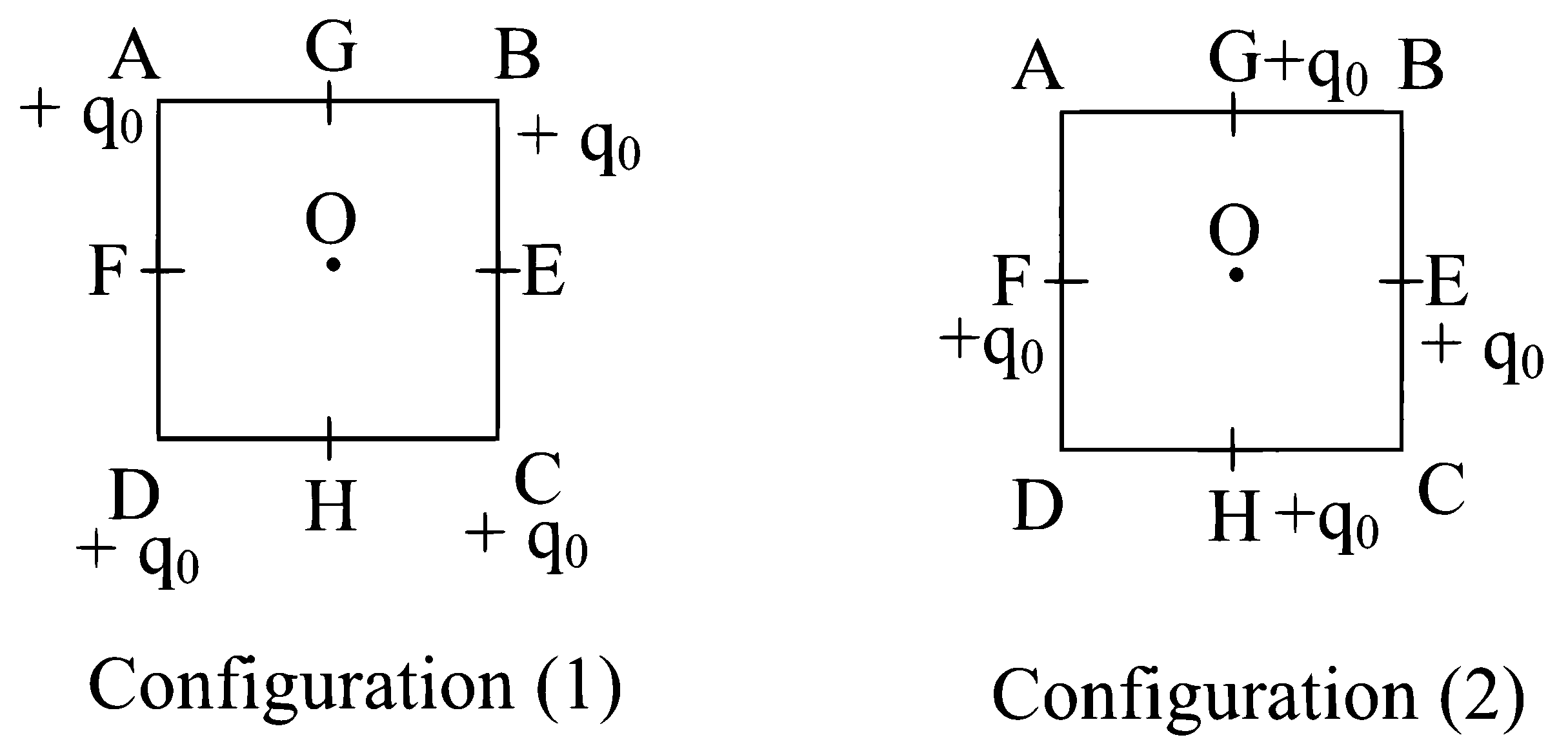
JEE Main 2025 (Online) 24th January Evening Shift Physics - Electrostatics Question 22 English In the first configuration (1) as shown in the figure, four identical charges (q0)\left(q_0\right)(q0​) are kept at the corners A, B, C and D of square of side length 'aaa'. In the second configuration (2), the same charges are shifted to mid points G,E,HG, E, HG,E,H and FFF, of the square. If K=14πϵ0K=\frac{1}{4 \pi \epsilon_0}K=4πϵ0​1​, the difference between the potential energies of configuration (2) and (1) is given by :
  1. A
    Kq02a(4−22)\frac{K q_0^2}{a}(4-2 \sqrt{2})aKq02​​(4−22​)
  2. B
    Kq02a(42−2)\frac{K q_0^2}{a}(4 \sqrt{2}-2)aKq02​​(42​−2)
  3. C
    Kq02a(3−2)\frac{\mathrm{Kq}_0^2}{\mathrm{a}}(3-\sqrt{2})aKq02​​(3−2​)
  4. D
    Kq02a(32−2)\frac{\mathrm{Kq}_0^2}{\mathrm{a}}(3 \sqrt{2}-2)aKq02​​(32​−2)
View written solutionFree

Correct answer: D

  1. Potential energy of a system of charges

For a system of point charges, U=∑i<jKqiqjrijU = \sum_{i<j} \frac{K q_i q_j}{r_{ij}}U=∑i<j​rij​Kqi​qj​​

Here all four charges are identical and equal to q0q_0q0​, so each pair contributes Kq02r\frac{K q_0^2}{r}rKq02​​

Since there are (42)=6\binom{4}{2}=6(24​)=6 pairs, we just need the pairwise distances in each configuration.


  1. Configuration (1): charges at the corners of a square

Let the square side be aaa.

Among the 6 pairs:

  • 4 pairs are along the sides, each at distance aaa
  • 2 pairs are along the diagonals, each at distance a2a\sqrt{2}a2​

So, U1=4(Kq02a)+2(Kq02a2)U_1 = 4\left(\frac{Kq_0^2}{a}\right) + 2\left(\frac{Kq_0^2}{a\sqrt{2}}\right)U1​=4(aKq02​​)+2(a2​Kq02​​)

U1=Kq02a(4+22)U_1 = \frac{Kq_0^2}{a}\left(4 + \frac{2}{\sqrt{2}}\right)U1​=aKq02​​(4+2​2​)

Since 22=2\frac{2}{\sqrt{2}}=\sqrt{2}2​2​=2​, U1=Kq02a(4+2)U_1 = \frac{Kq_0^2}{a}(4+\sqrt{2})U1​=aKq02​​(4+2​)


  1. Configuration (2): charges at the midpoints of the sides

The midpoints E,F,G,HE,F,G,HE,F,G,H form another square inside the original square.

Now find distances among these 4 midpoint charges:

  • Adjacent midpoints are separated by (a2)2+(a2)2=a2\sqrt{\left(\frac{a}{2}\right)^2+\left(\frac{a}{2}\right)^2} = \frac{a}{\sqrt{2}}(2a​)2+(2a​)2​=2​a​ There are 4 such pairs.

  • Opposite midpoints are separated by distance aaa. There are 2 such pairs.

Hence, U2=4(Kq02a/2)+2(Kq02a)U_2 = 4\left(\frac{Kq_0^2}{a/\sqrt{2}}\right) + 2\left(\frac{Kq_0^2}{a}\right)U2​=4(a/2​Kq02​​)+2(aKq02​​)

U2=4(2Kq02a)+2(Kq02a)U_2 = 4\left(\frac{\sqrt{2}Kq_0^2}{a}\right) + 2\left(\frac{Kq_0^2}{a}\right)U2​=4(a2​Kq02​​)+2(aKq02​​)

U2=Kq02a(42+2)U_2 = \frac{Kq_0^2}{a}(4\sqrt{2}+2)U2​=aKq02​​(42​+2)


  1. Required difference: configuration (2) minus configuration (1)

U2−U1=Kq02a(42+2)−Kq02a(4+2)U_2-U_1 = \frac{Kq_0^2}{a}(4\sqrt{2}+2) - \frac{Kq_0^2}{a}(4+\sqrt{2})U2​−U1​=aKq02​​(42​+2)−aKq02​​(4+2​)

U2−U1=Kq02a(42+2−4−2)U_2-U_1 = \frac{Kq_0^2}{a}\big(4\sqrt{2}+2-4-\sqrt{2}\big)U2​−U1​=aKq02​​(42​+2−4−2​)

U2−U1=Kq02a(32−2)U_2-U_1 = \frac{Kq_0^2}{a}(3\sqrt{2}-2)U2​−U1​=aKq02​​(32​−2)


  1. Option matching

This matches Option D: Kq02a(32−2)\boxed{\frac{Kq_0^2}{a}(3\sqrt{2}-2)}aKq02​​(32​−2)​

PreviousNext

More from Electrostatics

  • Three infinitely long wires with linear charge density λ are placed along the x−axis,y−axis and z− axis respectively. Which of the following denotes an equipotential surface?2025 · MCQ
  • A particle of mass ' m' and charge 'q' is fastened to one end 'A' of a massless string having equilibrium length l, whose other end is fixed at point ' O'. The whole system is placed on a frictionless horizontal plane and is… Includes diagram2025 · MCQ
  • An electric dipole of dipole moment 6×10⁻⁶Cm is placed in uniform electric field of magnitude 106V/m. Initially, the dipole moment is parallel to electric field. The work that needs to be…2025 · Numerical
  • An electric dipole of mass m, charge q, and length l is placed in a uniform electric field E=E0​i^. When the dipole is rotated slightly from its equilibrium position and released, the time period of its oscillations…2025 · MCQ
  • Match List - I with List - II. Choose the correct answer from the options given below : Includes table2025 · MCQ
  • A point charge causes an electric flux of −2×10⁴Nm2C−1 to pass through a spherical Gaussian surface of 8.0 cm radius, centred on the charge. The value of the point charge is : (Given ϵ0​=8.85×10⁻¹²C2 N−1 m−2…2025 · MCQ
  • An electric dipole is placed at a distance of 2 cm from an infinite plane sheet having positive charge density σo​. Choose the correct option from the following. Includes diagram2025 · MCQ
  • Two identical charged spheres are suspended by strings of equal lengths. The strings make an angle θ with each other. When suspended in water the angle remains the same. If density of the material of the sphere is 1.5 g/cc…2024 · Numerical