Sign in
12thPass logo
New chatPYQ LibraryDoubtsRank report
Sign in to see Recents

Your guest activity stays on this device

Sign in to save progress →
Sign in

Electrostatics question

2025 · 28 Jan · Shift 1 · Q65
Guest · filters and generic practice availableBrowsing as a guest · PYQ filters and generic practice are available. Sign in only for personalised features and saved progress.
  1. PYQ Library
  2. /JEE Main
  3. /Physics
  4. /Electrostatics
  5. /2025 · 28 Jan · Shift 1 · Q65

Electrostatics question

2025 · 28 Jan · Shift 1 · Q65

JEE MainPhysicsElectrostaticsMCQ+4 / −1
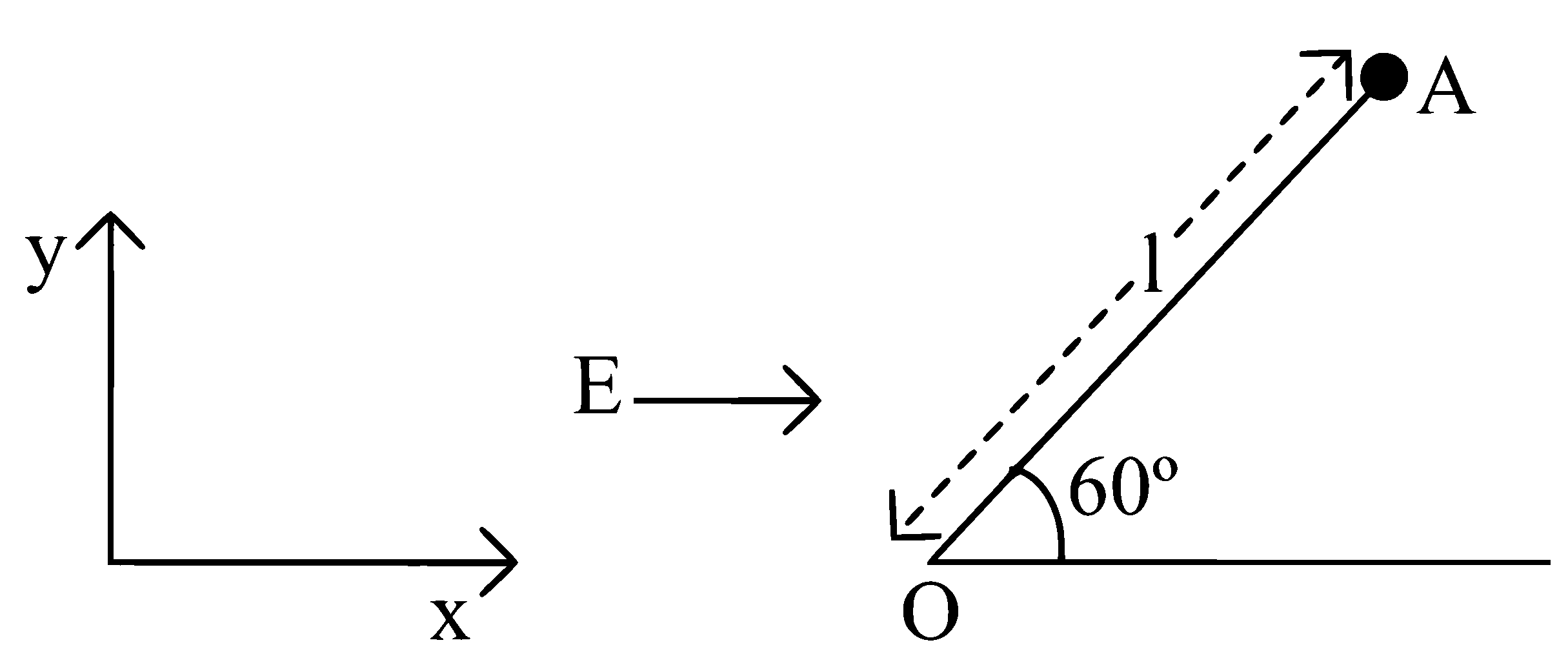
A particle of mass ' mmm' and charge 'qqq' is fastened to one end 'AAA' of a massless string having equilibrium length lll, whose other end is fixed at point ' OOO'. The whole system is placed on a frictionless horizontal plane and is initially at rest. If uniform electric field is switched on along the direction as shown in figure, then the speed of the particle when it crosses the xxx-axis is JEE Main 2025 (Online) 28th January Morning Shift Physics - Electrostatics Question 20 English
  1. A
    qEl2 m\sqrt{\frac{\mathrm{qE} l}{2 \mathrm{~m}}}2 mqEl​​
  2. B
    qEl4 m\sqrt{\frac{\mathrm{qE} l}{4 \mathrm{~m}}}4 mqEl​​
  3. C
    qEl m\sqrt{\frac{\mathrm{qE} l}{\mathrm{~m}}} mqEl​​
  4. D
    2qEl m\sqrt{\frac{2 \mathrm{qE} l}{\mathrm{~m}}} m2qEl​​
View written solutionFree

Correct answer: D: $\SQRT{\FRAC{2QEL}{M}}$

  1. Understand the setup

    • A charged particle of mass mmm and charge qqq is attached to a massless string of equilibrium length lll.
    • One end is fixed at OOO, the particle starts at point AAA.
    • The motion is on a frictionless horizontal plane.
    • A uniform electric field is switched on.
    • We need the speed of the particle when it crosses the xxx-axis.
  2. Key idea: use work-energy theorem

    The only force doing work is the electric force.

    • Tension in the string is always along the string and does no work in the constrained motion.
    • Hence, ΔK=Welectric\Delta K = W_{\text{electric}}ΔK=Welectric​
  3. Initial and final positions

    From the standard figure for this problem, the particle initially is at point AAA on the positive yyy-axis, with OA=lOA = lOA=l so initially its coordinates are A=(0,l).A=(0,l).A=(0,l).

    When it crosses the xxx-axis while remaining at distance lll from OOO, it is at the point B=(l,0).B=(l,0).B=(l,0).

    Thus the displacement in the direction of electric field (along +x+x+x) is Δx=l−0=l.\Delta x = l - 0 = l.Δx=l−0=l.

  4. Work done by electric field

    Electric force on the charge is F=qEF = qEF=qE along the field direction.

    Therefore work done from AAA to BBB is W=qE Δx=qEl.W = qE\,\Delta x = qEl.W=qEΔx=qEl.

  5. Apply energy conservation

    Initially the system is at rest, so Ki=0.K_i = 0.Ki​=0.

    At the instant it crosses the xxx-axis, let speed be vvv. Then Kf=12mv2.K_f = \frac12 mv^2.Kf​=21​mv2.

    Hence, 12mv2=qEl.\frac12 mv^2 = qEl.21​mv2=qEl.

    Solving, v2=2qElmv^2 = \frac{2qEl}{m}v2=m2qEl​ v=2qElm.v = \sqrt{\frac{2qEl}{m}}.v=m2qEl​​.

  6. Match with the options

    This corresponds to: 2qElm\boxed{\sqrt{\frac{2qEl}{m}}}m2qEl​​​

    So the correct option is D.

  7. Comparison with stored answer

    Stored correct answer is C: qElm\sqrt{\frac{qEl}{m}}mqEl​​.

    But from work-energy theorem, the correct result is clearly 2qElm.\boxed{\sqrt{\frac{2qEl}{m}}}.m2qEl​​​.

    Therefore, I disagree with the stored answer.

PreviousNext

More from Electrostatics

  • An electric dipole of dipole moment 6×10⁻⁶Cm is placed in uniform electric field of magnitude 106V/m. Initially, the dipole moment is parallel to electric field. The work that needs to be…2025 · Numerical
  • An electric dipole of mass m, charge q, and length l is placed in a uniform electric field E=E0​i^. When the dipole is rotated slightly from its equilibrium position and released, the time period of its oscillations…2025 · MCQ
  • Match List - I with List - II. Choose the correct answer from the options given below : Includes table2025 · MCQ
  • A point charge causes an electric flux of −2×10⁴Nm2C−1 to pass through a spherical Gaussian surface of 8.0 cm radius, centred on the charge. The value of the point charge is : (Given ϵ0​=8.85×10⁻¹²C2 N−1 m−2…2025 · MCQ
  • An electric dipole is placed at a distance of 2 cm from an infinite plane sheet having positive charge density σo​. Choose the correct option from the following. Includes diagram2025 · MCQ
  • Two identical charged spheres are suspended by strings of equal lengths. The strings make an angle θ with each other. When suspended in water the angle remains the same. If density of the material of the sphere is 1.5 g/cc…2024 · Numerical
  • C1​ and C2​ are two hollow concentric cubes enclosing charges 2Q and 3Q respectively as shown in figure. The ratio of electric flux passing through C1​ and C2​ is : Includes diagram2024 · MCQ
  • Suppose a uniformly charged wall provides a uniform electric field of 2×10⁴ N/C normally. A charged particle of mass 2 g being suspended through a silk thread of length 20 cm and…2024 · Numerical