Sign in
12thPass logo
New chatPYQ LibraryDoubtsRank report
Sign in to see Recents

Your guest activity stays on this device

Sign in to save progress →
Sign in

Electrostatics question

2021 · 24 Feb · Shift 1 · Q45
Guest · filters and generic practice availableBrowsing as a guest · PYQ filters and generic practice are available. Sign in only for personalised features and saved progress.
  1. PYQ Library
  2. /JEE Main
  3. /Physics
  4. /Electrostatics
  5. /2021 · 24 Feb · Shift 1 · Q45

Electrostatics question

2021 · 24 Feb · Shift 1 · Q45

JEE MainPhysicsElectrostaticsMCQ+4 / −1
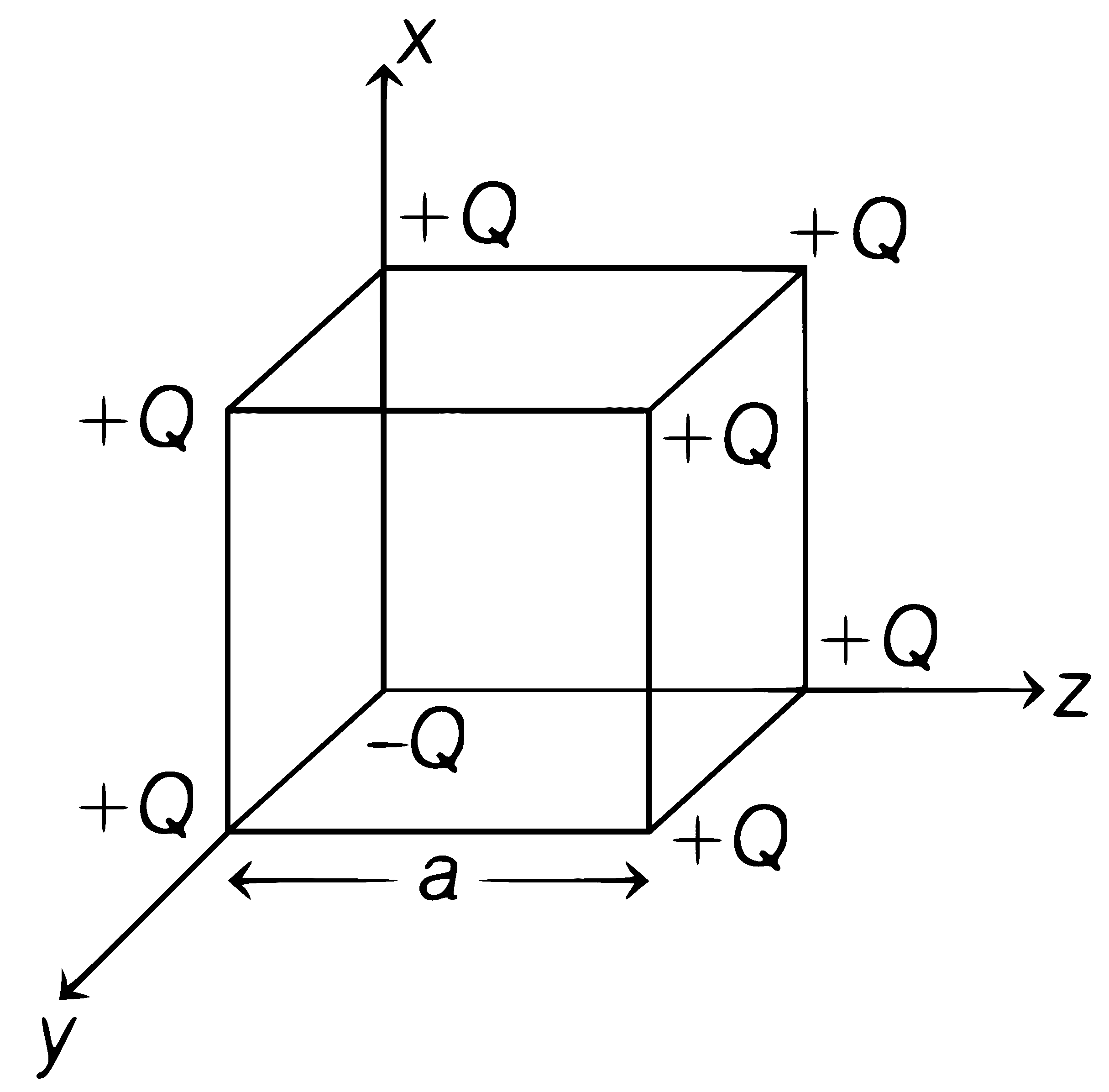
A cube of side 'a' has point charges +Q located at each of its vertices except at the origin where the charge is −-− Q. The electric field at the centre of cube is : JEE Main 2021 (Online) 24th February Morning Shift Physics - Electrostatics Question 162 English
  1. A
    2Q33πε0a2(x^+y^+z^){{2Q} \over {3\sqrt 3 \pi {\varepsilon _0}{a^2}}}\left( {\widehat x + \widehat y + \widehat z} \right)33​πε0​a22Q​(x+y​+z)
  2. B
    −Q33πε0a2(x^+y^+z^){{ - Q} \over {3\sqrt 3 \pi {\varepsilon _0}{a^2}}}\left( {\widehat x + \widehat y + \widehat z} \right)33​πε0​a2−Q​(x+y​+z)
  3. C
    Q33πε0a2(x^+y^+z^){Q \over {3\sqrt 3 \pi {\varepsilon _0}{a^2}}}\left( {\widehat x + \widehat y + \widehat z} \right)33​πε0​a2Q​(x+y​+z)
  4. D
    −2Q33πε0a2(x^+y^+z^){{ - 2Q} \over {3\sqrt 3 \pi {\varepsilon _0}{a^2}}}\left( {\widehat x + \widehat y + \widehat z} \right)33​πε0​a2−2Q​(x+y​+z)
View written solutionFree

Correct answer: D

  1. Set up the cube coordinates

Let the cube have vertices at

(0,0,0), (a,0,0), (0,a,0), (0,0,a), (a,a,0), (a,0,a), (0,a,a), (a,a,a)(0,0,0),\ (a,0,0),\ (0,a,0),\ (0,0,a),\ (a,a,0),\ (a,0,a),\ (0,a,a),\ (a,a,a)(0,0,0), (a,0,0), (0,a,0), (0,0,a), (a,a,0), (a,0,a), (0,a,a), (a,a,a)

with the origin carrying charge −Q-Q−Q and all other 7 vertices carrying charge +Q+Q+Q.

The centre of the cube is at

(a2,a2,a2).\left(\frac a2,\frac a2,\frac a2\right).(2a​,2a​,2a​).
  1. Use symmetry cleverly

If all 8 vertices had charge +Q+Q+Q, then by symmetry the electric field at the centre would be zero:

E⃗all +Q=0.\vec E_{\text{all }+Q}=0.Eall +Q​=0.

But in the actual problem, the charge at the origin is changed from +Q+Q+Q to −Q-Q−Q.

So compared to the symmetric case, the net change is equivalent to adding an extra charge −2Q-2Q−2Q at the origin:

(+Q→−Q)⇒change=−2Q.(+Q \to -Q) \Rightarrow \text{change} = -2Q.(+Q→−Q)⇒change=−2Q.

Hence, the required electric field at the centre is just the field due to a point charge −2Q-2Q−2Q placed at the origin.

  1. Distance from origin to centre

The distance is

r=(a2)2+(a2)2+(a2)2=a32.r=\sqrt{\left(\frac a2\right)^2+\left(\frac a2\right)^2+\left(\frac a2\right)^2} =\frac{a\sqrt3}{2}.r=(2a​)2+(2a​)2+(2a​)2​=2a3​​.

So

r2=3a24.r^2=\frac{3a^2}{4}.r2=43a2​.
  1. Magnitude of electric field due to charge −2Q-2Q−2Q

Using

E=14πε0∣q∣r2,E=\frac{1}{4\pi\varepsilon_0}\frac{|q|}{r^2},E=4πε0​1​r2∣q∣​,

we get

E=14πε0⋅2Q3a2/4=14πε0⋅8Q3a2=2Q3πε0a2.E=\frac{1}{4\pi\varepsilon_0}\cdot \frac{2Q}{3a^2/4} =\frac{1}{4\pi\varepsilon_0}\cdot \frac{8Q}{3a^2} =\frac{2Q}{3\pi\varepsilon_0 a^2}.E=4πε0​1​⋅3a2/42Q​=4πε0​1​⋅3a28Q​=3πε0​a22Q​.
  1. Direction of the field

Since the charge is negative, the electric field at the centre points towards the origin.

The vector from origin to centre is proportional to

x^+y^+z^.\hat x+\hat y+\hat z.x^+y^​+z^.

Therefore, the field towards the origin is along

−(x^+y^+z^).-(\hat x+\hat y+\hat z).−(x^+y^​+z^).

The unit vector in the body-diagonal direction is

x^+y^+z^3.\frac{\hat x+\hat y+\hat z}{\sqrt3}.3​x^+y^​+z^​.

Hence,

E⃗=−2Q3πε0a2⋅x^+y^+z^3=−2Q33πε0a2(x^+y^+z^).\vec E=-\frac{2Q}{3\pi\varepsilon_0 a^2}\cdot \frac{\hat x+\hat y+\hat z}{\sqrt3} = -\frac{2Q}{3\sqrt3\pi\varepsilon_0 a^2}(\hat x+\hat y+\hat z).E=−3πε0​a22Q​⋅3​x^+y^​+z^​=−33​πε0​a22Q​(x^+y^​+z^).
  1. Match with options

This matches:

D: −2Q33πε0a2(x^+y^+z^)\boxed{\text{D: }-\frac{2Q}{3\sqrt3\pi\varepsilon_0 a^2}(\hat x+\hat y+\hat z)}D: −33​πε0​a22Q​(x^+y^​+z^)​
PreviousNext

More from Electrostatics

  • Two electrons each are fixed at a distance '2d'. A third charge proton placed at the midpoint is displaced slightly by a distance x (x << d) perpendicular to the line joining the two fixed charges. Proton will execute simple harmonic…2021 · MCQ
  • A point charge of +12 μ C is at a distance 6 cm vertically above the centre of a square of side 12 cm as shown in figure. The magnitude of the electric flux through the square will be ​× 103 Nm2/C. Includes diagram2021 · Numerical
  • The electric field in a region is given by E=(53​E0​i+54​E0​j​)CN​. The ratio of flux of reported field through the rectangular surface of area 0.2 m2…2021 · Numerical
  • 512 identical drops of mercury are charged to a potential of 2V each. The drops are joined to form a single drop. The potential of this drop is ​ V.2021 · Numerical
  • A charge 'q' is placed at one corner of a cube as shown in figure. The flux of electrostatic field E through the shaded area is : Includes diagram2021 · MCQ
  • Two identical conducting spheres with negligible volume have 2.1 nC and − 0.1 nC charges, respectively. They are brought into contact and then separated by a distance of 0.5 m. The electrostatic force acting between the spheres is ​×…2021 · Numerical
  • Two small spheres each of mass 10 mg are suspended from a point by threads 0.5 m long. They are equally charged and repel each other to a distance of 0.20 m. The charge on each of the sphere is 21a​×10−8 C. The…2021 · Numerical
  • A particle of mass 1 mg and charge q is lying at the mid-point of two stationary particles kept at a distance '2 m' when each is carrying same charge 'q'. If the free charged particle is displaced from its equilibrium position through…2021 · Numerical