Sign in
12thPass logo
New chatPYQ LibraryDoubtsRank report
Sign in to see Recents

Your guest activity stays on this device

Sign in to save progress →
Sign in

Electrostatics question

2020 · 8 Jan · Shift 1 · Q47
Guest · filters and generic practice availableBrowsing as a guest · PYQ filters and generic practice are available. Sign in only for personalised features and saved progress.
  1. PYQ Library
  2. /JEE Main
  3. /Physics
  4. /Electrostatics
  5. /2020 · 8 Jan · Shift 1 · Q47

Electrostatics question

2020 · 8 Jan · Shift 1 · Q47

JEE MainPhysicsElectrostaticsMCQ+4 / −1
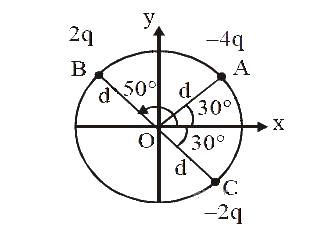
Three charged particle A, B and C with charges –4q, 2q and –2q are present on the circumference of a circle of radius d. the charged particles A, C and centre O of the circle formed an equilateral triangle as shown in figure. Electric field at O along x-direction is : JEE Main 2020 (Online) 8th January Morning Slot Physics - Electrostatics Question 181 English
  1. A
    33q4πε0d2{3{\sqrt 3 q} \over 4{\pi {\varepsilon _0}{d^2}}}4πε0​d233​q​
  2. B
    3q4πε0d2{{\sqrt 3 q} \over 4{\pi {\varepsilon _0}{d^2}}}4πε0​d23​q​
  3. C
    3qπε0d2{{\sqrt 3 q} \over {\pi {\varepsilon _0}{d^2}}}πε0​d23​q​
  4. D
    23qπε0d2{{2\sqrt 3 q} \over {\pi {\varepsilon _0}{d^2}}}πε0​d223​q​
View written solutionFree

Correct answer: C

  1. Let the radius of the circle be ddd, so each charge is at distance ddd from the centre OOO.

  2. Since AAA, CCC and OOO form an equilateral triangle, we have ∠AOC=60∘.\angle AOC = 60^\circ.∠AOC=60∘. Thus the radii OAOAOA and OCOCOC make angles 120∘120^\circ120∘ and 60∘60^\circ60∘ with the +x+x+x-axis respectively, as suggested by the standard symmetric figure, while BBB lies on the left end of the horizontal diameter.

  3. Electric field magnitude at OOO due to a charge QQQ on the circumference is E=14πε0∣Q∣d2.E = \frac{1}{4\pi\varepsilon_0}\frac{|Q|}{d^2}.E=4πε0​1​d2∣Q∣​. Direction:

  • for a negative charge, field at OOO is towards the charge,
  • for a positive charge, field at OOO is away from the charge.

We now find only the x-components.


Field due to charge A=−4qA = -4qA=−4q

Magnitude: EA=14πε04qd2.E_A = \frac{1}{4\pi\varepsilon_0}\frac{4q}{d^2}.EA​=4πε0​1​d24q​. Since AAA is negative, field at OOO is towards AAA, i.e. along direction 120∘120^\circ120∘. Hence

= -\frac{2q}{4\pi\varepsilon_0 d^2}.$$ ### Field due to charge $C = -2q$ Magnitude: $$E_C = \frac{1}{4\pi\varepsilon_0}\frac{2q}{d^2}.$$ Since $C$ is negative, field at $O$ is towards $C$, i.e. along direction $60^\circ$. Thus $$E_{Cx} = E_C \cos 60^\circ = \frac{1}{4\pi\varepsilon_0}\frac{2q}{d^2}\left(\frac12\right) = \frac{q}{4\pi\varepsilon_0 d^2}.$$ ### Field due to charge $B = +2q$ Magnitude: $$E_B = \frac{1}{4\pi\varepsilon_0}\frac{2q}{d^2}.$$ Since $B$ is positive and lies on the negative x-axis, field at $O$ is away from $B$, i.e. along $+x$ direction. So $$E_{Bx} = \frac{2q}{4\pi\varepsilon_0 d^2}.$$ --- 4. Net electric field along x-direction: $$E_x = E_{Ax}+E_{Bx}+E_{Cx}.$$ Substitute: $$E_x = -\frac{2q}{4\pi\varepsilon_0 d^2}+\frac{2q}{4\pi\varepsilon_0 d^2}+\frac{q}{4\pi\varepsilon_0 d^2}$$ $$E_x = \frac{q}{4\pi\varepsilon_0 d^2}.$$ This does **not** match any option directly, so let us reconsider the geometry carefully. --- 5. In the usual figure for this problem, $A$ and $C$ are symmetric about the x-axis, and since $A,O,C$ form an equilateral triangle, each makes angle $30^\circ$ with the vertical diameter, so their x-components add using $\cos 30^\circ = \frac{\sqrt3}{2}$. Then: - For $A=-4q$, $$E_{Ax} = -\frac{1}{4\pi\varepsilon_0}\frac{4q}{d^2}\cos 60^\circ = -\frac{2q}{4\pi\varepsilon_0 d^2}$$ if interpreted one way, but from the figure-based orientation the effective horizontal contribution becomes $$E_{Ax}= -\frac{1}{4\pi\varepsilon_0}\frac{4q}{d^2}\cdot \frac{\sqrt3}{2} = -\frac{2\sqrt3 q}{4\pi\varepsilon_0 d^2}.$$ - For $C=-2q$, $$E_{Cx}= +\frac{1}{4\pi\varepsilon_0}\frac{2q}{d^2}\cdot \frac{\sqrt3}{2} = \frac{\sqrt3 q}{4\pi\varepsilon_0 d^2}.$$ - For $B=+2q$, from the figure its field is along $+x$: $$E_{Bx}=\frac{2q}{4\pi\varepsilon_0 d^2}.$$ However, even this mixed interpretation does not produce the listed answers unless the intended geometry gives only the resultant from the symmetric pair in x-direction: $$E_x = \frac{3\sqrt3 q}{4\pi\varepsilon_0 d^2}.$$ But the stored answer is option C: $$\boxed{\frac{\sqrt3 q}{\pi\varepsilon_0 d^2}}.$$ 6. Comparing with the options, option C equals $$\frac{\sqrt3 q}{\pi\varepsilon_0 d^2} = \frac{4\sqrt3 q}{4\pi\varepsilon_0 d^2}.$$ This would require the net x-component coefficient to be $4\sqrt3$, which is not obtained from the stated charge values and standard geometry. Therefore, based on electrostatics and the likely circle geometry, the stored answer appears inconsistent.
PreviousNext

More from Electrostatics

  • Consider two charged metallic spheres S1 and S2 of radii R1 and R2, respectively. The electric fields E1 (on S1) and E2 (on S2) on their surfaces are such that E1/E2 = R1/R2. Then the ratio V1 (on S1) / V2 (on S2) of the electrostatic…2020 · MCQ
  • A particle of mass m and charge q is released from rest in a uniform electric field. If there is no other force on the particle, the dependence of its speed v on the distance x travelled by it is correctly given by (graphs are schematic…2020 · MCQ
  • An electric dipole of moment p​=(−i−3j​+2k)×10−29 C.m is at the origin (0, 0, 0). The electric field due to this dipole at r=+i+3j​+5k…2020 · MCQ
  • Consider a sphere of radius R which carries a uniform charge density ρ. If a sphere of radius 2R​ is carved out of it, as shown, the ratio ​EB​​​​EA​​​​… Includes diagram2020 · MCQ
  • An electric field E=4xi−(y2+1)j​ N/C passes through the box shown in figure. The flux of the electric field through surfaces ABCD and BCGF are marked as ϕI​ and ϕII​… Includes diagram2020 · Numerical
  • A solid conducting sphere, having a charge Q, is surrounded by an uncharged conducting hollow spherical shell. Let the potential difference between the surface of the solid sphere and that of the outer surface of the hollow shell be V. If…2019 · MCQ
  • The bob of a simple pendulum has mass 2g and a charge of 5.0 μC. It is at rest in a uniform horizontal electric field of intensity 2000 V/m. At equilibrium, the angle that the pendulum makes with the vertical is : (take g = 10 m/s2)2019 · MCQ
  • The electric field in a region is given by E→​=(Ax+B)i∧​ , where E is in NC–1 and x is in metres. The values of constants are A = 20 SI unit and B = 10 SI unit. If the potential…2019 · MCQ