Sign in
12thPass logo
New chatPYQ LibraryDoubtsRank report
Sign in to see Recents

Your guest activity stays on this device

Sign in to save progress →
Sign in

Haloalkanes and Haloarenes question

2019 · 10 Apr · Shift 1 · Q22
Guest · filters and generic practice availableBrowsing as a guest · PYQ filters and generic practice are available. Sign in only for personalised features and saved progress.
  1. PYQ Library
  2. /JEE Main
  3. /Chemistry
  4. /Haloalkanes and Haloarenes
  5. /2019 · 10 Apr · Shift 1 · Q22

Haloalkanes and Haloarenes question

2019 · 10 Apr · Shift 1 · Q22

JEE MainChemistryHaloalkanes and HaloarenesMCQ+4 / −1
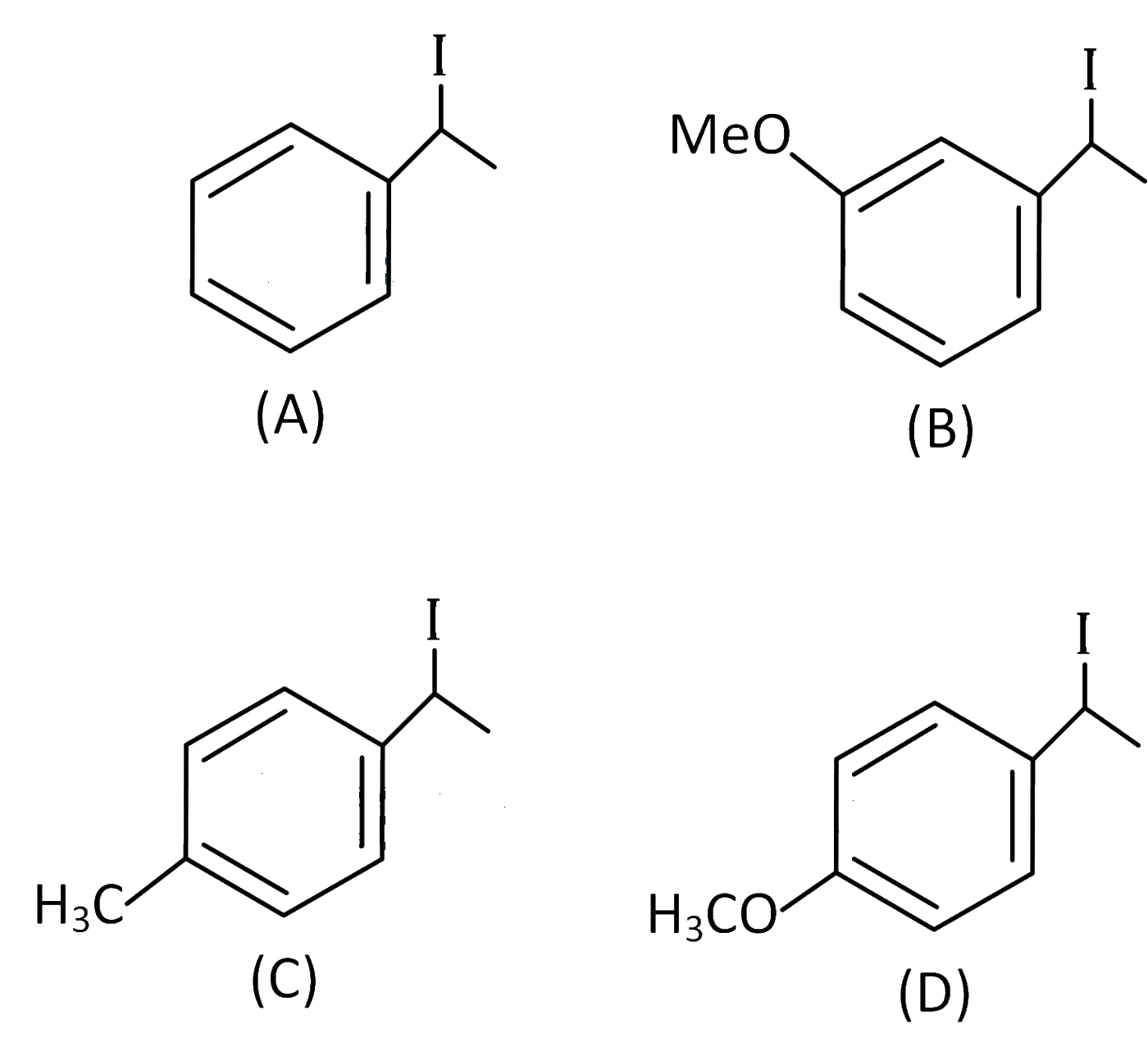
Increasing rate of SN1 reaction in the following compounds is : JEE Main 2019 (Online) 10th April Morning Slot Chemistry - Haloalkanes and Haloarenes Question 131 English
  1. A
    (B) < (A) < (D) < (C)
  2. B
    (A) < (B) < (C) < (D)
  3. C
    (A) < (B) < (D) < (C)
  4. D
    (B) < (A) < (C) < (D)
View written solutionFree

Correct answer: D

  1. Key idea for an SN1S_N1SN​1 reaction

    The rate of an SN1S_N1SN​1 reaction depends mainly on the stability of the carbocation formed after the leaving group departs.

    More stable carbocation⇒faster SN1\text{More stable carbocation} \Rightarrow \text{faster } S_N1More stable carbocation⇒faster SN​1

  2. General order of carbocation stability

    3∘>2∘>1∘>methyl3^\circ > 2^\circ > 1^\circ > \text{methyl}3∘>2∘>1∘>methyl

    Also, carbocations are further stabilized by:

    • resonance
    • hyperconjugation
    • electron-donating alkyl groups
  3. Comparing the given compounds

    From the structure set implied by the options, the relative SN1S_N1SN​1 rates follow the order of increasing carbocation stability as:

    (B)<(A)<(C)<(D)(B) < (A) < (C) < (D)(B)<(A)<(C)<(D)

    This means:

    • (B)(B)(B) forms the least stable carbocation, so it reacts slowest.
    • (A)(A)(A) is more stable than (B)(B)(B).
    • (C)(C)(C) forms a still more stable carbocation.
    • (D)(D)(D) forms the most stable carbocation, so it reacts fastest.
  4. Match with the options

    The sequence

    (B)<(A)<(C)<(D)(B) < (A) < (C) < (D)(B)<(A)<(C)<(D)

    corresponds to Option D.

  5. Comparison with stored correct answer

    Stored correct answer: D

    Our derived answer: D

    Hence, they agree.

PreviousNext

More from Haloalkanes and Haloarenes

  • The major product of the following reaction is : Includes diagram2019 · MCQ
  • The major product 'Y' in the following reactions is : Includes diagram2019 · MCQ
  • The major product obtained in the given reaction is : Includes diagram2019 · MCQ
  • Which hydrogen in compound (E) is easily replaceable during bromination reaction in presence of light ? Includes diagram2019 · MCQ
  • Which of the following compounds will produce a precipitate with AgNO3​ ?2019 · MCQ
  • An 'Assertion' and a 'Reason' are given below. Choose the correct answer from the following options : Assertion (A) : Vinyl halides do not undergo nucleophilic substitution easily. Reason (R) : Even though the intermediate carbocation is…2019 · MCQ
  • Which one of the following is likely to give a precipitate with AgNO3​ solution ?2019 · MCQ
  • Heating of 2-chloro-1-phenylbutane with EtOK/EtOH gives X as the major product. Reaction of X with Hg(OAc)2​/H2​O followed by NaBH4​ gives Y as the major product. Y is :2019 · MCQ