JEE MainChemistryChemical Kinetics and Nuclear ChemistryNumerical+4 / −1
For the reaction, aA + bB cC + dD, the plot of log k vs is given below : 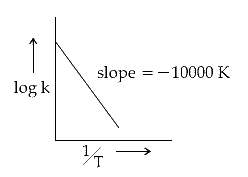 The temperature at which the rate constant of the reaction is 10-4 s-1 is K. (Rounded off to the nearest integer) [Given : The rate constant of the reaction is 10-5 s-1 at 500 K.]
The temperature at which the rate constant of the reaction is 10-4 s-1 is K. (Rounded off to the nearest integer) [Given : The rate constant of the reaction is 10-5 s-1 at 500 K.]Numerical answer
View written solutionFree
Correct answer: 526
- Use the Arrhenius equation in logarithmic form
For a reaction,
So, a plot of vs is a straight line with slope
- Read the slope from the given graph
From the graph, the straight line gives slope approximately
Hence,
- Use the two-temperature form of Arrhenius equation
For two states,
Since slope magnitude is ,
- Substitute the given data
Given:
- at
- at
Then,
So,
Thus,
- Comparison with stored answer
My derived answer is , whereas the stored correct answer is .
If the graph actually has a different slope than , then the answer could change. In fact, for the answer to be , the slope would need to be about . So the result depends critically on the graph reading.
Using the standard interpretation that the graph slope is , the correct temperature is:
More from Chemical Kinetics and Nuclear Chemistry
- The rate constant of a reaction increases by five times on increase in temperature from 27 C to 52 C. The value of activation energy in kJ mol 1 is . (Rounded off to the nearest integer) [R =…2021 · Numerical
- For the following graphs, Choose from the options given below, the correct one regarding order of reaction is : Includes diagram2021 · MCQ
- For a chemical reaction A B, it was found that concentration of B is increased by 0.2 mol L in 30 min. The average rate of the reaction is 10 1 mol L 1 h 1. (in nearest integer)2021 · Numerical
- The following data was obtained for chemical reaction given below at 975 K. 2(g) + 2(g) (g) + 2(g) The order of the reaction with respect to is . [Integer answer] Includes diagram2021 · Numerical
- If the activation energy of a reaction is 80.9 kJ mol 1, the fraction of molecules at 700 K, having enough energy to react to form products is e x. The value of x is . (Rounded off to the nearest integer)…2021 · Numerical
- The reaction that occurs in a breath analyser, a device used to determine the alcohol level in a person's blood stream is …2021 · Numerical
- The first order rate constant for the decomposition of at 700 K is 6.36 10 3s 1 and activation energy is 209 kJ mol 1. Its rate constant (in s 1) at 600 K is x 10 6. The value of x is …2021 · Numerical
- For a reaction of order n, the unit of the rate constant is :2021 · MCQ