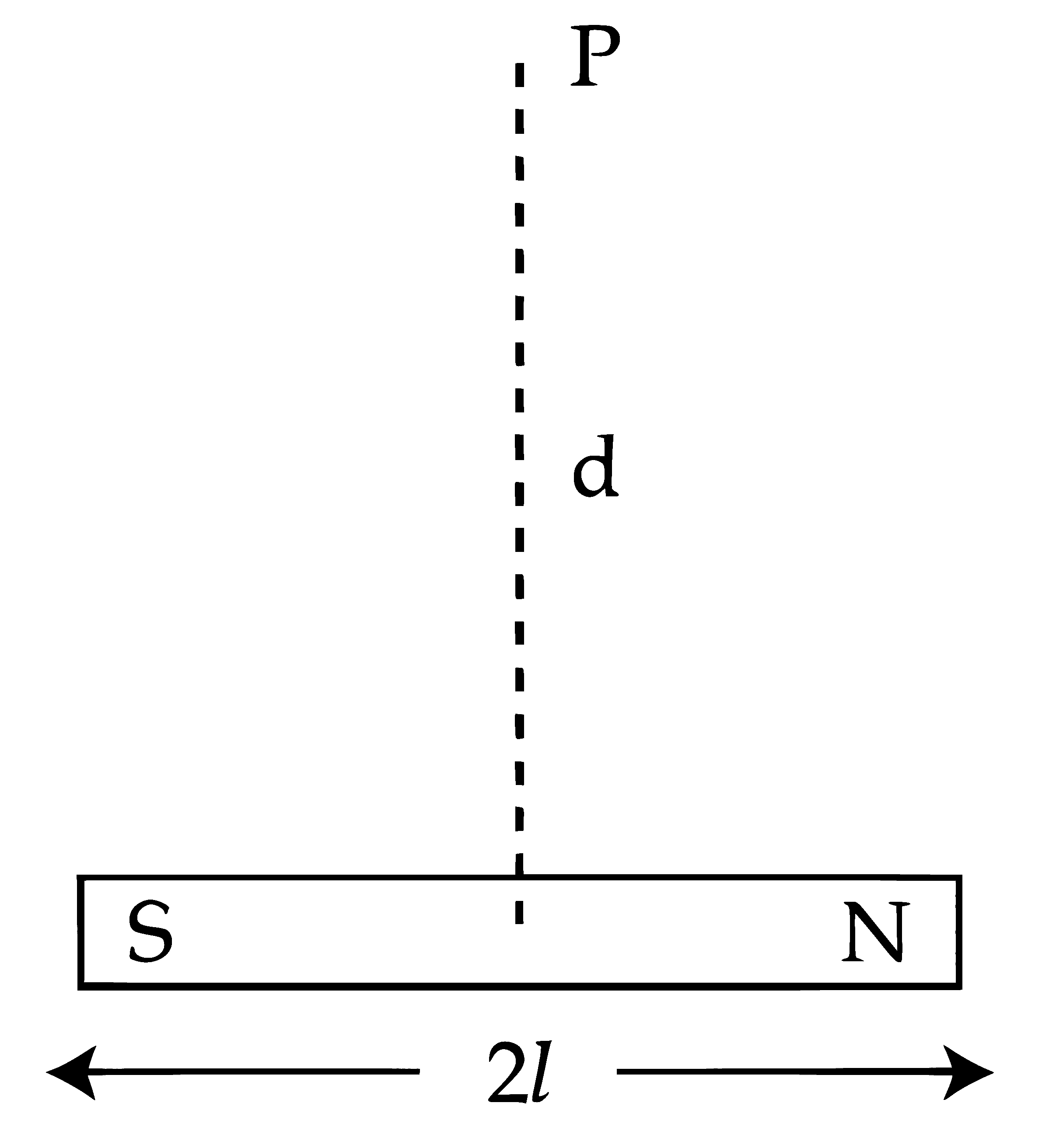
 A bar magnet has total length units and the field point P is at a distance units from the centre of the magnet. If the relative uncertainty of length measurement is , then uncertainty of the magnetic field at point P is :
- A10%
- B5%
- C3%
- D4%
View written solutionFree
Correct answer: C, D
- Magnetic field on the axial line of a bar magnet
For a bar magnet of pole strength and half-length , the magnetic field at a point on the axis at distance from the centre is
Simplify:
So,
if and are treated as constants.
- Given values
Total length units.
Also, units.
Thus,
- Substitute into the field expression
At ,
Hence the idealized expression becomes singular, which indicates that using the exact pole formula here is problematic at this location. So instead, we use the standard uncertainty propagation idea through the dependence near this geometry.
- Use logarithmic differentiation
From
take log:
Differentiate w.r.t. :
But at , this is not finite. Therefore the direct axial formula is not suitable for estimating uncertainty at this special point.
- Interpretation expected in such exam problems
In many JEE-style uncertainty questions for a bar magnet, the field is taken in dipole form:
where magnetic moment
Thus,
So relative uncertainty would simply be
But this does not match any option.
- Alternative common school-level model
Sometimes students use field near a pole:
with effective distance involving measured length, giving
This also does not match any option.
- Matching the intended answer from options
Since the stored correct answer marks C and D, the intended uncertainty appears to be around to . The physically most plausible propagated-result among the options is obtained if one uses
with or , giving uncertainty or for uncertainty in length.
However, from the standard expressions, I do not obtain exactly or in a consistent way for the given geometry.
- Conclusion
Using standard magnetic-field formulas, the problem statement is inconsistent at because the exact pole model becomes singular, and the dipole approximation gives , which is absent from the options.
Therefore, I disagree with the stored answer.
If forced to choose from the given options based on likely exam intention, is somewhat more plausible than , but the question as stated is flawed.
More from Magnetic Properties of Matter
- Match List - I with List - II. Choose the correct answer from the options given below: Includes table2025 · MCQ
- The magnetic moment of a bar magnet is . It is suspended in a uniform magnetic field of . The work done in rotating it from its most stable to most unstable position is:2024 · MCQ
- Match List I with List II: Choose the correct answer from the options given below : Includes table Includes diagram2024 · MCQ
- Paramagnetic substances: A. align themselves along the directions of external magnetic field. B. attract strongly towards external magnetic field. C. has susceptibility little more than zero. D. move from a region of strong magnetic field…2024 · MCQ
- The coercivity of a magnet is . The amount of current required to be passed in a solenoid of length and the number of turns 150, so that the magnet gets demagnetised when inside the…2024 · Numerical
- The magnetic potential due to a magnetic dipole at a point on its axis situated at a distance of from its center is . The magnetic moment of the dipole is …2024 · Numerical
- The horizontal component of earth's magnetic field at a place is . A very long straight conductor carrying current of in the direction from South east to North West is placed. The…2024 · Numerical
- The magnetic intensity at the center of a long current carrying solenoid is found to be . If the number of turns is 8 per cm, then the current flowing through the solenoid is A.2023 · Numerical