Sign in
12thPass logo
New chatPYQ LibraryDoubtsRank report
Sign in to see Recents

Your guest activity stays on this device

Sign in to save progress →
Sign in

Electrostatics question

2023 · 31 Jan · Shift 1 · Q52
Guest · filters and generic practice availableBrowsing as a guest · PYQ filters and generic practice are available. Sign in only for personalised features and saved progress.
  1. PYQ Library
  2. /JEE Main
  3. /Physics
  4. /Electrostatics
  5. /2023 · 31 Jan · Shift 1 · Q52

Electrostatics question

2023 · 31 Jan · Shift 1 · Q52

JEE MainPhysicsElectrostaticsMCQ+4 / −1
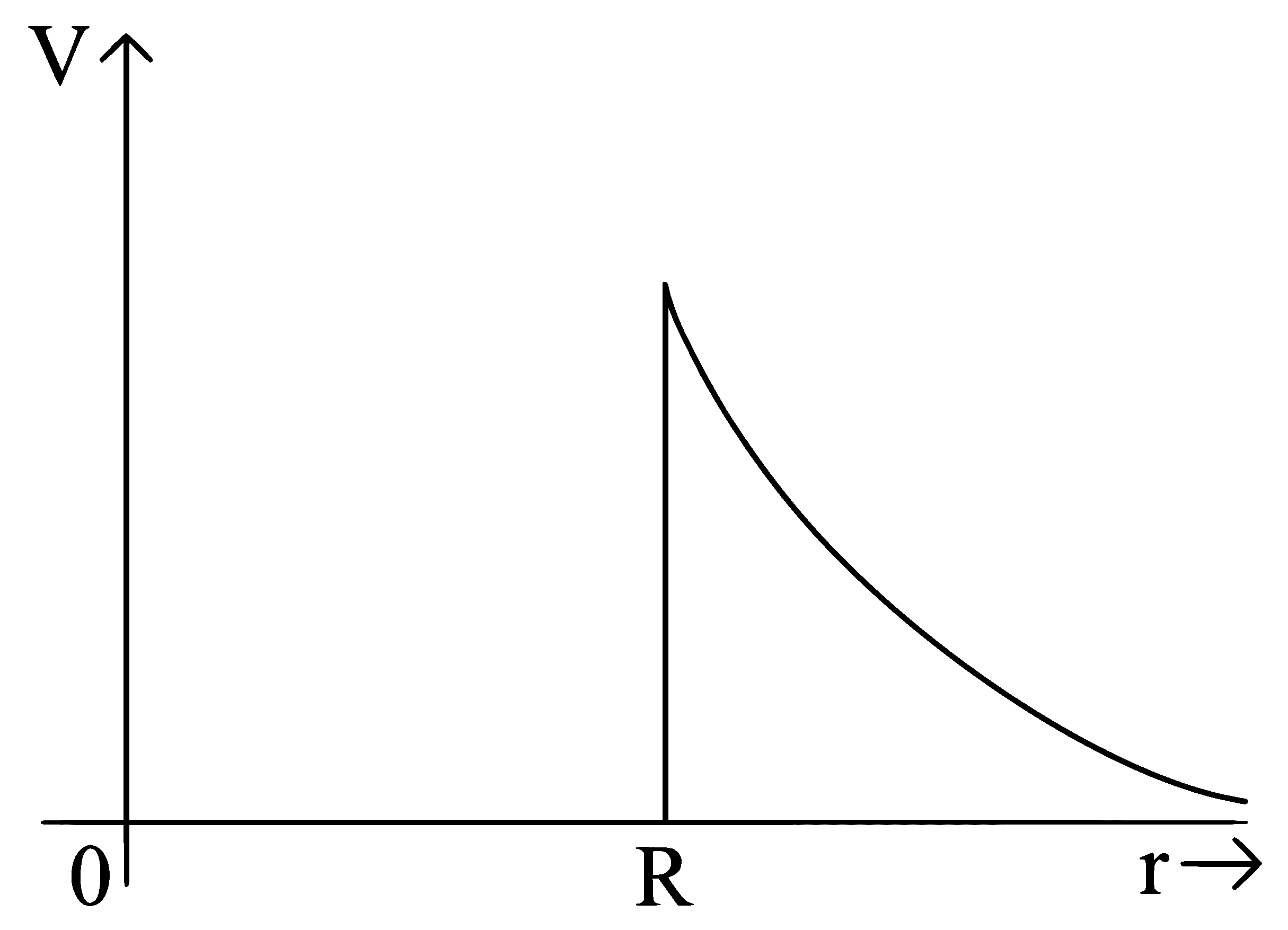
Which of the following correctly represents the variation of electric potential (V)(\mathrm{V})(V) of a charged spherical conductor of radius (R)(\mathrm{R})(R) with radial distance (r)(\mathrm{r})(r) from the center?
  1. A
    JEE Main 2023 (Online) 31st January Morning Shift Physics - Electrostatics Question 100 English Option 1
  2. B
    JEE Main 2023 (Online) 31st January Morning Shift Physics - Electrostatics Question 100 English Option 2
  3. C
    JEE Main 2023 (Online) 31st January Morning Shift Physics - Electrostatics Question 100 English Option 3
  4. D
    JEE Main 2023 (Online) 31st January Morning Shift Physics - Electrostatics Question 100 English Option 4
View written solutionFree

Correct answer: D

  1. Electric potential of a charged spherical conductor

For a spherical conductor of radius RRR carrying charge QQQ:

  • Outside the conductor (r≥R)(r \ge R)(r≥R), it behaves like a point charge: V(r)=14πε0QrV(r)=\frac{1}{4\pi\varepsilon_0}\frac{Q}{r}V(r)=4πε0​1​rQ​

  • On the surface (r=R)(r=R)(r=R): V(R)=14πε0QRV(R)=\frac{1}{4\pi\varepsilon_0}\frac{Q}{R}V(R)=4πε0​1​RQ​

  • Inside the conductor (r<R)(r < R)(r<R), the electric field is zero, so the potential remains constant and equal to the surface potential: V(r)=14πε0QRV(r)=\frac{1}{4\pi\varepsilon_0}\frac{Q}{R}V(r)=4πε0​1​RQ​


  1. Nature of the graph

So the variation of VVV with rrr is:

  • From r=0r=0r=0 to r=Rr=Rr=R: constant
  • For r>Rr>Rr>R: decreases as 1r\dfrac{1}{r}r1​

Thus the correct graph must show:

  • a horizontal line from 000 to RRR
  • then a falling curve like 1/r1/r1/r beyond RRR

  1. Identify the correct option

Among the given choices, this corresponds to Option D.


  1. Comparison with stored answer

Stored correct answer: D

Derived answer: D

Hence, the derived answer agrees with the stored correct answer.

PreviousNext

More from Electrostatics

  • Expression for an electric field is given by E=4000x2i^mV​. The electric flux through the cube of side 20 cm when placed in electric field (as shown in the… Includes diagram2023 · Numerical
  • Considering a group of positive charges, which of the following statements is correct ?2023 · MCQ
  • A vertical electric field of magnitude 4.9 × 10⁵ N/C just prevents a water droplet of a mass 0.1 g from falling. The value of charge on the droplet will be : (Given : g = 9.8 m/s2)2022 · MCQ
  • Two identical charged particles each having a mass 10 g and charge 2.0 × 10 − 7C are placed on a horizontal table with a separation of L between them such that they stay in limited equilibrium. If the coefficient of friction…2022 · MCQ
  • A long cylindrical volume contains a uniformly distributed charge of density ρ. The radius of cylindrical volume is R. A charge particle (q) revolves around the cylinder in a circular path. The kinetic energy of the particle is :2022 · MCQ
  • The volume charge density of a sphere of radius 6 m is 2μCcm−3. The number of lines of force per unit surface area coming out from the surface of the sphere is ​×1010NC−1…2022 · Numerical
  • In the figure, a very large plane sheet of positive charge is shown. P1 and P2 are two points at distance l and 2l from the charge distribution. If σ is the surface charge density, then the magnitude of electric fields E1 and E2 at… Includes diagram2022 · MCQ
  • 27 identical drops are charged at 22V each. They combine to form a bigger drop. The potential of the bigger drop will be ​ V.2022 · Numerical