Sign in
12thPass logo
New chatPYQ LibraryDoubtsRank report
Sign in to see Recents

Your guest activity stays on this device

Sign in to save progress →
Sign in

Electrostatics question

2023 · 8 Apr · Shift 1 · Q53
Guest · filters and generic practice availableBrowsing as a guest · PYQ filters and generic practice are available. Sign in only for personalised features and saved progress.
  1. PYQ Library
  2. /JEE Main
  3. /Physics
  4. /Electrostatics
  5. /2023 · 8 Apr · Shift 1 · Q53

Electrostatics question

2023 · 8 Apr · Shift 1 · Q53

JEE MainPhysicsElectrostaticsMCQ+4 / −1
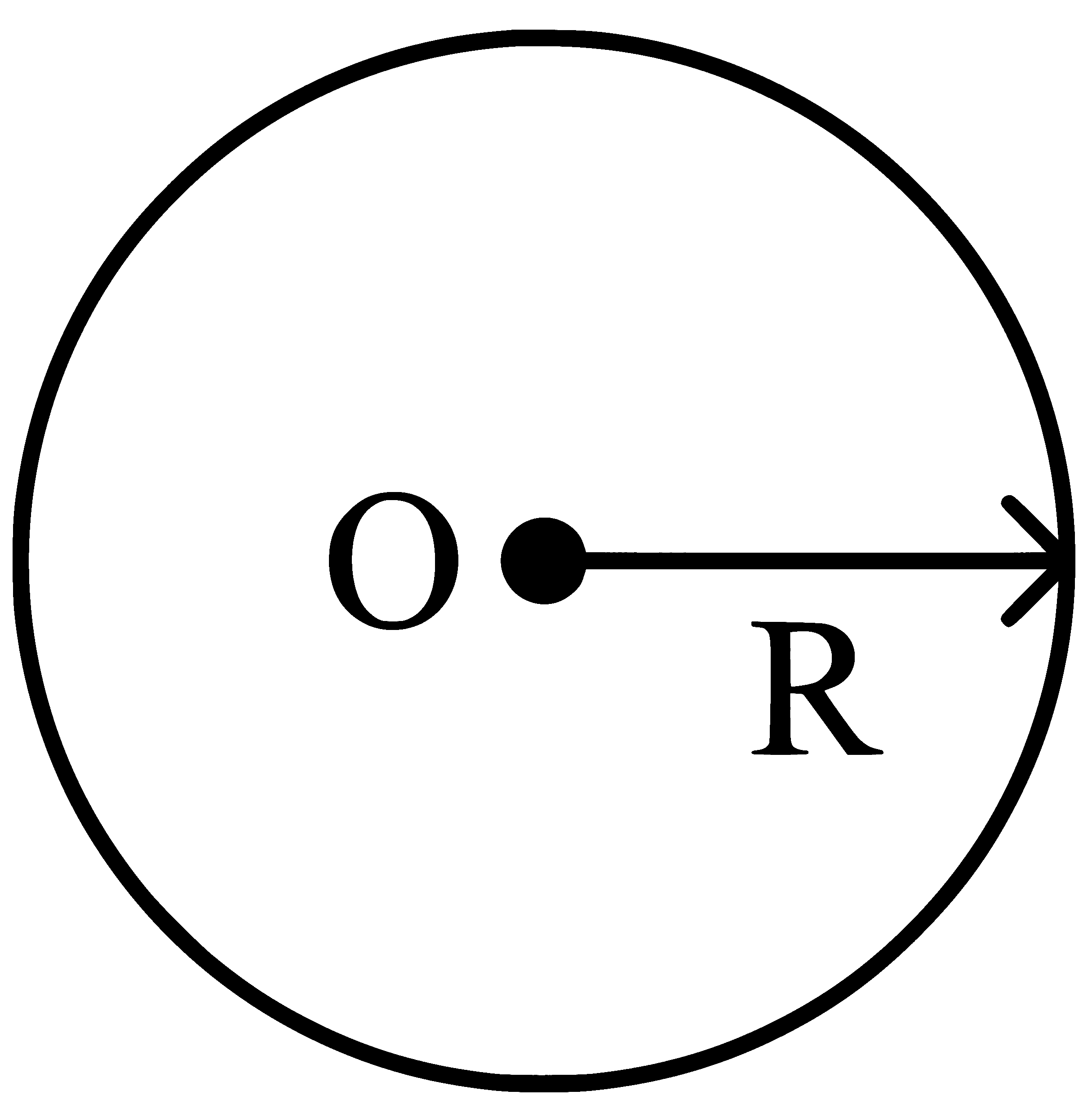
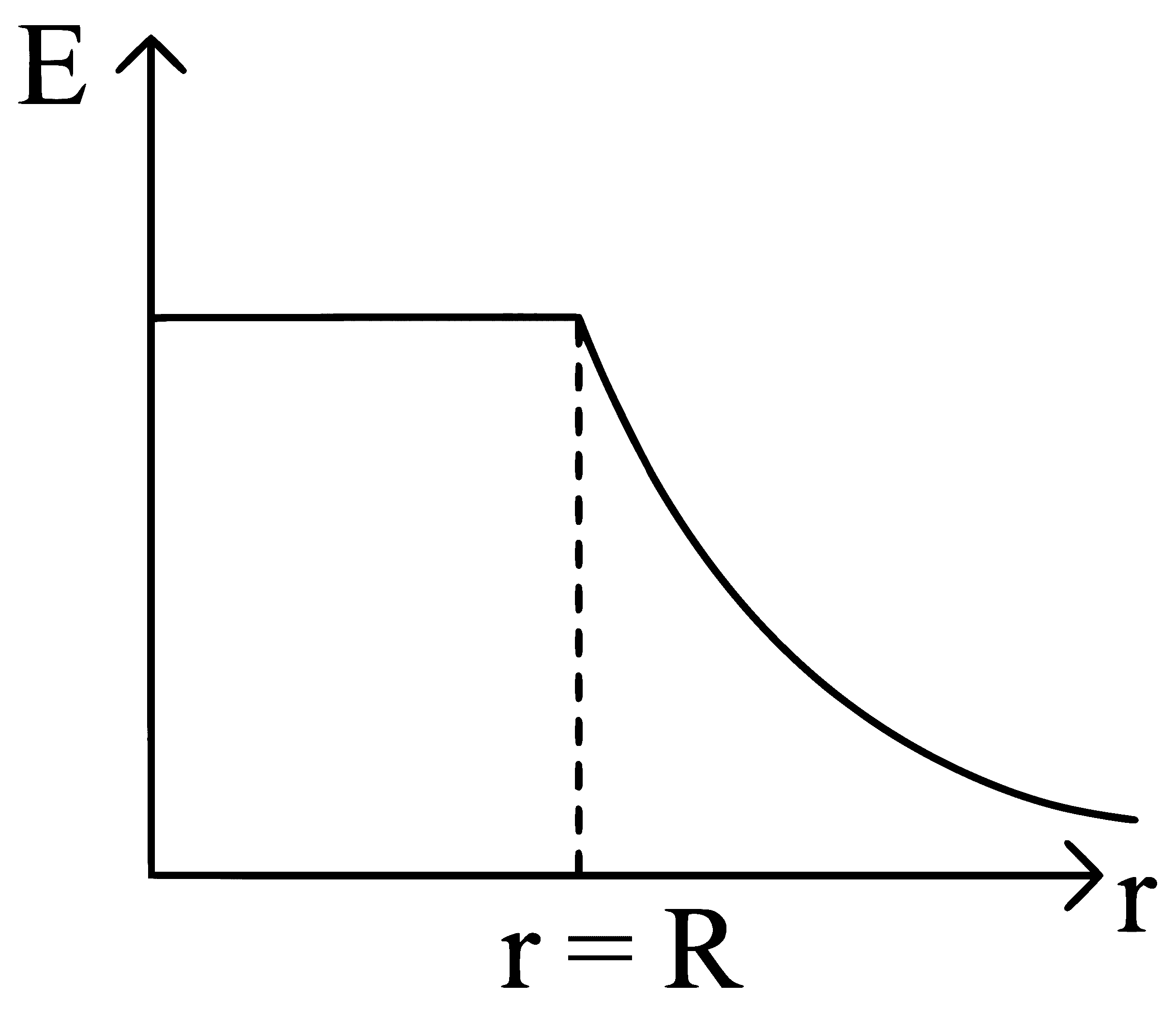
Graphical variation of electric field due to a uniformly charged insulating solid sphere of radius R\mathrm{R}R, with distance rrr from the centre O is represented by: JEE Main 2023 (Online) 8th April Morning Shift Physics - Electrostatics Question 72 English
  1. A
    JEE Main 2023 (Online) 8th April Morning Shift Physics - Electrostatics Question 72 English Option 1
  2. B
    JEE Main 2023 (Online) 8th April Morning Shift Physics - Electrostatics Question 72 English Option 2
  3. C
    JEE Main 2023 (Online) 8th April Morning Shift Physics - Electrostatics Question 72 English Option 3
  4. D
    JEE Main 2023 (Online) 8th April Morning Shift Physics - Electrostatics Question 72 English Option 4
View written solutionFree

Correct answer: D

  1. Electric field due to a uniformly charged insulating solid sphere

For a solid insulating sphere of radius RRR with uniform volume charge density, the electric field varies differently in two regions:

  • Inside the sphere: r<Rr < Rr<R
  • Outside the sphere: r≥Rr \ge Rr≥R

  1. Field inside the sphere (r<R)(r<R)(r<R)

Using Gauss’s law,

∮E⃗⋅dA⃗=qencε0\oint \vec E \cdot d\vec A = \frac{q_{\text{enc}}}{\varepsilon_0}∮E⋅dA=ε0​qenc​​

For a Gaussian surface of radius r<Rr<Rr<R,

qenc=Q(r3R3)q_{\text{enc}} = Q\left(\frac{r^3}{R^3}\right)qenc​=Q(R3r3​)

So,

E(4πr2)=Qr3ε0R3E(4\pi r^2)=\frac{Q r^3}{\varepsilon_0 R^3}E(4πr2)=ε0​R3Qr3​

E=14πε0QR3rE = \frac{1}{4\pi\varepsilon_0}\frac{Q}{R^3}rE=4πε0​1​R3Q​r

Hence, inside the sphere,

E∝rE \propto rE∝r

So the graph is a straight line through the origin.


  1. Field outside the sphere (r≥R)(r\ge R)(r≥R)

The whole charge acts as if concentrated at the centre:

E=14πε0Qr2E = \frac{1}{4\pi\varepsilon_0}\frac{Q}{r^2}E=4πε0​1​r2Q​

Hence, outside the sphere,

E∝1r2E \propto \frac{1}{r^2}E∝r21​

So the graph decreases as an inverse-square curve.


  1. At the surface (r=R)(r=R)(r=R)

From inside:

Ein=14πε0QR2E_{\text{in}} = \frac{1}{4\pi\varepsilon_0}\frac{Q}{R^2}Ein​=4πε0​1​R2Q​

From outside:

Eout=14πε0QR2E_{\text{out}} = \frac{1}{4\pi\varepsilon_0}\frac{Q}{R^2}Eout​=4πε0​1​R2Q​

So the electric field is continuous at r=Rr=Rr=R.

Thus the correct graph must:

  • start from E=0E=0E=0 at r=0r=0r=0,
  • increase linearly up to r=Rr=Rr=R,
  • then decrease as 1/r21/r^21/r2 for r>Rr>Rr>R.

  1. Matching with options

This corresponds to Option D.


  1. Comparison with stored answer

Stored correct answer = D

Derived answer = D

So they agree.

PreviousNext

More from Electrostatics

  • An electric dipole of dipole moment is 6.0×10⁻⁶ Cm placed in a uniform electric field of 1.5×10³ NC−1 in such a way that dipole moment is along electric field. The work done in rotating…2023 · Numerical
  • Electric potential at a point 'P' due to a point charge of 5×10⁻⁹C is 50 V. The distance of 'P' from the point charge is: (Assume, 4πε0​1​=9×10+9 Nm2C−2…2023 · MCQ
  • Three concentric spherical metallic shells X, Y and Z of radius a, b and c respectively [a < b < c] have surface charge densities σ,−σ and σ respectively. The shells X and Z are at same potential. If the radii of X…2023 · Numerical
  • In a metallic conductor, under the effect of applied electric field, the free electrons of the conductor2023 · MCQ
  • An electron revolves around an infinite cylindrical wire having uniform linear charge density 2×10⁻⁸Cm−1 in circular path under the influence of attractive electrostatic field as shown in the figure. The… Includes diagram2023 · Numerical
  • As shown in the figure, a configuration of two equal point charges (q0​=+2μC) is placed on an inclined plane. Mass of each point charge is 20 g. Assume that there is no friction between charge and… Includes diagram2023 · Numerical
  • Given below are two statements: one is labelled as Assertion A and the other is labelled as Reason R Assertion A : If an electric dipole of dipole moment 30×10−5 C m is enclosed by a closed surface, the net…2023 · MCQ
  • 64 identical drops each charged upto potential of 10 mV are combined to form a bigger drop. The potential of the bigger drop will be ​mV.2023 · Numerical