Sign in
12thPass logo
New chatPYQ LibraryDoubtsRank report
Sign in to see Recents

Your guest activity stays on this device

Sign in to save progress →
Sign in

Electrostatics question

2023 · 10 Apr · Shift 2 · Q62
Guest · filters and generic practice availableBrowsing as a guest · PYQ filters and generic practice are available. Sign in only for personalised features and saved progress.
  1. PYQ Library
  2. /JEE Main
  3. /Physics
  4. /Electrostatics
  5. /2023 · 10 Apr · Shift 2 · Q62

Electrostatics question

2023 · 10 Apr · Shift 2 · Q62

JEE MainPhysicsElectrostaticsNumerical+4 / −1
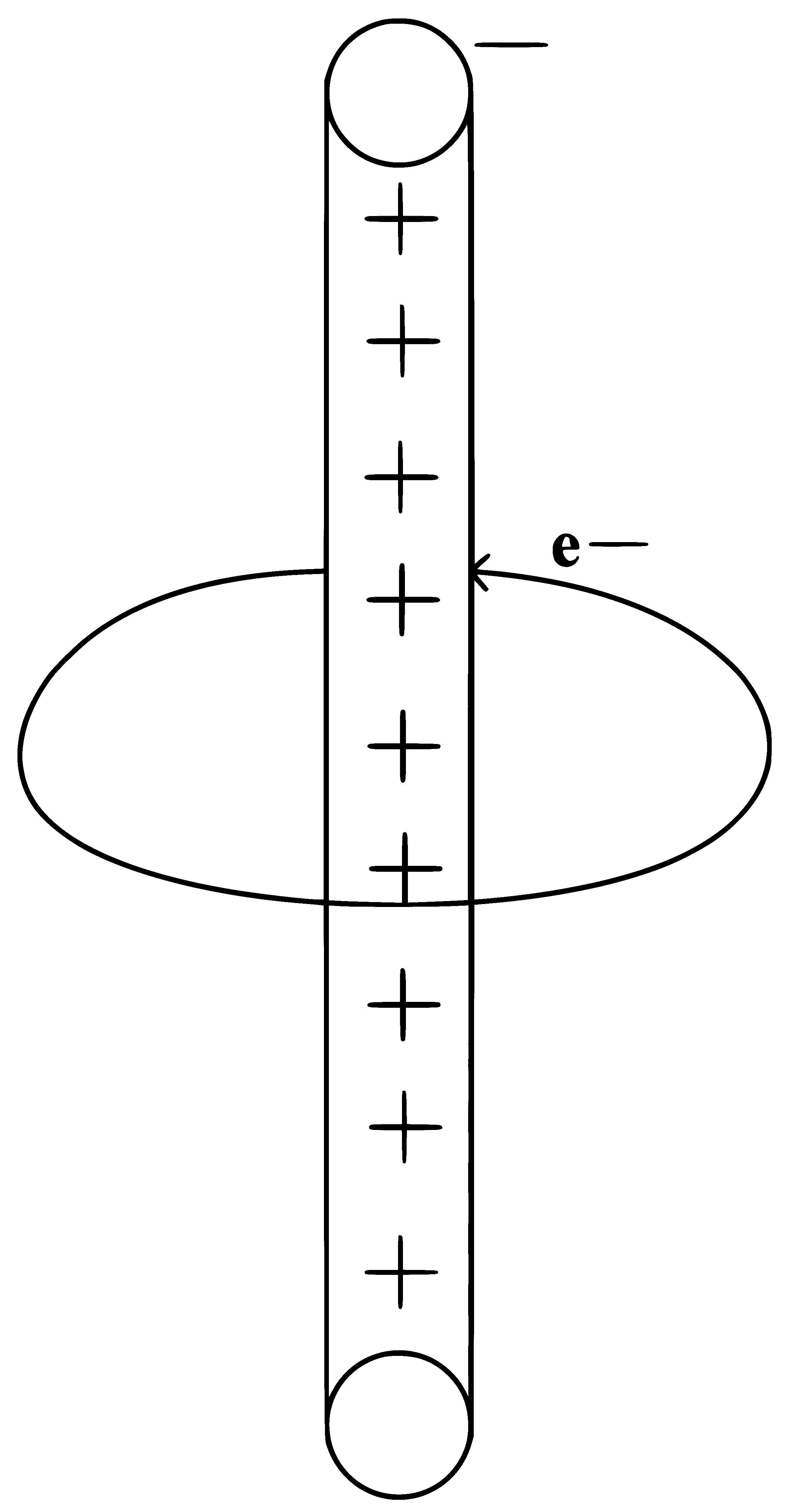
An electron revolves around an infinite cylindrical wire having uniform linear charge density 2×10⁻⁸Cm−12 \times 10^{-8} \mathrm{C} \mathrm{m}^{-1}2×10⁻⁸Cm−1 in circular path under the influence of attractive electrostatic field as shown in the figure. The velocity of electron with which it is revolving is ‾\underline{\hspace{2cm}}​×106 m s−1\times 10^{6} \mathrm{~m} \mathrm{~s}^{-1}×106 m s−1. Given mass of electron =9×10⁻³¹ kg=9 \times 10^{-31} \mathrm{~kg}=9×10⁻³¹ kg JEE Main 2023 (Online) 10th April Evening Shift Physics - Electrostatics Question 76 English
Numerical answer
View written solutionFree

Correct answer: 8

  1. Electric field due to an infinite line charge

For an infinite straight wire with linear charge density λ\lambdaλ, the electric field at distance rrr is

E=λ2πε0rE = \frac{\lambda}{2\pi \varepsilon_0 r}E=2πε0​rλ​

Since the electron is revolving around the wire, this electric field provides the required centripetal force.

  1. Electrostatic force on the electron

Magnitude of force on electron:

Fe=eE=e⋅λ2πε0rF_e = eE = e\cdot \frac{\lambda}{2\pi \varepsilon_0 r}Fe​=eE=e⋅2πε0​rλ​

  1. Centripetal force condition

For circular motion,

mv2r=e⋅λ2πε0r\frac{mv^2}{r} = e\cdot \frac{\lambda}{2\pi \varepsilon_0 r}rmv2​=e⋅2πε0​rλ​

Notice that rrr cancels out:

mv2=eλ2πε0mv^2 = \frac{e\lambda}{2\pi \varepsilon_0}mv2=2πε0​eλ​

So,

v=eλ2πε0mv = \sqrt{\frac{e\lambda}{2\pi \varepsilon_0 m}}v=2πε0​meλ​​

  1. Substitute values

Given:

λ=2×10⁻⁸ C m−1\lambda = 2\times 10^{-8}\ \mathrm{C\,m^{-1}}λ=2×10⁻⁸ Cm−1 e=1.6×10⁻¹⁹ Ce = 1.6\times 10^{-19}\ \mathrm{C}e=1.6×10⁻¹⁹ C m=9×10⁻³¹ kgm = 9\times 10^{-31}\ \mathrm{kg}m=9×10⁻³¹ kg

Also,

14πε0=9×10⁹\frac{1}{4\pi\varepsilon_0}=9\times 10^94πε0​1​=9×10⁹

Hence,

12πε0=2×9×109=1.8×10¹⁰\frac{1}{2\pi\varepsilon_0}=2\times 9\times 10^9=1.8\times 10^{10}2πε0​1​=2×9×109=1.8×10¹⁰

Now,

v2=(1.6×10⁻¹⁹)(2×10⁻⁸)(1.8×10¹⁰)9×10⁻³¹v^2 = \frac{(1.6\times 10^{-19})(2\times 10^{-8})(1.8\times 10^{10})}{9\times 10^{-31}}v2=9×10⁻³¹(1.6×10⁻¹⁹)(2×10⁻⁸)(1.8×10¹⁰)​

First simplify numerator:

1.6×2×1.8=5.761.6\times 2\times 1.8 = 5.761.6×2×1.8=5.76

and powers:

10−19×10−8×1010=10−1710^{-19} \times 10^{-8} \times 10^{10} = 10^{-17}10−19×10−8×1010=10−17

So,

v2=5.76×10−179×10−31v^2 = \frac{5.76\times 10^{-17}}{9\times 10^{-31}}v2=9×10−315.76×10⁻¹⁷​

v2=0.64×1014=6.4×10¹³v^2 = 0.64\times 10^{14} = 6.4\times 10^{13}v2=0.64×1014=6.4×10¹³

Therefore,

v=6.4×10¹³v = \sqrt{6.4\times 10^{13}}v=6.4×10¹³​

v≈8×10⁶ m s−1v \approx 8\times 10^6\ \mathrm{m\,s^{-1}}v≈8×10⁶ ms−1

  1. Final integer value

The question asks for the blank in

‾×106 m s−1\underline{\hspace{2cm}}\times 10^6\ \mathrm{m\,s^{-1}}​×106 ms−1

Hence the required integer is

8\boxed{8}8​

PreviousNext

More from Electrostatics

  • As shown in the figure, a configuration of two equal point charges (q0​=+2μC) is placed on an inclined plane. Mass of each point charge is 20 g. Assume that there is no friction between charge and… Includes diagram2023 · Numerical
  • Given below are two statements: one is labelled as Assertion A and the other is labelled as Reason R Assertion A : If an electric dipole of dipole moment 30×10−5 C m is enclosed by a closed surface, the net…2023 · MCQ
  • 64 identical drops each charged upto potential of 10 mV are combined to form a bigger drop. The potential of the bigger drop will be ​mV.2023 · Numerical
  • Two charges each of magnitude 0.01 C and separated by a distance of 0.4 mm constitute an electric dipole. If the dipole is placed in an uniform electric field 'E' of 10 dyne/C making 30∘ angle with E…2023 · MCQ
  • A thin infinite sheet charge and an infinite line charge of respective charge densities +σ and +λ are placed parallel at 5 m distance from each other. Points 'P' and 'Q' are at π3​ m and π4​…2023 · Numerical
  • A 10 μC charge is divided into two parts and placed at 1 cm distance so that the repulsive force between them is maximum. The charges of the two parts are:2023 · MCQ
  • Three point charges q,−2q and 2q are placed on x-axis at a distance x=0,x=43​R and x=R respectively from origin as shown. If q=2×10⁻⁶C and R=2 cm… Includes diagram2023 · Numerical
  • The electric field due to a short electric dipole at a large distance (r) from center of dipole on the equatorial plane varies with distance as :2023 · MCQ