Sign in
12thPass logo
New chatPYQ LibraryDoubtsRank report
Sign in to see Recents

Your guest activity stays on this device

Sign in to save progress →
Sign in

Chemical Kinetics and Nuclear Chemistry question

2019 · 9 Apr · Shift 2 · Q7
Guest · filters and generic practice availableBrowsing as a guest · PYQ filters and generic practice are available. Sign in only for personalised features and saved progress.
  1. PYQ Library
  2. /JEE Main
  3. /Chemistry
  4. /Chemical Kinetics and Nuclear Chemistry
  5. /2019 · 9 Apr · Shift 2 · Q7

Chemical Kinetics and Nuclear Chemistry question

2019 · 9 Apr · Shift 2 · Q7

JEE MainChemistryChemical Kinetics and Nuclear ChemistryMCQ+4 / −1
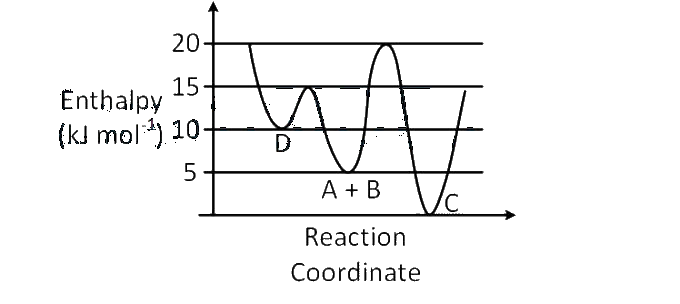
Consider the given plot of enthalpy of the following reaction between A and B. A+ B →\to→ C + D Identify the incorrect statement. JEE Main 2019 (Online) 9th April Evening Slot Chemistry - Chemical Kinetics and Nuclear Chemistry Question 139 English
  1. A
    Formation of A and B from C has highest enthalpy of activation.
  2. B
    D is kinetically stable product.
  3. C
    C is the thermodynamically stable product
  4. D
    Activation enthalpy to form C is 5kJ mol–1 less than that to form D.
View written solutionFree

Correct answer: D

  1. Interpret the enthalpy profile

    The reaction is: A+B→C+DA+B \rightarrow C+DA+B→C+D

    Such a diagram typically shows two possible product channels:

    • one product formed via a lower activation enthalpy but ending at higher enthalpy → kinetic product
    • another product formed via a higher activation enthalpy but ending at lower enthalpy → thermodynamic product

    From the statements given, we infer:

    • CCC is the thermodynamically stable product, so HC<HDH_C < H_DHC​<HD​
    • DDD is the kinetically stable/product formed faster, so formation of DDD has lower activation enthalpy than formation of CCC
  2. Check each option

    Option A

    Formation of AAA and BBB from CCC has highest enthalpy of activation.

    Since CCC is the lowest-enthalpy (most stable) species, going from CCC back to the transition state requires the largest energy rise.

    So this statement is correct.


    Option B

    DDD is kinetically stable product.

    The kinetic product is the one formed through the lower activation barrier. From the profile, DDD corresponds to that product.

    So this statement is correct.


    Option C

    CCC is the thermodynamically stable product.

    Thermodynamic stability means lower final enthalpy. From the profile, CCC lies lower than DDD.

    So this statement is correct.


    Option D

    Activation enthalpy to form CCC is 5 kJ mol−15\,\text{kJ mol}^{-1}5kJ mol−1 less than that to form DDD.

    This contradicts the usual kinetic/thermodynamic interpretation above: if DDD is the kinetic product, then ΔH‡(to form D)<ΔH‡(to form C)\Delta H^\ddagger(\text{to form }D) < \Delta H^\ddagger(\text{to form }C)ΔH‡(to form D)<ΔH‡(to form C) not the reverse.

    Therefore this statement is incorrect.

  3. Conclusion

    The incorrect statement is: D\boxed{\text{D}}D​

  4. Comparison with stored answer

    Stored correct answer: D

    My derived answer also is D, so they agree.

PreviousNext

More from Chemical Kinetics and Nuclear Chemistry

  • The following results were obtained during kinetic studies of the reaction ; 2A + B → Products The time (in minutes) required to consume half of A is : Includes table2019 · MCQ
  • For the reaction, 2A + B → products, when the concentrations of A and B both were doubled, the rate of the reaction increased from 0.3 mol L − 1s − 1 to 2.4 mol L − 1s − 1. When the concentration of A alone is doubled, the rate…2019 · MCQ
  • A bacterial infection in an internal wound grows as N'(t) = N0 exp(t), where the time t is in hours. A does of antibiotic, taken orally, needs 1 hour to reach the wound. Once it reaches there, the bacterial population goes down as dtdN​=−5N2…2019 · MCQ
  • For the reaction of H2​ with I2​, the rate constant is 2.5 × 10⁻⁴ dm3 mol–1s–1 at 327°C and 1.0 dm3 mol–1 at 527°C. The activation energy for the reaction, in kJ mole–1 is : (R = 8.314 JK–1 mol–1 )2019 · MCQ
  • Consider the given plots for a reaction obeying Arrhenius equation (0oC < T < 300oC) : (K and Ea are rate constant and activation energy, respectively) Choose the correct option : Includes diagram2019 · MCQ
  • For an elementary chemical reaction, the expression for dtd[A]​ is Includes diagram2019 · MCQ
  • If a reaction follows the Arrhenius equation, the plot ln k vs (RT)1​ gives straight line with a gradient (− y) unit. The energy required to active the reactant is :2019 · MCQ
  • The reaction 2X → B is a zeroth order reaction. If the initial concentration of X is 0.2 M, the half-life is 6 h. When the initial concentration of X is 0.5 M, the time required to reach its final concentration of 0.2 M will be:2019 · MCQ