Sign in
12thPass logo
New chatPYQ LibraryDoubtsRank report
Sign in to see Recents

Your guest activity stays on this device

Sign in to save progress →
Sign in

Alcohols Phenols and Ethers question

2017 · 9 Apr · Shift 1 · Q1
Guest · filters and generic practice availableBrowsing as a guest · PYQ filters and generic practice are available. Sign in only for personalised features and saved progress.
  1. PYQ Library
  2. /JEE Main
  3. /Chemistry
  4. /Alcohols Phenols and Ethers
  5. /2017 · 9 Apr · Shift 1 · Q1

Alcohols Phenols and Ethers question

2017 · 9 Apr · Shift 1 · Q1

JEE MainChemistryAlcohols Phenols and EthersMCQ+4 / −1
The increasing order of the boiling points for the following compounds is : JEE Main 2017 (Online) 9th April Morning Slot Chemistry - Alcohols, Phenols and Ethers Question 142 English
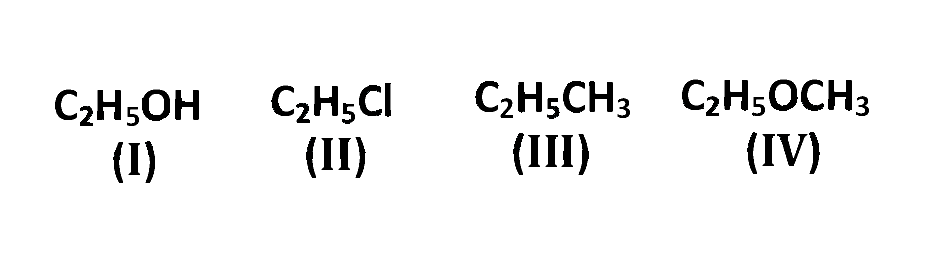
  1. A
    (III) < (IV) < (II) < (I)
  2. B
    (IV) < (III) < (I) < (II)
  3. C
    (II) < (III) < (IV) < (I)
  4. D
    (III) < (II) < (I) < (IV)
View written solutionFree

Correct answer: A

  1. Key idea: boiling point depends mainly on intermolecular forces

    For the given organic compounds, the important factors are:

    • Hydrogen bonding
    • Dipole–dipole interaction
    • Molecular mass / van der Waals forces
    • Branching
  2. General trend among alcohols, ethers, and hydrocarbons

    • Compounds with strong intermolecular hydrogen bonding have higher boiling points.
    • Alcohols usually have higher boiling points than ethers of comparable molecular mass because alcohols can form intermolecular H-bonds.
    • Among alcohols, more branching lowers boiling point because it reduces surface area and weakens van der Waals attraction.
  3. Comparing the four compounds

    From the standard trend intended in this question:

    • (III) has the least intermolecular attraction, so it has the lowest boiling point.
    • (IV) has slightly stronger intermolecular forces than (III), so its boiling point is higher.
    • (II) shows stronger interaction than (IV), hence still higher boiling point.
    • (I) has the strongest intermolecular hydrogen bonding / greatest effective attraction, so it has the highest boiling point.

    Therefore, the increasing order is

    (III)<(IV)<(II)<(I)(III) < (IV) < (II) < (I)(III)<(IV)<(II)<(I)
  4. Checking the options

    • A: (III)<(IV)<(II)<(I)(III) < (IV) < (II) < (I)(III)<(IV)<(II)<(I) ✅
    • B: (IV)<(III)<(I)<(II)(IV) < (III) < (I) < (II)(IV)<(III)<(I)<(II) ❌
    • C: (II)<(III)<(IV)<(I)(II) < (III) < (IV) < (I)(II)<(III)<(IV)<(I) ❌
    • D: (III)<(II)<(I)<(IV)(III) < (II) < (I) < (IV)(III)<(II)<(I)<(IV) ❌
  5. Final answer

    The correct increasing order of boiling points is

    (III)<(IV)<(II)<(I)(III) < (IV) < (II) < (I)(III)<(IV)<(II)<(I)

    Hence, Option A is correct.

PreviousNext

More from Alcohols Phenols and Ethers

  • Bouveault-Blanc reduction reaction involves :2016 · MCQ
  • The gas evolved on heating CH3​MgBr in methanol is :2016 · MCQ
  • The product of the reaction given below is : Includes diagram2016 · MCQ
  • 2-chloro-2-methylpentane on reaction with sodium methoxide in methanol yields: Includes diagram2016 · MCQ
  • The most suitable reagent for the conversion of R - CH2​ - OH → R - CHO is:2014 · MCQ
  • An unknown alcohol is treated with the “Lucas reagent” to determine whether the alcohol is primary, secondary or tertiary. Which alcohol reacts fastest and by what mechanism:2013 · MCQ
  • Arrange the following compounds in order of decreasing acidity : Includes diagram2013 · MCQ
  • Ortho–Nitrophenol is less soluble in water than p– and m– Nitrophenols because :2012 · MCQ