JEE AdvancedPhysicsGravitationMCQ+3 / −1
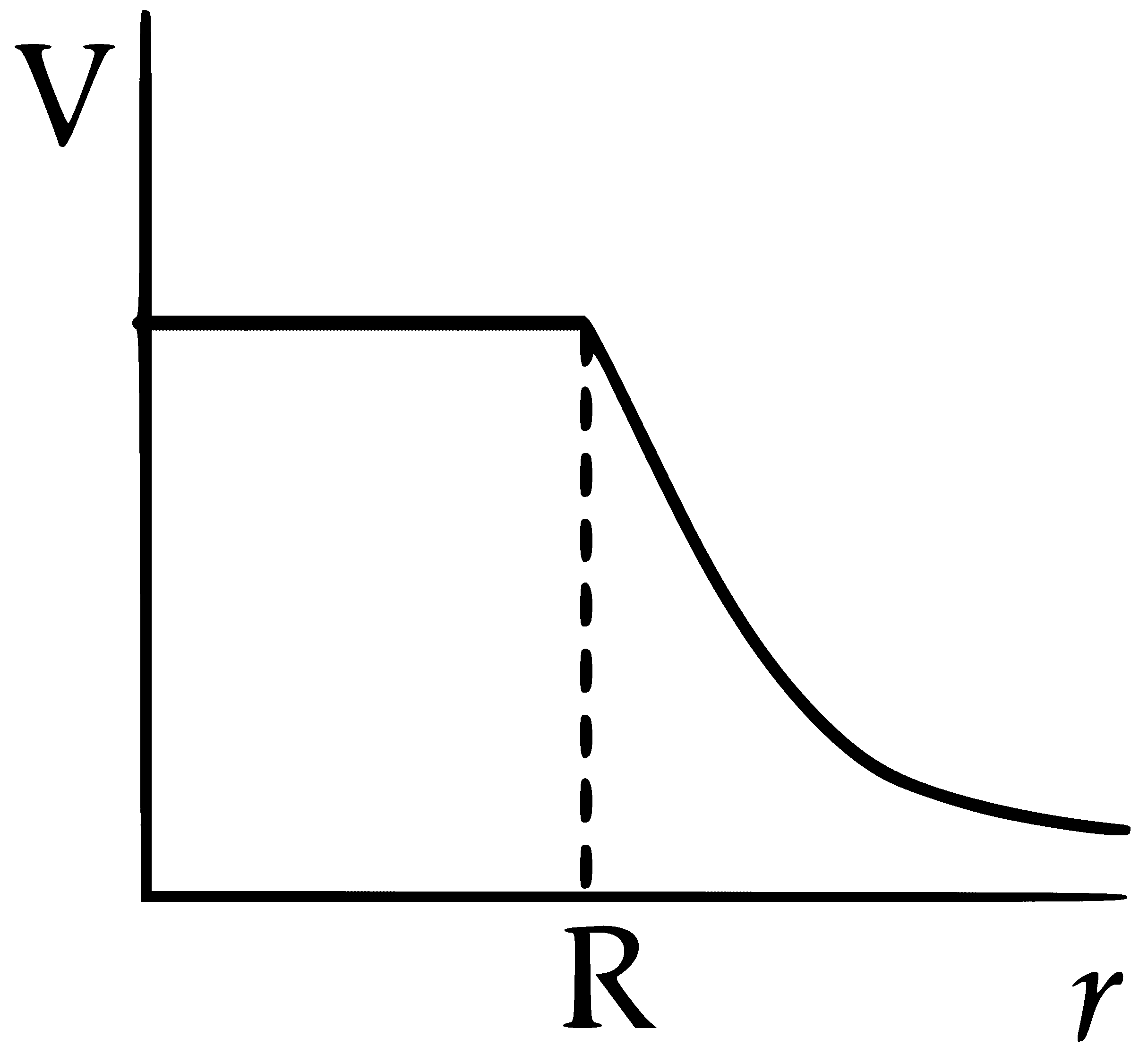
A spherically symmetric gravitational system of particles has a mass density Where is a constant. A test mass can undergo circular motion under the influence of the gravitational field of particles. Its speed V as a function of distance from the centre of the system is represented by
- A

- B

- C

- D
More from Gravitation
- STATEMENT - 1 An astronaut in an orbiting space station above the Earth experiences weightlessness. and STATEMENT - 2 An object moving around the Earth under the influence of Earth's gravitational force is in a state of 'free-fall'.2008 · MCQ
- Some physical quantities are given in Column I and some possible SI units in which these quantities may be expressed are given in Column II. Match the physical quantities in Column I with the units in Column II and indicate your answer by… Includes table2007 · MCQ
- Consider a star of mass m2 kg revolving in a circular orbit around another star of mass m1 kg with m1 \gg m2. The heavier star slowly acquires mass from the lighter star at a constant rate of kg/s. In this transfer process, there…2025 · MCQ
- A geostationary satellite above the equator is orbiting around the earth at a fixed distance from the center of the earth. A second satellite is orbiting in the equatorial plane in the opposite direction to the earth's rotation, at a…2025 · Numerical
- A particle of mass is under the influence of the gravitational field of a body of mass . The particle is moving in a circular orbit of radius with time period around the mass . Then, the particle is subjected…2024 · MCQ
- Two satellites and are moving in different circular orbits around the Earth (radius ). The heights of and from the Earth surface are and ,…2023 · MCQ
- Two spherical stars and have densities and , respectively. and have the same radius, and their masses and are related by . Due to an interaction process, star loses…2022 · Numerical
- The distance between two stars of masses 3MS and 6MS is 9R. Here R is the mean distance between the centers of the Earth and the Sun, and MS is the mass of the Sun. The two stars orbit around their common center of mass in circular orbits…2021 · Numerical