Sign in
12thPass logo
New chatPYQ LibraryDoubtsRank report
Sign in to see Recents

Your guest activity stays on this device

Sign in to save progress →
Sign in

Some Basic Concepts of Organic Chemistry question

2010 · Q130
Guest · filters and generic practice availableBrowsing as a guest · PYQ filters and generic practice are available. Sign in only for personalised features and saved progress.
  1. PYQ Library
  2. /NEET
  3. /Chemistry
  4. /Some Basic Concepts of Organic Chemistry
  5. /2010 · Q130

Some Basic Concepts of Organic Chemistry question

2010 · Q130

NEETChemistrySome Basic Concepts of Organic ChemistryMCQ+4 / −1
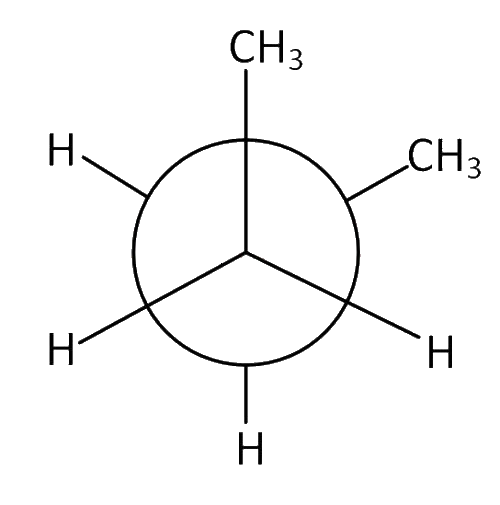
In the following the most stable conformation of n-butane is
  1. A
    AIPMT 2010 Prelims Chemistry - Some Basic Concepts of Organic Chemistry Question 48 English Option 1
  2. B
    AIPMT 2010 Prelims Chemistry - Some Basic Concepts of Organic Chemistry Question 48 English Option 2
  3. C
    AIPMT 2010 Prelims Chemistry - Some Basic Concepts of Organic Chemistry Question 48 English Option 3
  4. D
    AIPMT 2010 Prelims Chemistry - Some Basic Concepts of Organic Chemistry Question 48 English Option 4
View written solutionFree

Correct answer: B

The anti-conformation is the most stable conformation of n-butane. In this, the bulky methyl groups are as far apart as possible thereby keeping steric repulsion at a minimum.

PreviousNext

More from Some Basic Concepts of Organic Chemistry

  • The IUPAC name of the compound having the formula CH≡C−CH=CH2 is2009 · MCQ
  • Base strength of is in the order of Includes diagram2008 · MCQ
  • Which one of the following is most reactive towards electrophilic attack?2008 · MCQ
  • The stability of carbanions in the following. is in the order of Includes diagram2008 · MCQ
  • How many stereoisomers does this molecule have? CH3CH=CHCH2CHBrCH32008 · MCQ
  • The order of decreasing reactivity towards an electrophilic reagent, for the following would be (i) benzene (ii) toluene (iii) chlorobenzene (iv) phenol2007 · MCQ
  • For (i) I−, (ii) Cl−, (iii) Br−, the increasing order of nucleophilicity would be2007 · MCQ
  • If there is no rotation of plane polarised light by a compound in a specific solvent, through to be chiral, it may mean than2007 · MCQ