JEE MainPhysicsSimple Harmonic MotionMCQ+4 / −1
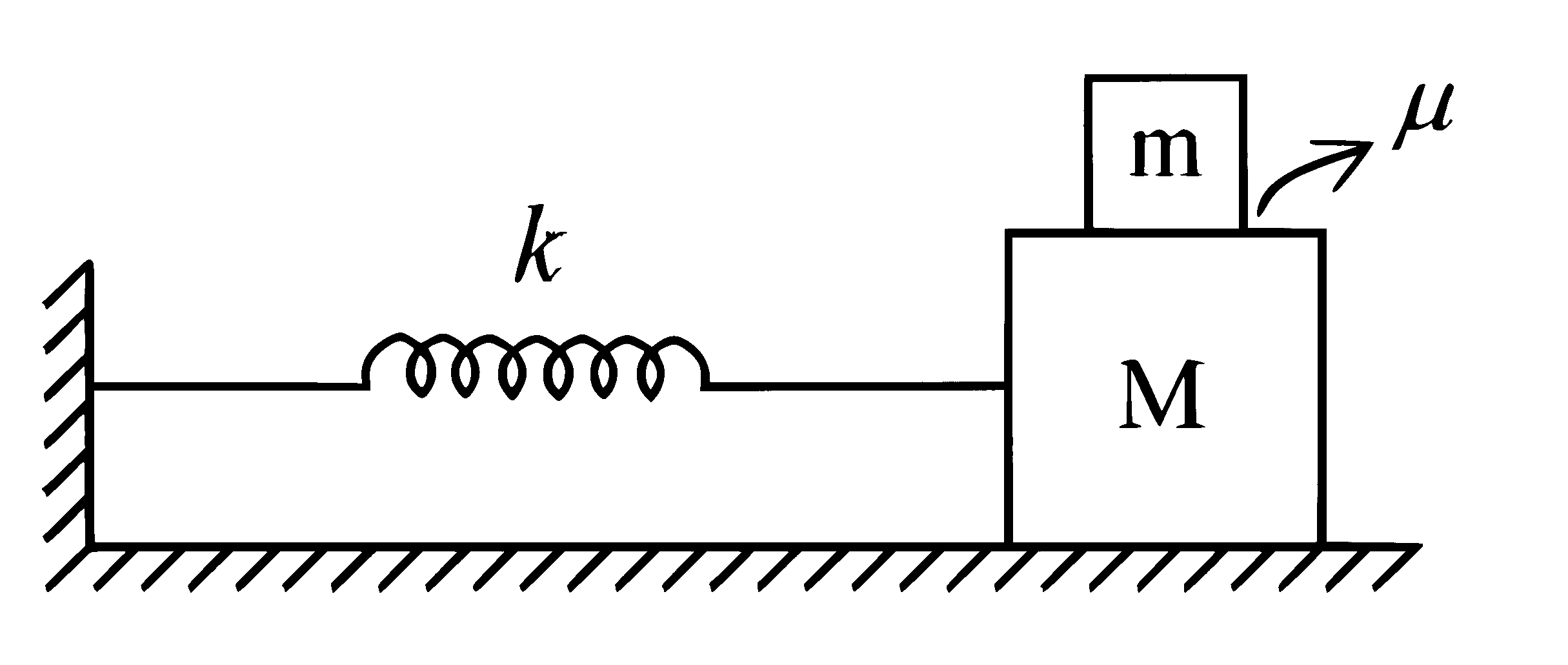 Two blocks of masses and , are placed on a frictionless table as shown in figure. A massless spring with spring constant k is attached with the lower block. If the system is slightly displaced and released, then ( coefficient of friction between the two blocks) A. The time period of small oscillation of the two blocks is B. The acceleration of the blocks is ( displacement of the blocks from the mean position) C. The magnitude of the frictional force on the upper block is D. The maximum amplitude of the upper block, if it does not slip, is E. Maximum frictional force can be . Choose the correct answer from the options given below :
- AB, C, D Only
- BC, D, E Only
- CA, B, D Only
- DA, B, C Only
More from Simple Harmonic Motion
- Two simple pendulums having lengths and with negligible string mass undergo angular displacements and , from their mean positions, respectively. If the angular accelerations of both pendulums are same, then…2025 · MCQ
- A block of mass 2 kg is attached to one end of a massless spring whose other end is fixed at a wall. The spring-mass system moves on a frictionless horizontal table. The spring's natural length is 2 m and spring constant is 200 N/m. The…2025 · MCQ
- Given below are two statements. One is labelled as Assertion (A) and the other is labelled as Reason (R). Assertion (A) : A simple pendulum is taken to a planet of mass and radius, 4 times and 2 times, respectively, than the Earth. The…2025 · MCQ
- A light hollow cube of side length 10 cm and mass 10 g , is floating in water. It is pushed down and released to execute simple harmonic oscillations. The time period of oscillations is , where the value…2025 · MCQ
- A particle is executing simple harmonic motion with time period 2 s and amplitude 1 cm . If D and d are the total distance and displacement covered by the particle in 12.5 s , then is2025 · MCQ
- A particle oscillates along the -axis according to the law, where . The kinetic energy of the particle as a function of is correctly…2025 · MCQ
- Given below are two statements. One is labelled as Assertion (A) and the other is labelled as Reason (R). Assertion (A) : Knowing initial position and initial momentum is enough to determine the position and momentum…2025 · MCQ
- Given below are two statements: one is labelled as Assertion (A) and the other is labelled as Reason (R). Assertion (A) : Time period of a simple pendulum is longer at the top of a mountain than that at the base of the mountain. Reason (R)…2025 · MCQ