Sign in
12thPass logo
New chatPYQ LibraryDoubtsRank report
Sign in to see Recents

Your guest activity stays on this device

Sign in to save progress →
Sign in

Current Electricity question

2021 · 27 Jul · Shift 1 · Q48
Guest · filters and generic practice availableBrowsing as a guest · PYQ filters and generic practice are available. Sign in only for personalised features and saved progress.
  1. PYQ Library
  2. /JEE Main
  3. /Physics
  4. /Current Electricity
  5. /2021 · 27 Jul · Shift 1 · Q48

Current Electricity question

2021 · 27 Jul · Shift 1 · Q48

JEE MainPhysicsCurrent ElectricityMCQ+4 / −1
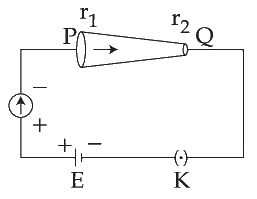
In the given figure, a battery of emf E is connected across a conductor PQ of length 'l' and different area of cross-sections having radii r1 and r2 (r2 < r1). JEE Main 2021 (Online) 27th July Morning Shift Physics - Current Electricity Question 187 English Choose the correct option as one moves from P to Q :
  1. A
    Drift velocity of electron increases.
  2. B
    Electric field decreases.
  3. C
    Electron current decreases.
  4. D
    All of these
View written solutionFree

Correct answer: B

  1. Given situation

A battery of emf EEE is connected across a conductor PQPQPQ whose cross-sectional area changes along its length. The radii are r1r_1r1​ and r2r_2r2​ with r2>r1r_2 > r_1r2​>r1​ (so the wire becomes thicker as we move from PPP to QQQ).

Thus, as we move from PPP to QQQ:

  • area AAA increases,
  • current III in steady state remains the same through all cross-sections.

  1. Drift velocity

For a conductor,

I=neAvdI = n e A v_dI=neAvd​

where:

  • nnn = number density of electrons,
  • eee = charge of electron,
  • AAA = area of cross-section,
  • vdv_dvd​ = drift velocity.

Since III, nnn, and eee are constant,

vd=IneAv_d = \frac{I}{n e A}vd​=neAI​

So vd∝1Av_d \propto \frac{1}{A}vd​∝A1​.

As we move from PPP to QQQ, area increases, hence drift velocity decreases.

So Option A is false.


  1. Electric field

Using microscopic Ohm's law,

J=σEJ = \sigma EJ=σE

where current density

J=IAJ = \frac{I}{A}J=AI​

Therefore,

E=ρJ=ρIAE = \rho J = \rho \frac{I}{A}E=ρJ=ρAI​

Since AAA increases from PPP to QQQ, EEE decreases.

So Option B is true.


  1. Electron current

In steady state, current is the same at every cross-section of a series conductor; otherwise charge would accumulate. Thus electron current does not decrease.

So Option C is false.


  1. Check option D

Since only B is true, Option D (All of these) is false.


  1. Final answer

The correct option is:

B: Electric field decreases\boxed{\text{B: Electric field decreases}}B: Electric field decreases​
  1. Comparison with stored answer

Stored correct answer: AAA

My derived answer is BBB.

Reason for disagreement:

  • If the wire gets thicker from PPP to QQQ (r2>r1r_2 > r_1r2​>r1​), area increases.
  • Since vd=I/(neA)v_d = I/(neA)vd​=I/(neA), drift velocity must decrease, not increase.
  • Electric field varies as E=ρI/AE = \rho I/AE=ρI/A, so it decreases.

Hence the stored answer appears inconsistent with the standard relations for current in a non-uniform conductor.

PreviousNext

More from Current Electricity

  • The resistance of a conductor at 15 ∘ C is 16 Ω and at 100 ∘ C is 20 Ω. What will be the temperature coefficient of resistance of the conductor?2021 · MCQ
  • For the circuit shown, the value of current at time t = 3.2 s will be ​ A. [Voltage distribution V(t) is shown by Fig. (1) and the circuit is shown in Fig. (2)] Includes diagram2021 · Numerical
  • Consider a galvanometer shunted with 5 Ω resistance and 2% of current passes through it. What is the resistance of the given galvanometer ?2021 · MCQ
  • A square shaped wire with resistance of each side 3 Ω is bent to form a complete circle. The resistance between two diametrically opposite points of the circle in unit of Ω will be ​.2021 · Numerical
  • The voltage drop across 15 Ω resistance in the given figure will be ​ V. Includes diagram2021 · Numerical
  • The equivalent resistance of the given circuit between the terminals A and B is : Includes diagram2021 · MCQ
  • A resistor dissipates 192 J of energy in 1s when a current of 4A is passed through it. Now, when the current is doubled, the amount of thermal energy dissipated in 5s in ​ J.2021 · Numerical
  • Consider four conducting materials copper, tungsten, mercury and aluminium with resistivity ρ C, ρ T, ρ M and ρ A respectively. Then :2020 · MCQ