JEE MainPhysicsCenter of MassNumerical+4 / −1
A particle of mass m is moving along the x-axis with initial velocity . It collides elastically with a particle of mass 10 m at rest and then moves with half its initial kinetic energy (see figure). If then value of n is . 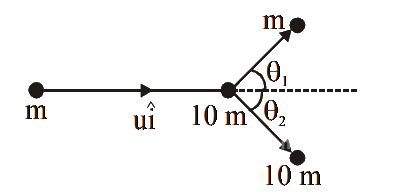
Numerical answer
View written solutionFree
Correct answer: 10
- Given data
- Mass of first particle:
- Initial velocity of first particle:
- Mass of second particle:
- Second particle initially at rest
- Collision is elastic
- After collision, the first particle has half its initial kinetic energy.
Let after collision:
- particle move with speed at angle
- particle move with speed at angle
We need to find if
- Use the given kinetic-energy condition
Initial kinetic energy of mass :
After collision, first particle has half of this:
But
So,
- Use conservation of kinetic energy
Since collision is elastic,
Substitute :
- Use conservation of momentum in y-direction
Initially there is no momentum in the -direction. So after collision,
(Careful with sign: the particles go on opposite sides of the x-axis, so magnitudes satisfy this relation.)
Cancel :
Hence,
Now substitute and :
Therefore,
Comparing with we get
- Final answer
More from Center of Mass
- A block of mass m = 1 kg slides with velocity v = 6 m/s on a frictionless horizontal surface and collides with a uniform vertical rod and sticks to it as shown. The rod is pivoted about O and swings as a result of the collision making… Includes diagram2020 · MCQ
- A block of mass 1.9 kg is at rest at the edge of a table, of height 1 m. A bullet of mass 0.1 kg collides with the block and sticks to it. If the velocity of the bullet is 20 m/s in the horizontal direction just before the collision then…2020 · MCQ
- Blocks of masses m, 2m, 4m and 8m are arranged in a line on a frictionless floor. Another block of mass m, moving with speed v along the same line (see figure) collides with mass m in perfectly inelastic manner. All the subsequent… Includes diagram2020 · MCQ
- Two bodies of the same mass are moving with the same speed, but in different directions in a plane. They have a completely inelastic collision and move together thereafter with a final speed which is half of their initial speed. The angle…2020 · Numerical
- Particle A of mass m1 moving with velocity collides with another particle B of mass m2 which is at rest initially. Let and be…2020 · MCQ
- The centre of mass of solid hemisphere of radius 8 cm is x from the centre of the flat surface. Then value of x is .2020 · Numerical
- Three point particles of masses 1.0 kg, 1.5 kg and 2.5 kg are placed at three corners of a right angle triangle of sides 4.0 cm, 3.0 cm and 5.0 cm as shown in the figure. The center of mass of the system is at a point: Includes diagram2020 · MCQ
- The coordinates of centre of mass of a uniform flag shaped lamina (thin flat plate) of mass 4kg. (The coordinates of the same are shown in figure) are : Includes diagram2020 · MCQ