Sign in
12thPass logo
New chatPYQ LibraryDoubtsRank report
Sign in to see Recents

Your guest activity stays on this device

Sign in to save progress →
Sign in

Center of Mass question

2008 · Shift 0 · Q78
Guest · filters and generic practice availableBrowsing as a guest · PYQ filters and generic practice are available. Sign in only for personalised features and saved progress.
  1. PYQ Library
  2. /JEE Main
  3. /Physics
  4. /Center of Mass
  5. /2008 · Shift 0 · Q78

Center of Mass question

2008 · Shift 0 · Q78

JEE MainPhysicsCenter of MassMCQ+4 / −1
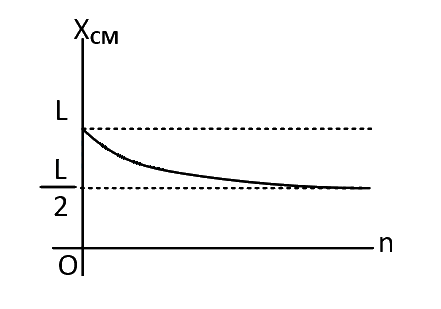
A thin rod of length ′L′'L'′L′ is lying along the xxx-axis with its ends at x=0x=0x=0 and x=Lx=Lx=L. Its linear density (mass/length) varies with xxx as k(xL)n,k{\left( {{x \over L}} \right)^n},k(Lx​)n, where nnn can be zero or any positive number. If the position XCM{X_{CM}}XCM​ of the center of mass of the rod is plotted against ′n′,'n',′n′, which of the following graphs best approximates the dependence of XCM{X_{CM}}XCM​ on nnn?
  1. A
    AIEEE 2008 Physics - Center of Mass and Collision Question 110 English Option 1
  2. B
    AIEEE 2008 Physics - Center of Mass and Collision Question 110 English Option 2
  3. C
    AIEEE 2008 Physics - Center of Mass and Collision Question 110 English Option 3
  4. D
    AIEEE 2008 Physics - Center of Mass and Collision Question 110 English Option 4
View written solutionFree

Correct answer: A

  1. Given linear mass density

The rod lies from x=0x=0x=0 to x=Lx=Lx=L, and its linear density is

λ(x)=k(xL)n,\lambda(x)=k\left(\frac{x}{L}\right)^n,λ(x)=k(Lx​)n,

where n=0,1,2,…n=0,1,2,\dotsn=0,1,2,…

We need the center of mass:

XCM=∫x dm∫dm.X_{CM}=\frac{\int x\,dm}{\int dm}.XCM​=∫dm∫xdm​.

Since dm=λ(x) dxdm=\lambda(x)\,dxdm=λ(x)dx,

XCM=∫0Lxλ(x) dx∫0Lλ(x) dx.X_{CM}=\frac{\int_0^L x\lambda(x)\,dx}{\int_0^L \lambda(x)\,dx}.XCM​=∫0L​λ(x)dx∫0L​xλ(x)dx​.
  1. Compute the denominator (total mass)
M=∫0Lk(xL)ndx=kLn∫0Lxn dxM=\int_0^L k\left(\frac{x}{L}\right)^n dx =\frac{k}{L^n}\int_0^L x^n\,dxM=∫0L​k(Lx​)ndx=Lnk​∫0L​xndx

Using

∫0Lxndx=Ln+1n+1,\int_0^L x^n dx=\frac{L^{n+1}}{n+1},∫0L​xndx=n+1Ln+1​,

we get

M=kLn⋅Ln+1n+1=kLn+1.M=\frac{k}{L^n}\cdot \frac{L^{n+1}}{n+1}=\frac{kL}{n+1}.M=Lnk​⋅n+1Ln+1​=n+1kL​.
  1. Compute the numerator
∫0Lxλ(x) dx=∫0Lx k(xL)ndx=kLn∫0Lxn+1dx\int_0^L x\lambda(x)\,dx =\int_0^L x\,k\left(\frac{x}{L}\right)^n dx =\frac{k}{L^n}\int_0^L x^{n+1}dx∫0L​xλ(x)dx=∫0L​xk(Lx​)ndx=Lnk​∫0L​xn+1dx

Now,

∫0Lxn+1dx=Ln+2n+2.\int_0^L x^{n+1}dx=\frac{L^{n+2}}{n+2}.∫0L​xn+1dx=n+2Ln+2​.

So,

∫0Lxλ(x)dx=kLn⋅Ln+2n+2=kL2n+2.\int_0^L x\lambda(x)dx =\frac{k}{L^n}\cdot \frac{L^{n+2}}{n+2} =\frac{kL^2}{n+2}.∫0L​xλ(x)dx=Lnk​⋅n+2Ln+2​=n+2kL2​.
  1. Find XCMX_{CM}XCM​
XCM=kL2n+2kLn+1=Ln+1n+2.X_{CM}=\frac{\frac{kL^2}{n+2}}{\frac{kL}{n+1}} =L\frac{n+1}{n+2}.XCM​=n+1kL​n+2kL2​​=Ln+2n+1​.

So the center of mass is

XCM=Ln+1n+2.\boxed{X_{CM}=L\frac{n+1}{n+2}}.XCM​=Ln+2n+1​​.
  1. Study how it depends on nnn

Let

f(n)=XCML=n+1n+2=1−1n+2.f(n)=\frac{X_{CM}}{L}=\frac{n+1}{n+2}=1-\frac{1}{n+2}.f(n)=LXCM​​=n+2n+1​=1−n+21​.

This tells us:

  • At n=0n=0n=0, XCM=L12=L2.X_{CM}=L\frac{1}{2}=\frac{L}{2}.XCM​=L21​=2L​.
  • As nnn increases, XCMX_{CM}XCM​ increases.
  • As n→∞n\to\inftyn→∞, XCM→L.X_{CM}\to L.XCM​→L. So it approaches LLL asymptotically.

Now check curvature:

f′(n)=1(n+2)2>0,f'(n)=\frac{1}{(n+2)^2}>0,f′(n)=(n+2)21​>0,

so the graph is increasing.

f′′(n)=−2(n+2)3<0,f''(n)=-\frac{2}{(n+2)^3}<0,f′′(n)=−(n+2)32​<0,

so the graph is concave downward.

Thus the graph:

  • starts at L/2L/2L/2 when n=0n=0n=0,
  • rises with nnn,
  • gradually flattens,
  • approaches LLL asymptotically from below.

  1. Match with options

The correct graph must show an increasing, concave-down curve starting from L/2L/2L/2 at n=0n=0n=0 and tending to LLL for large nnn.

Hence the correct option is:

A\boxed{A}A​
  1. Comparison with stored answer

Stored correct answer: AAA

Our derived answer: AAA

They agree.

PreviousNext

More from Center of Mass

  • A block of mass 0.50kg is moving with a speed of 2.00ms−1 on a smooth surface. It strike another mass of 1.0kg and then they move together as a single body. The energy loss during the collision is :2008 · MCQ
  • A circular disc of radius R is removed from a bigger circular disc of radius 2R such that the circumferences of the discs coincide. The center of mass of the new disc is αR form the center of the bigger disc. The value of α…2007 · MCQ
  • A player caught a cricket ball of mass 150g moving at a rate of 20m/s. If the catching process is completed in 0.1s, the force of the blow exerted by the ball on the hand of the player is equal to2006 · MCQ
  • A bomb of mass 16kg at rest explodes into two pieces of masses 4kg and 12kg. The velocity of the 12kg mass is 4ms−1. The kinetic energy of the other mass is2006 · MCQ
  • Consider a two particle system with particles having masses m1​ and m2​. If the first particle is pushed towards the center of mass through a distance d, by what distance should the second particle is moved, so as to keep the…2006 · MCQ
  • The block of mass M moving on the frictionless horizontal surface collides with the spring of spring constant k and compresses it by length L. The maximum momentum of the block after collision is Includes diagram2005 · MCQ
  • A mass ′m′ moves with a velocity ′v′ and collides inelastically with another identical mass. After collision the 1st mass moves with velocity 3​v​ in a direction perpendicular to the initial direction of… Includes diagram2005 · MCQ
  • A T shaped object with dimensions shown in the figure, is lying on a smooth floor. A force ′F′ is applied at the point P parallel to AB, such that the object has only the translational motion without… Includes diagram2005 · MCQ