Sign in
12thPass logo
New chatPYQ LibraryDoubtsRank report
Sign in to see Recents

Your guest activity stays on this device

Sign in to save progress →
Sign in

Alternating Current question

2009 · Shift 0 · Q54
Guest · filters and generic practice availableBrowsing as a guest · PYQ filters and generic practice are available. Sign in only for personalised features and saved progress.
  1. PYQ Library
  2. /JEE Main
  3. /Physics
  4. /Alternating Current
  5. /2009 · Shift 0 · Q54

Alternating Current question

2009 · Shift 0 · Q54

JEE MainPhysicsAlternating CurrentMCQ+4 / −1
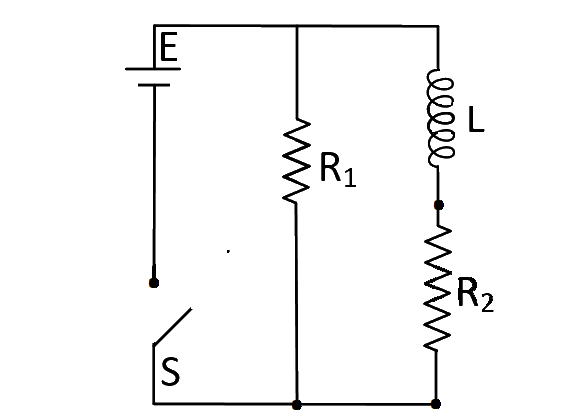
An inductor of inductance L=400mHL=400mHL=400mH and resistors of resistance R1=2Ω{R_1} = 2\OmegaR1​=2Ω and R2=2Ω{R_2} = 2\OmegaR2​=2Ω are connected to a battery of emf12Vemf12Vemf12V as shown in the figure. The internal resistance of the battery is negligible. The switch SSS is closed at t=0.t=0.t=0. The potential drop across LLL as a function of time is : AIEEE 2009 Physics - Alternating Current Question 163 English
  1. A
    12te−3tV{{12} \over t}{e^{ - 3t}}Vt12​e−3tV
  2. B
    6(1−e−t/0.2)V6\left( {1 - {e^{ - t/0.2}}} \right)V6(1−e−t/0.2)V
  3. C
    12e−5tV12{e^{ - 5t}}V12e−5tV
  4. D
    6e−5tV6{e^{ - 5t}}V6e−5tV
View written solutionFree

Correct answer: C

  1. Interpret the circuit

    From the given data and options, the standard arrangement is:

    • battery of 12 V12\text{ V}12 V,
    • resistor R1=2ΩR_1=2\OmegaR1​=2Ω in series with a parallel branch containing:
      • inductor L=400 mH=0.4 HL=400\text{ mH}=0.4\text{ H}L=400 mH=0.4 H,
      • resistor R2=2ΩR_2=2\OmegaR2​=2Ω.

    We need the potential drop across the inductor as a function of time after closing the switch at t=0t=0t=0.

  2. Initial condition at t=0+t=0^+t=0+

    Just after switching on, current through an inductor cannot change instantaneously, so the inductor behaves like an open circuit.

    Therefore, initially the circuit reduces to R1R_1R1​ and R2R_2R2​ in series: R1+R2=2+2=4ΩR_1+R_2=2+2=4\OmegaR1​+R2​=2+2=4Ω

    Initial current through the circuit: I(0+)=124=3 AI(0^+)=\frac{12}{4}=3\text{ A}I(0+)=412​=3 A

    Hence the voltage across R2R_2R2​ is VR2(0+)=I(0+)R2=3×2=6 VV_{R_2}(0^+)=I(0^+)R_2=3\times 2=6\text{ V}VR2​​(0+)=I(0+)R2​=3×2=6 V

    Since LLL is in parallel with R2R_2R2​, the initial voltage across the inductor is also VL(0+)=6 VV_L(0^+)=6\text{ V}VL​(0+)=6 V

  3. Final condition at t→∞t\to\inftyt→∞

    In steady state, the inductor behaves like a short circuit.

    Then the branch containing LLL shorts the parallel combination, so R2R_2R2​ gets bypassed. The circuit becomes only R1R_1R1​ in series with the battery.

    Thus the voltage across the inductor branch becomes VL(∞)=0V_L(\infty)=0VL​(∞)=0

  4. Time constant

    For the transient of an inductor, the time constant is τ=LRth\tau=\frac{L}{R_{\text{th}}}τ=Rth​L​ where RthR_{\text{th}}Rth​ is the Thevenin resistance seen by the inductor with the battery replaced by a short.

    Looking into the inductor terminals:

    • battery is shorted,
    • R1R_1R1​ and R2R_2R2​ both connect from the inductor terminal to ground, so they are in parallel.

    Therefore, Rth=R1∥R2=2⋅22+2=1ΩR_{\text{th}}=R_1\parallel R_2=\frac{2\cdot 2}{2+2}=1\OmegaRth​=R1​∥R2​=2+22⋅2​=1Ω

    Hence, τ=0.41=0.4 s\tau=\frac{0.4}{1}=0.4\text{ s}τ=10.4​=0.4 s

  5. Voltage across the inductor

    Since the inductor voltage decays exponentially from 6 V6\text{ V}6 V to 000: VL(t)=VL(0+)e−t/τV_L(t)=V_L(0^+)e^{-t/\tau}VL​(t)=VL​(0+)e−t/τ

    Substituting values, VL(t)=6e−t/0.4=6e−2.5t VV_L(t)=6e^{-t/0.4}=6e^{-2.5t}\text{ V}VL​(t)=6e−t/0.4=6e−2.5t V

  6. Compare with options

    • A: 12te−3t\dfrac{12}{t}e^{-3t}t12​e−3t — incorrect form
    • B: 6(1−e−t/0.2)6(1-e^{-t/0.2})6(1−e−t/0.2) — rises from 000 to 666, incorrect
    • C: 12e−5t12e^{-5t}12e−5t — wrong initial value and exponent
    • D: 6e−5t6e^{-5t}6e−5t — correct initial value but wrong time constant

    So the correct expression should be: 6e−2.5t V\boxed{6e^{-2.5t}\text{ V}}6e−2.5t V​

  7. Comparison with stored answer

    Stored correct answer is C, i.e. 12e−5t V12e^{-5t}\text{ V}12e−5t V.

    But our derivation shows the voltage across the inductor is 6e−2.5t V\boxed{6e^{-2.5t}\text{ V}}6e−2.5t V​ which does not match any option exactly.

    Therefore, the stored answer appears inconsistent with the circuit analysis. If forced to choose the closest option by initial value behavior, none is fully correct.

PreviousNext

More from Alternating Current

  • In an a.c. circuit the voltage applied is E=E0​sinωt. The resulting current in the circuit is I=I0​sin(ωt−2π​). The power consumption in the circuit is given by2007 · MCQ
  • In an AC generator, a coil with N turns, all of the same area A and total resistance R, rotates with frequency ω in a magnetic field B. The maximum value of emf generated in the coil is2006 · MCQ
  • In a series resonant LCR circuit, the voltage across R is 100 volts and R=1kΩ with C=2μF. The resonant frequency ω is 200rad/s. At resonance the voltage across L is2006 · MCQ
  • The self inductance of the motor of an electric fan is 10H. In order to impart maximum power at 50Hz, it should be connected to a capacitance of2005 · MCQ
  • A circuit has a resistance of 12ohm and an impedance of 15ohm. The power factor of the circuit will be2005 · MCQ
  • The phase difference between the alternating current and emf is 2π​. Which of the following cannot be the constituent of the circuit?2005 · MCQ
  • Alternating current can not be measured by D.C. ammeter because2004 · MCQ
  • In an LCR series a.c. circuit, the voltage across each of the components, L,C and R is 50V. The voltage across the L.C combination will be :2004 · MCQ