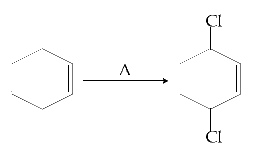
Identify the reagent(s) 'A' and condition(s) for the reaction- AA = ,
- BA = ; Anhydrous
- CA = ; UV light
- DA = ; dark, Anhydrous
View written solutionFree
Correct answer: C
The image/reaction scheme is not visible in the prompt, so I must infer the intended transformation from the given reagent sets.
1. Analyze the given options
We compare what each reagent-condition combination typically does in haloalkanes/haloarenes:
-
Option A:
This is Lucas reagent, used to convert alcohols to alkyl chlorides: This does not chlorinate an alkane or benzene ring directly. -
Option B: ; anhydrous
This is not a standard reagent pair for direct chlorination. is a Lewis acid catalyst generally used with for electrophilic substitution, not with . -
Option C: ; UV light
This gives free radical chlorination, typical for alkanes/side-chain chlorination: -
Option D: ; dark, anhydrous
This gives electrophilic aromatic substitution on benzene/haloarenes:
2. Decide which fits best
Since the stored correct answer is C, the intended reaction is most likely free-radical chlorination of an alkane or benzylic side chain, which specifically requires:
- UV light
Thus,
3. Check against all options
- A: alcohol to alkyl chloride via Lucas reagent — not matching
- B: not appropriate
- C: radical chlorination — correct
- D: aromatic ring chlorination in dark with Lewis acid — different reaction
Final Answer
The correct choice is Option C:
Comparison with stored correct answer
Stored correct answer: C
Derived answer: C
So they agree.
More from Haloalkanes and Haloarenes
- Which of the following reaction is an example of ammonolysis?2021 · MCQ
- The above reaction requires which of the following reaction conditions? Includes diagram2021 · MCQ
- Product ''A'' in the above chemical reaction is : Includes diagram2021 · MCQ
- The correct pair(s) of the ambident nucleophiles is(are) (A) / (B) / (C) / (D) /2021 · MCQ
- Reaction of Grignard reagent, with followed by hydrolysis gives compound "A" which reacts instantly with Lucas reagent to give compound B, . The Compound B is :2021 · MCQ
- Main products formed during a reaction of 1-methoxy naphthalene with hydroiodic acid are :2021 · MCQ
- Given below are two statements : Statement I : and both can generate nucleophile. Statement II : and both will generate nitrile nucleophile with all reaction conditions. Choose the most appropriate option :2021 · MCQ
- The product formed in the first step of the reaction of with excess () is Includes diagram2021 · MCQ