JEE MainChemistryChemical Kinetics and Nuclear ChemistryNumerical+4 / −1
Given below are two statements : Statement I : The rate law for the reaction is rate . When the concentration of both and is doubled, the reaction rate is increased "" times. Statement II : 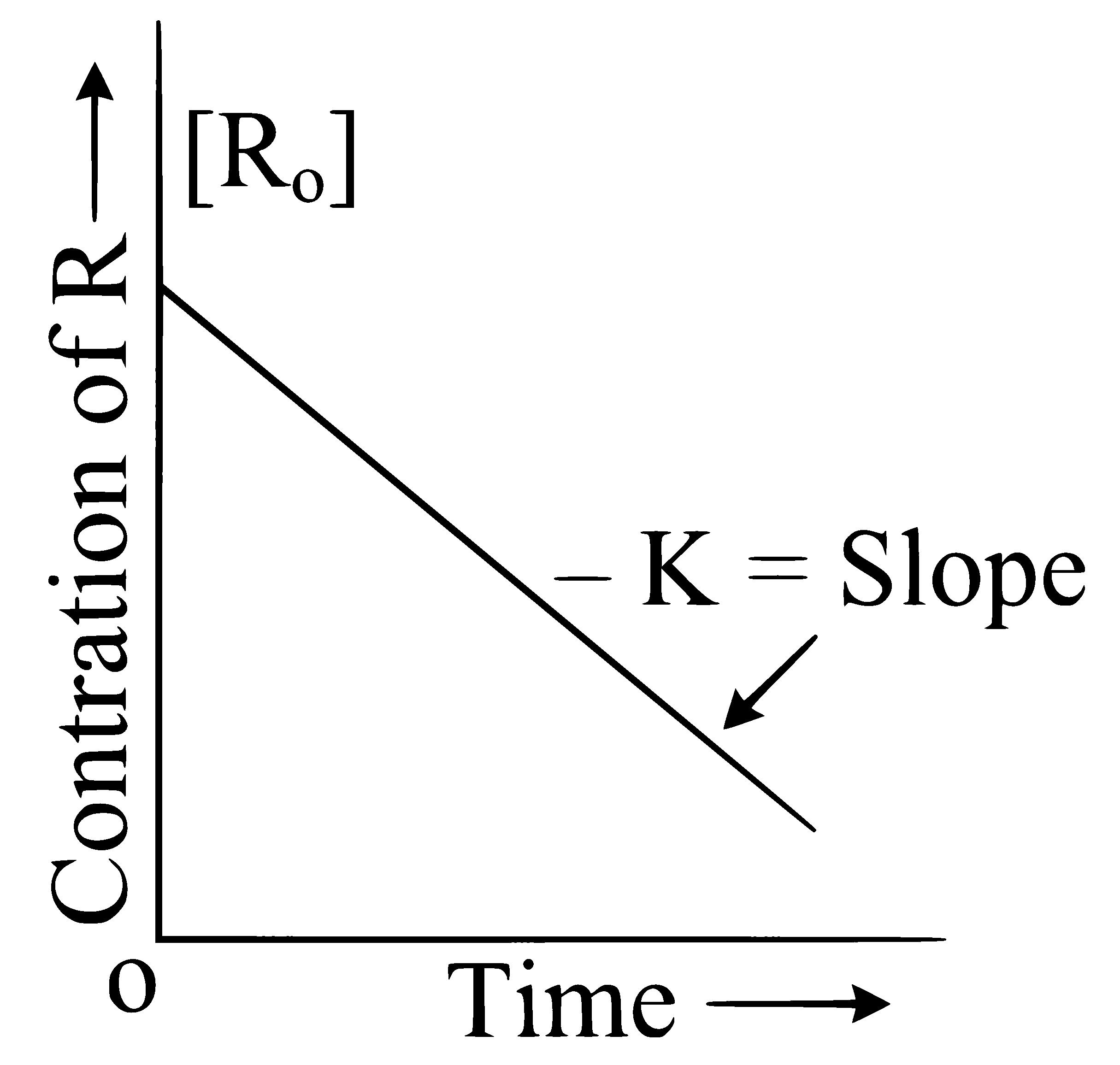 The figure is showing "the variation in concentration against time plot" for a "" order reaction. The Value of is .
The figure is showing "the variation in concentration against time plot" for a "" order reaction. The Value of is .Numerical answer
View written solutionFree
Correct answer: 8
- Find from Statement I
Given rate law:
If both concentrations are doubled, then
New rate:
So, Hence,
- Find from Statement II
For standard concentration vs time plots:
- Zero-order: straight line decrease of concentration with time
- First-order: exponential decay curve
- Second-order: curved decay with stronger change in slope
The given plot corresponds to a zero-order reaction, for which concentration decreases linearly with time:
Thus,
- Compute
- Compare with stored answer
Stored correct answer =
Our derived answer matches it.
More from Chemical Kinetics and Nuclear Chemistry
- Consider the following first order gas phase reaction at constant temperature If the total pressure of the gases is found to be 200 torr after 23 …2024 · Numerical
- Consider the following data for the given reaction The order of the reaction is . Includes diagram2024 · Numerical
- Time required for completion of of a First order reaction is times of half life of the reaction.2024 · Numerical
- For a reaction taking place in three steps at same temperature, overall rate constant . If and are 40, 50 and …2024 · Numerical
- The half-life of radioisotope bromine - 82 is 36 hours. The fraction which remains after one day is . (Given antilog )2024 · Numerical
- The rate of First order reaction is at 10 minutes and at 20 minutes after initiation. Half life of the reaction is …2024 · Numerical
- required for a reaction is produced by decomposition of in as by equation …2024 · Numerical
- Integrated rate law equation for a first order gas phase reaction is given by (where is initial pressure and is total pressure at time )2024 · MCQ